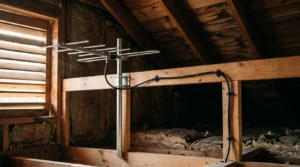
Your condominium association’s architectural bylaws might strictly ban exterior fixtures, but federal law renders those restrictions completely void on your private balcony. If your board threatens fines for installing an aerial, you hold preemptive legal protection.
Cord-cutting—canceling traditional cable or satellite TV in favor of streaming services and broadcast signals—saves thousands of dollars. Yet condo boards routinely bully residents with unlawful architectural violation notices.
Under federal statutes, you do not need board permission, architectural approval, or expensive permits to mount a broadcast television antenna inside your exclusive-use area.
Federal Preemption Explained: 47 C.F.R. Section 1.4000
Congress enacted the Over-the-Air Reception Devices (OTARD) rule under Section 207 of the Telecommunications Act of 1996. The rule guarantees your right to access free broadcast television signals without local governmental or association interference.
Codified under 47 C.F.R. Section 1.4000, this regulation establishes federal preemption over local rules. Preemption means federal law overrides any conflicting Homeowners Association (HOA) covenant, condition, and restriction (CC&R).
On January 22, 1999, the Federal Communications Commission expanded OTARD protections to condominium owners and residential tenants. This critical amendment prohibits property boards from banning antennas situated on exclusive-use private property.
Federal supremacy comes directly from the Supremacy Clause of the United States Constitution. State courts and arbitration panels cannot enforce association rules that contravene federal telecommunications policy.
Many condo boards mistakenly believe that television antennas share the same regulatory limits as satellite dishes. However, federal rules establish completely different physical standards for each technology.
Satellite dishes carry a statutory size cap of one meter (39.37 inches) in diameter. In contrast, standard over-the-air broadcast television antennas have no statutory diameter limitations under OTARD.
As long as an outdoor antenna is designed to receive local over-the-air television broadcast signals, its physical dimensions remain protected. Associations cannot impose arbitrary size limits on broadcast aerials.
According to the official FCC Consumer Guide on reception devices, any covenant that impairs signal reception is void. Board members who attempt to enforce void rules risk federal declaratory rulings against their association.
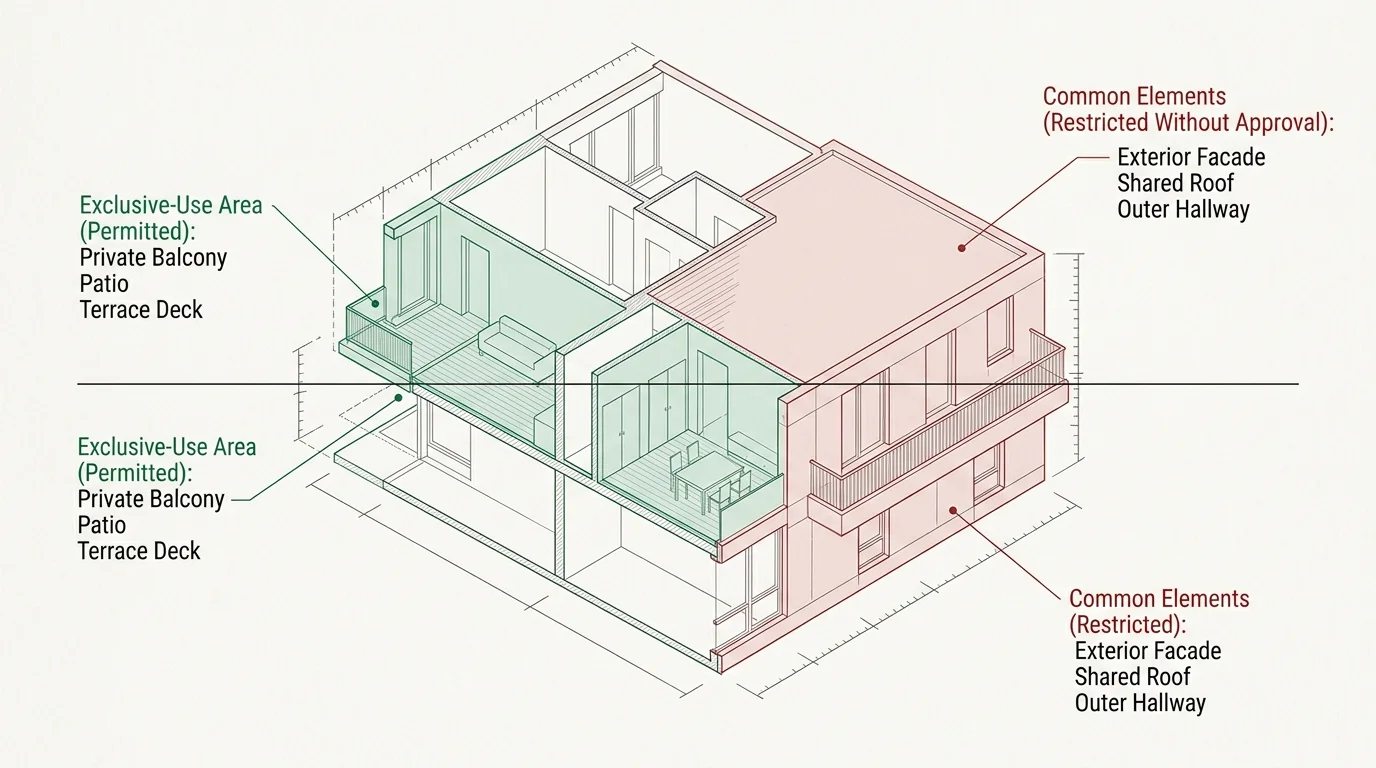
Exclusive-Use Areas vs. Common Elements: Where You Can Mount
Understanding the exact legal distinction between exclusive-use property and common elements is essential for every condo resident. Federal law protects antenna installations only when they sit within property under your exclusive control.
Even if your balcony faces away from transmission towers, you can often pull clear broadcast signals through structural obstructions by taking advantage of signal reflection.
Exclusive-use areas include private balconies, enclosed patios, private terraces, and railings enclosing those spaces. Your hoa antenna ban legal rights apply fully within these defined boundaries.
In contrast, common elements remain under the collective ownership and legal management of your condominium association. Shared elements include building roofs, external hallways, stairwells, and perimeter structural facades.
If you drill mounting brackets directly into exterior brick, stucco, or common siding, you violate common property boundaries. The association holds lawful authority to prohibit drilling into shared exterior walls.
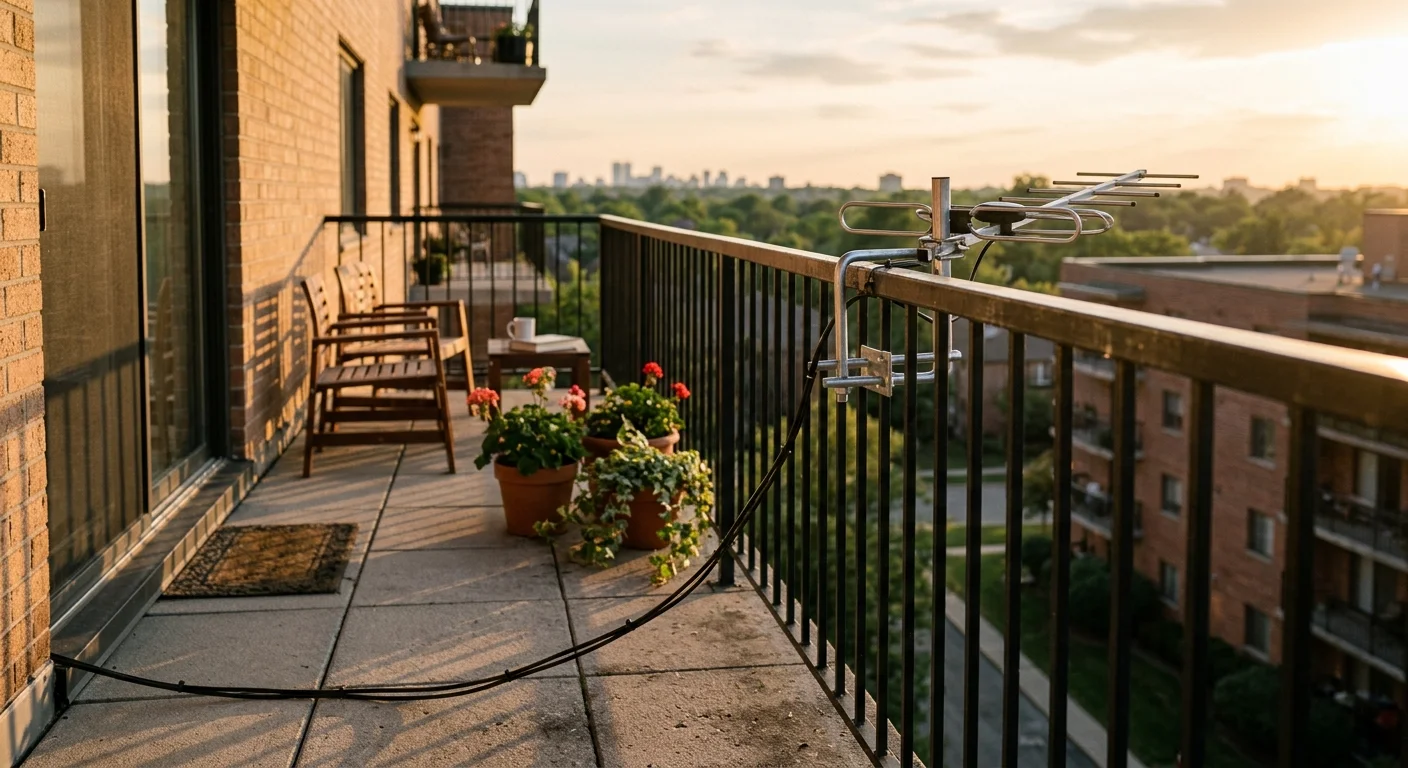
Outdoor antenna condo balcony rules protect setups that remain entirely inside your balcony’s imaginary vertical perimeter plane. Your antenna mast and aerial must not overhang common walkways or airspace.
Balcony railings present a frequent point of friction with condominium managers. The interior surface of your balcony railing constitutes exclusive-use property under federal interpretation.
If you clamp an antenna bracket to the interior face of your balcony railing without drilling, the installation is protected. The association cannot demand removal based on cosmetic objections.
“An association cannot use aesthetic rules to forbid an antenna that stays within your private balcony perimeter.” — FCC Legal Guidance
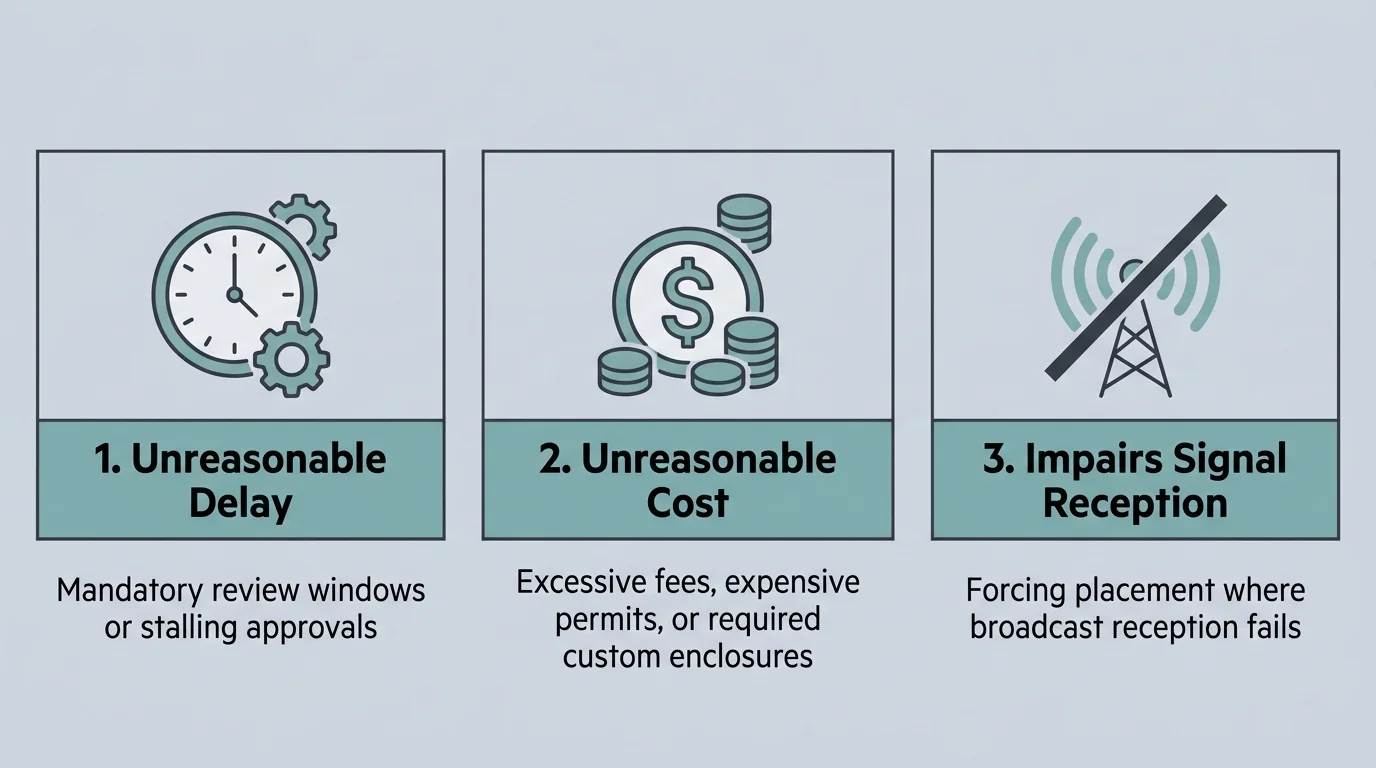
The FCC Three-Prong Impairment Test HOAs Cannot Violate
Under 47 C.F.R. Section 1.4000(a)(3), any association restriction that impairs antenna installation, maintenance, or use is federally preempted. The regulation defines impairment through a precise three-prong test.
The first prong prohibits restrictions that unreasonably delay or prevent installation, maintenance, or use. Requiring prior Architectural Review Board (ARB) approval before mounting an antenna is an unlawful delay.
Boards often demand that residents submit architectural alteration applications and wait 30 to 60 days for committee review. The FCC has explicitly ruled that prior review requirements for protected antennas are void.
The second prong outlaws restrictions that unreasonably increase the cost of installation, maintenance, or use. Imposing application fees, review costs, or mandatory liability insurance policies creates an unlawful financial barrier.
The third prong protects signal quality by forbidding rules that preclude reception of an acceptable-quality broadcast signal. Associations cannot order residents to relocate antennas to locations that degrade reception.
If your balcony faces north and receives towers clearly, an HOA cannot force you to move the antenna indoors. Indoor placement often destroys reception of high-VHF digital channels.
Under 47 C.F.R. Section 1.4000(g), the legal burden of proof rests entirely on the association. You do not have to prove the covenant is invalid; the board must prove its rule is enforceable.
Associations can only restrict antennas for verified, written safety reasons or valid historic preservation mandates. These safety rules must exist in advance and apply equally to all non-antenna fixtures.
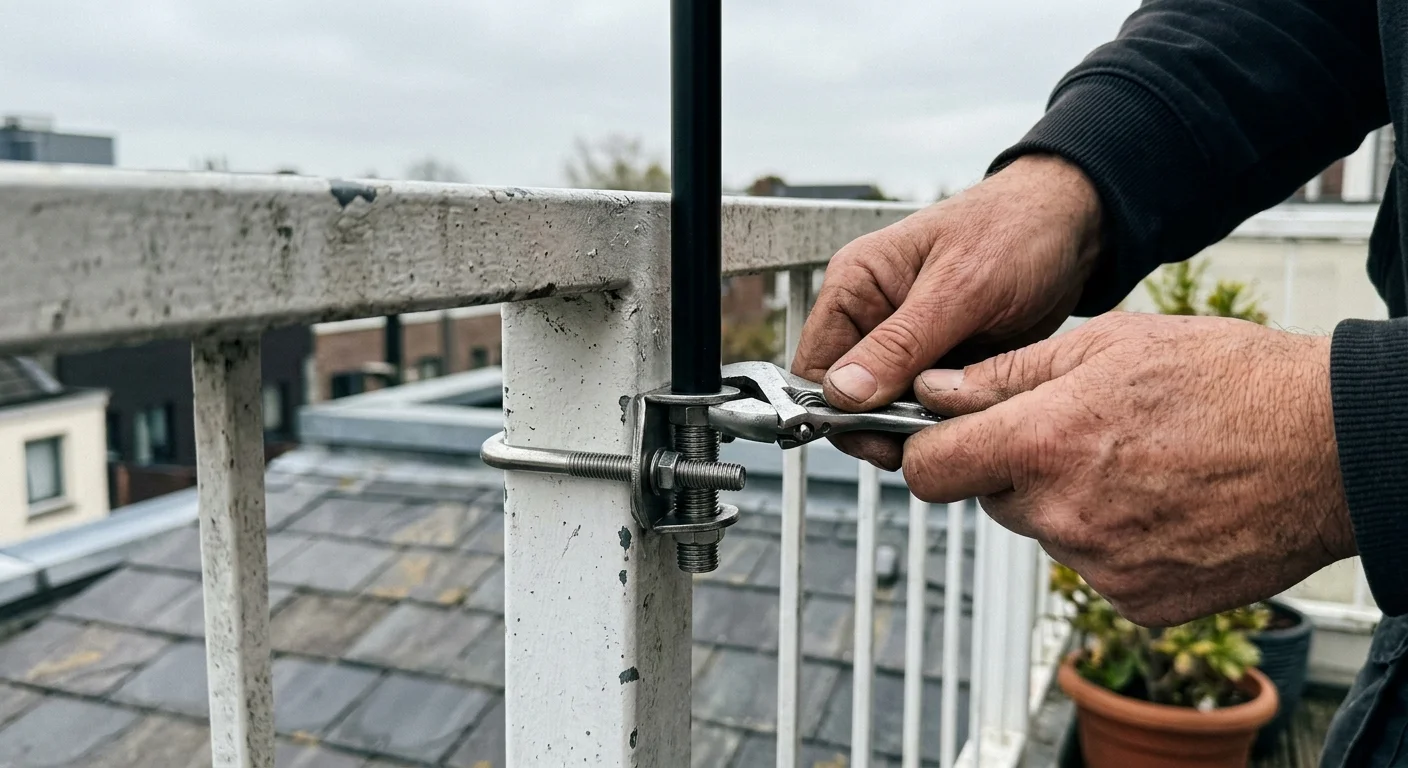
Condo Balcony Mounting Hardware and Mast Regulations
Federal OTARD rules explicitly cover antenna masts alongside reception aerials. Condominium associations cannot require permits or licenses for masts unless they extend more than 12 feet above the roofline.
Because condo balconies sit below the building’s primary roofline, balcony masts virtually never exceed the 12-foot statutory limit. Consequently, associations cannot subject your balcony mast to prior permitting.
To secure an antenna without drilling into structural walls, install non-penetrating clamping hardware. Heavy-duty U-bolt brackets clamp directly onto vertical or horizontal metal railing spindles.
Freestanding non-penetrating sled mounts provide another compliant mounting option for wide balconies. These steel frames sit flat on the balcony floor and remain stable using 25-pound rubber or concrete weights.
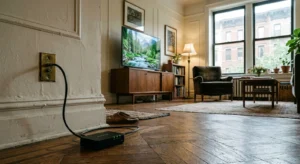
Routing coaxial cable into your living room requires no structural modifications. Flat coaxial ribbon jumpers pass easily through sliding glass door weatherstripping while maintaining an airtight thermal seal.
Compact multidirectional and directional antennas deliver superior gain across UHF and high-VHF frequencies. Modern compact units capture high-definition signals from broadcast towers up to 60 miles away.
| Mount Model & Hardware | Surface Compatibility | Max Mast Height | Penetration Required | Hardware Cost |
|---|---|---|---|---|
| Solid Signal Balcony Rail Clamp | Round or square rails (0.75 to 2.0 inches) | 5 feet above railing | No (Dual U-bolts) | $24.99 |
| Winegard DS-2000 J-Pipe Mount | Vertical balcony posts or timber beams | 3.25 feet pipe length | Optional (Clamp-compatible) | $22.95 |
| Antennas Direct Universal Mast Assembly | Balcony spindles or railing caps (up to 2.5 inches) | 6 feet above railing | No (Bracket compression) | $29.99 |
| Rohn Flat-Base Non-Penetrating Stand | Flat balcony concrete floor (weighted with blocks) | 8 feet freestanding | No (Gravity-based) | $89.50 |

Worked Financial Scenario: Cable Bundle vs. Antenna and Streaming
Let us examine a concrete scenario for a condo resident paying for a typical Comcast or Charter cable bundle. The resident seeks to cut costs while maintaining access to local news and prime-time programming.
For most households, learning how to keep local broadcast channels after dropping pay TV represents the single biggest recurring monthly savings in the entire cord-cutting transition.
The resident’s monthly cable invoice totals $178.50. This charge includes a $115.00 programming package, a $21.50 broadcast TV fee, a $12.50 regional sports fee, and $20.00 for two leased set-top boxes.
Government taxes and regulatory fees add another $9.50 monthly. Over an entire year, this resident sends $2,142.00 to their traditional cable television provider.
To replace this service, the resident purchases an outdoor aerial and streaming equipment. Initial equipment purchases require a one-time capital investment of $268.94.
This hardware bundle includes an Antennas Direct ClearStream 2MAX antenna for $79.99, a Solid Signal railing clamp kit for $24.99, and a flat coaxial jumper for $8.99.
The resident also purchases a Tablo 4th Gen 2-Tuner OTA DVR for $99.99 and a 50-foot RG6 quad-shield coaxial cable for $14.99. A DVR, or digital video recorder, lets you record and watch shows later.
The Tablo connects to the antenna on the balcony and transmits live broadcast television over the home Wi-Fi network. This arrangement feeds high-definition broadcast video to every television without running additional cables.
For entertainment, streaming means watching video content over the internet instead of cable or satellite. If an older television lacks internet capability, you simply add a streaming device.
A streaming device is a small box or stick, such as a Roku Express 4K+ for $39.99, that adds streaming apps to any display. Modern smart TVs—televisions with built-in internet connections and apps—need no extra device.
The resident replaces cable video with two streaming services: the Disney and Hulu ad-supported bundle for $10.99 monthly, plus Peacock Premium for $7.99 monthly. Ad-supported plans are cheaper options that show commercials.
In contrast, ad-free plans cost more but eliminate commercials completely. Streaming services also provide on-demand access, which lets you watch whatever you want, whenever you want, rather than relying on broadcast schedules.
The resident retains standalone 300 Mbps broadband internet service for $50.00 per month. Monthly recurring costs for broadband and streaming services total $68.98.
Over 12 months, ongoing broadband and streaming subscriptions cost $827.76. Combining that recurring cost with the one-time hardware investment of $268.94 results in a total first-year expense of $1,096.70.
Comparing $2,142.00 for cable against $1,096.70 reveals net first-year savings of $1,045.30. In year two and beyond, annual savings jump to $1,314.24 because the hardware is fully paid off.
Industry analysis from Cord Cutters News confirms that eliminating leased converter boxes and broadcast surcharges generates the largest recurring financial savings for cord-cutters.

Legally Sound Response Templates for HOA Pushback
Condominium boards and property management agencies routinely issue automated violation letters when inspectors spot balcony aerials. Responding quickly with exact federal statutory citations stops association enforcement actions in their tracks.
Below is a legally verified response template designed for condo owners who receive a notice to remove their balcony antenna.
Dear Board of Directors,
I am writing in response to your violation notice dated [Insert Date] regarding the antenna installed on the private balcony of Unit [Insert Unit Number].
This installation is federally protected under 47 C.F.R. Section 1.4000 (the Over-the-Air Reception Devices Rule), enacted pursuant to Section 207 of the Telecommunications Act of 1996.
The antenna is situated entirely within my exclusive-use private balcony and does not penetrate common elements. Under federal law, association restrictions that prohibit antennas or mandate architectural review are void and unenforceable.
Under 47 C.F.R. Section 1.4000(g), the association bears the legal burden of proof. Please confirm in writing within 10 business days that this violation notice has been rescinded without fines.
Use the following template if your board attempts to demand an architectural alteration form, application fees, or security deposits.
Dear Architectural Review Committee,
I have received your request for an architectural review application and deposit for the television antenna located on my balcony.
Under 47 C.F.R. Section 1.4000(a)(3), associations cannot enforce regulations that unreasonably delay installation or increase costs. The FCC specifically prohibits prior approval requirements, application fees, and deposits for exclusive-use antenna setups.
Because my equipment sits entirely within my exclusive-use space, the board lacks legal authority to require architectural applications. I will proceed with installation in full compliance with federal safety guidelines.
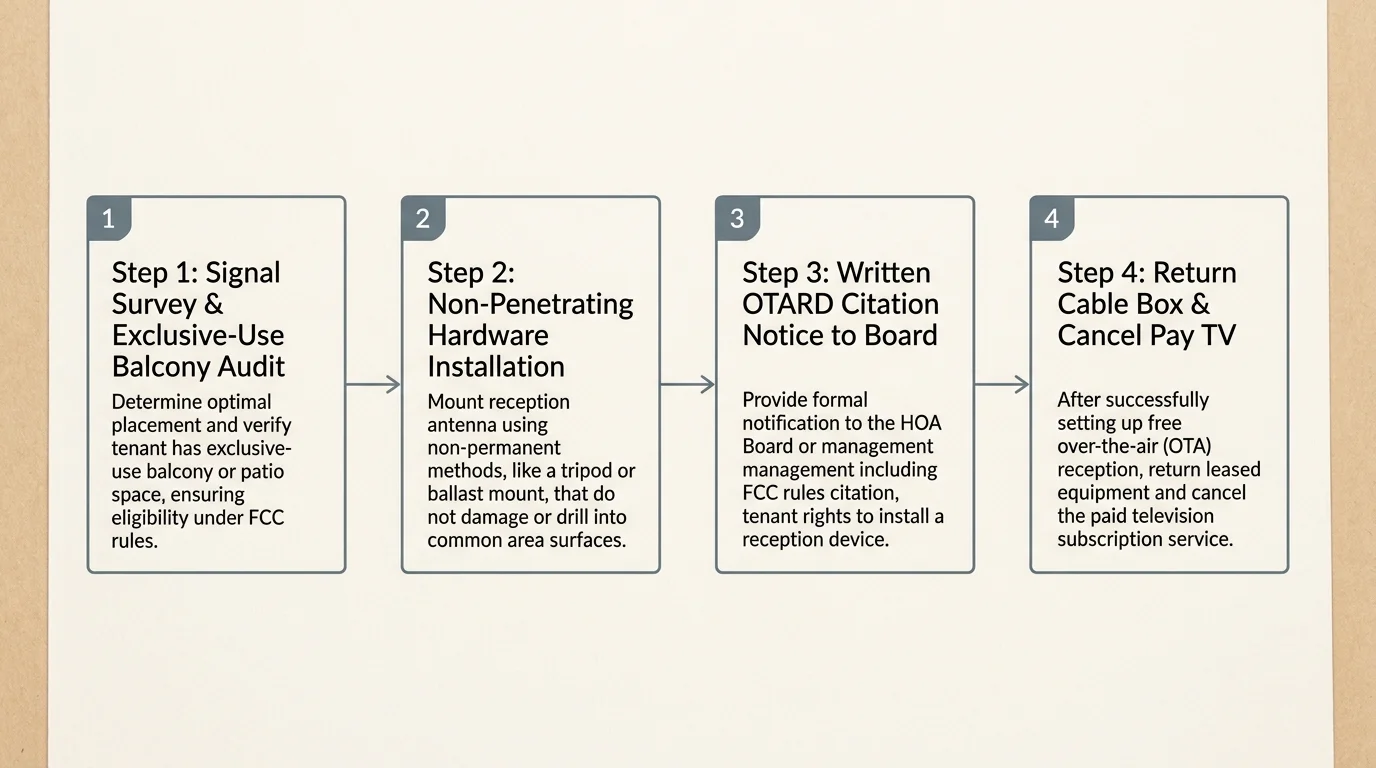
Step-by-Step Cable Cancellation and HOA Dispute Resolution
Canceling traditional cable television and defending your federal antenna rights requires a methodical approach. Follow this step-by-step procedure to transition your household smoothly while protecting yourself against administrative pushback.
Execute each phase systematically to maximize your monthly savings and prevent billing disputes.
-
Audit Your Current Contract and Equipment: Review your recent cable statement to identify promotional expiration dates and potential early termination fees. Cable operators charge substantial penalty fees if you cancel before a contract term ends.
Identify every physical converter box, cable modem, and remote control currently leased from the provider. You must return every rented component to prevent unreturned equipment penalties.
-
Verify Internet Speed and Infrastructure: Transition your subscription to an internet-only broadband tier. Independent equipment evaluations from Consumer Reports demonstrate that 100 to 300 Mbps service effortlessly accommodates multi-screen streaming.
Technical evaluations published by CNET indicate that streaming a single 4K ultra-high-definition stream requires only 25 Mbps of steady bandwidth. Avoid paying for costly gigabit packages you do not need.
-
Install Balcony Reception Equipment: Clamp your antenna bracket securely to your interior balcony railing. Position the aerial toward primary broadcast transmitters using online signal locators.
Route flat coaxial cable through your patio door and run a channel scan on your digital tuner. Confirm stable reception on local CBS, NBC, ABC, and Fox affiliates before terminating cable service.
-
Cancel Video Service and Return Hardware: Contact your cable provider’s retention department and state clearly that you are canceling video programming. Refuse promotional discounts and confirm the exact cancellation date.
Return all leased equipment directly to an official retail store. Demand an itemized return receipt containing serial numbers for every returned box and retain that document indefinitely.
-
Escalate Disputes to the FCC Media Bureau: If your association assesses fines or threatens legal action, file a Petition for Declaratory Ruling under 47 C.F.R. Section 1.4000(g).
The FCC Media Bureau adjudicates OTARD disputes without assessing any filing fees. Under federal regulations, filing a petition halts the collection of association fines until the FCC issues a binding determination.
Frequently Asked Questions
Can my condo HOA require me to paint my balcony antenna to match the wall?
An HOA may only require painting or screening if doing so does not impair reception or impose unreasonable costs. If painting voids your manufacturer warranty or degrades signal quality, the requirement violates federal OTARD regulations.
Does OTARD allow me to mount an antenna on the shared roof of my condo?
No. OTARD protections apply exclusively to areas within your exclusive use and control, such as private balconies or patios. Shared roofs are common elements, meaning your association holds the legal right to prohibit rooftop installations.
Can my landlord or HOA demand a security deposit before I install a balcony aerial?
No. The FCC explicitly prohibits associations and landlords from charging application fees, deposits, or insurance requirements for exclusive-use installations. These charges represent an unlawful financial impairment under 47 C.F.R. Section 1.4000(a)(3).
What should I do if my HOA begins assessing daily fines on my unit?
Send an immediate written demand citing 47 C.F.R. Section 1.4000 and file a Petition for Declaratory Ruling with the FCC Media Bureau. Under federal rules, the HOA cannot collect fines until the FCC determines rule validity.
Do I need a separate antenna for every smart TV in my condominium?
No. Connecting your outdoor antenna to a networked OTA DVR device broadcasts local television over Wi-Fi directly to every television, streaming stick, and mobile tablet inside your residence simultaneously.
Disclaimer: Cable and streaming prices vary by location and change frequently. The cost comparisons in this article are estimates based on typical pricing. Your actual savings will depend on your current cable package, internet costs, and which streaming services you choose.