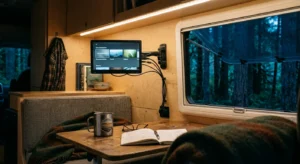
Your condominium association may claim that community bylaws prohibit all exterior broadcast television equipment. Under established federal regulations, that blanket ban is entirely void and unenforceable against tenants.
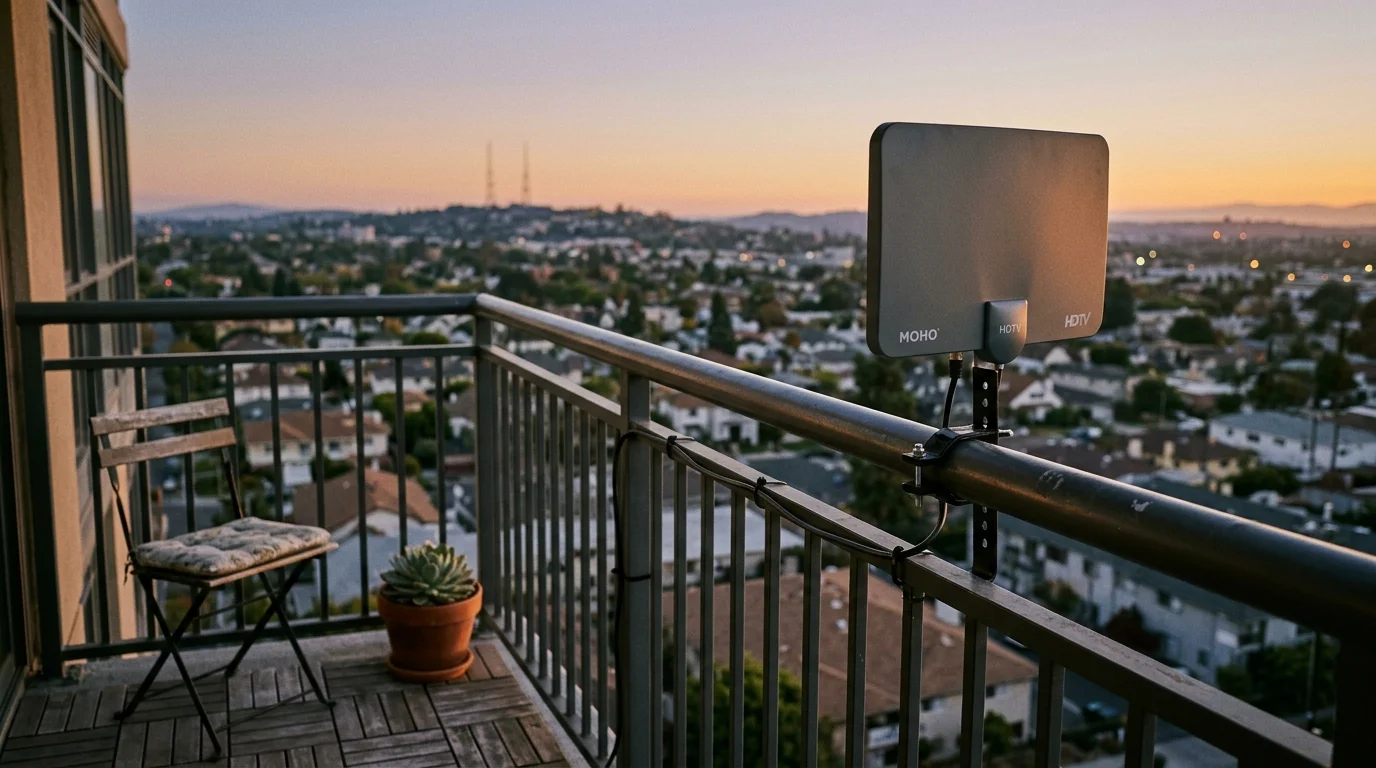
The FCC Over-the-Air Reception Devices rule gives you the explicit legal right to install reception hardware on your private balcony. You do not need prior architectural review board approval to exercise this right.
By combining non-penetrating railing brackets with a calibrated flat coax window passthrough setup, you can secure pristine local networks without drilling exterior walls or risking leasehold penalties.
The FCC OTARD Rule: Legal Framework and Rights
Federal regulations override private community covenants regarding over-the-air television reception.
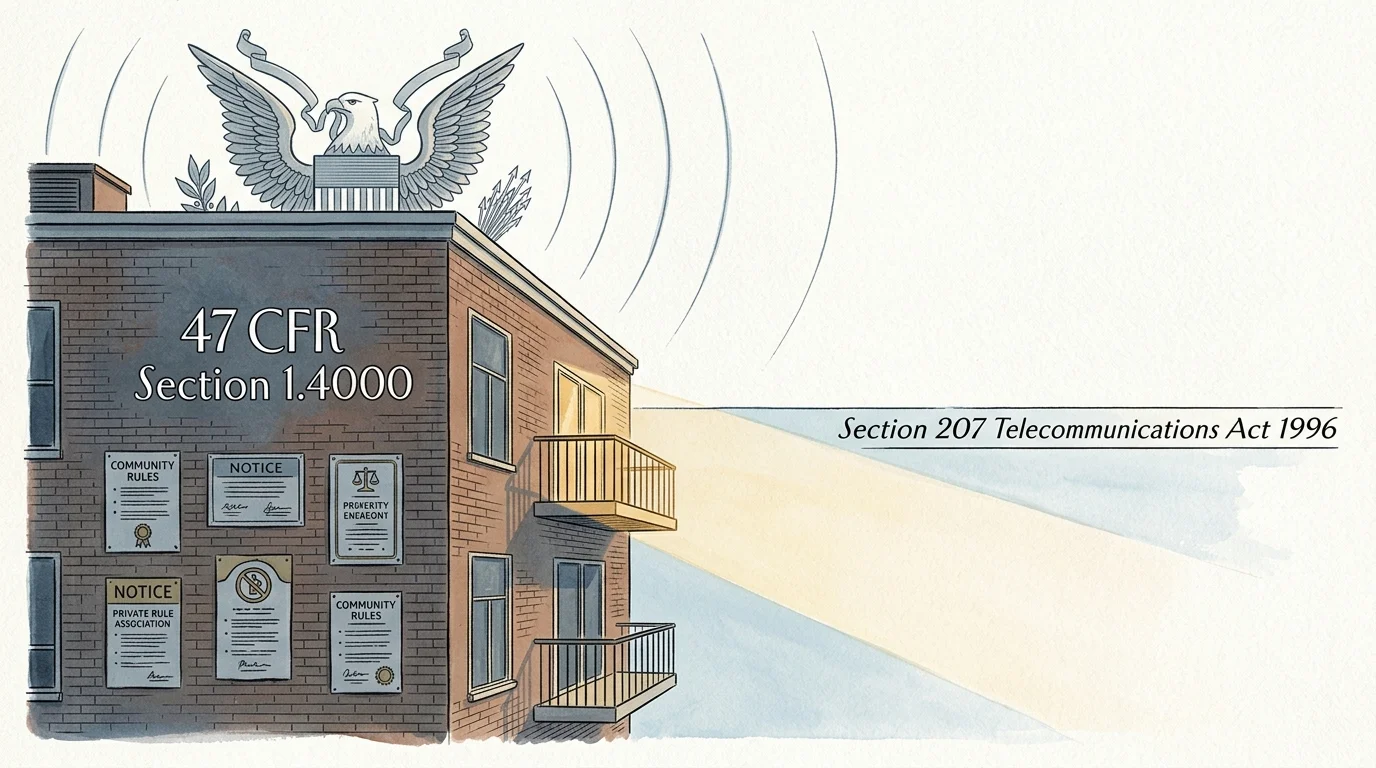
Congress enacted Section 207 of the Telecommunications Act of 1996 to stop landlords and associations from restricting viewer choice.
From that mandate, the Federal Communications Commission established 47 CFR Section 1.4000, commonly known as the OTARD rule.
According to the official FCC Consumer Guide on antenna rules, associations cannot enforce restrictions that impair installation or reception.
Under federal law, an HOA rule impairs your installation if it unreasonably delays access, inflates installation costs, or degrades signal quality.
For tenants pursuing cord-cutting—canceling traditional cable/satellite TV in favor of streaming services—these protections safeguard free television access.
While streaming means watching video content over the internet instead of cable or satellite, broadcast antennas pull local channels directly from open airwaves.
In 1999, the FCC expanded OTARD protections to cover tenants and renters who hold exclusive-use rights.
Consequently, association rules that mandate prior board applications, architectural review fees, or installation deposits are completely invalid.
You have the legal authority to install your antenna without asking the board for prior approval or waiting for committee meetings.

Exclusive Use vs. Common Elements in Condominiums
Understanding property boundaries determines whether federal law shields your antenna installation.
Even if surrounding buildings create physical obstructions, ground-floor apartment renters can pull OTA channels by aiming their gear to capture reflected broadcast waves.
The OTARD rule applies strictly to areas under your exclusive use or control.
Exclusive-use zones include private balconies, covered terraces, and enclosed patio decks assigned to your condo unit.
Conversely, federal protection does not extend to condominium common elements.
Common elements include building roofs, exterior brick or stucco walls, shared hallways, and outside window frames.
As a renter or unit owner, your antenna hardware must reside entirely within your balcony perimeter.
If any part of the antenna extends beyond the outer boundary of the railing, the HOA can legally order its removal.
Furthermore, drilling holes into exterior common walls breaches property boundaries and allows associations to levy legitimate damage penalties.
Successful antenna installation in a condo requires mounting methods that avoid all structural alterations.
Non-Penetrating Balcony Mount Schematics and Hardware
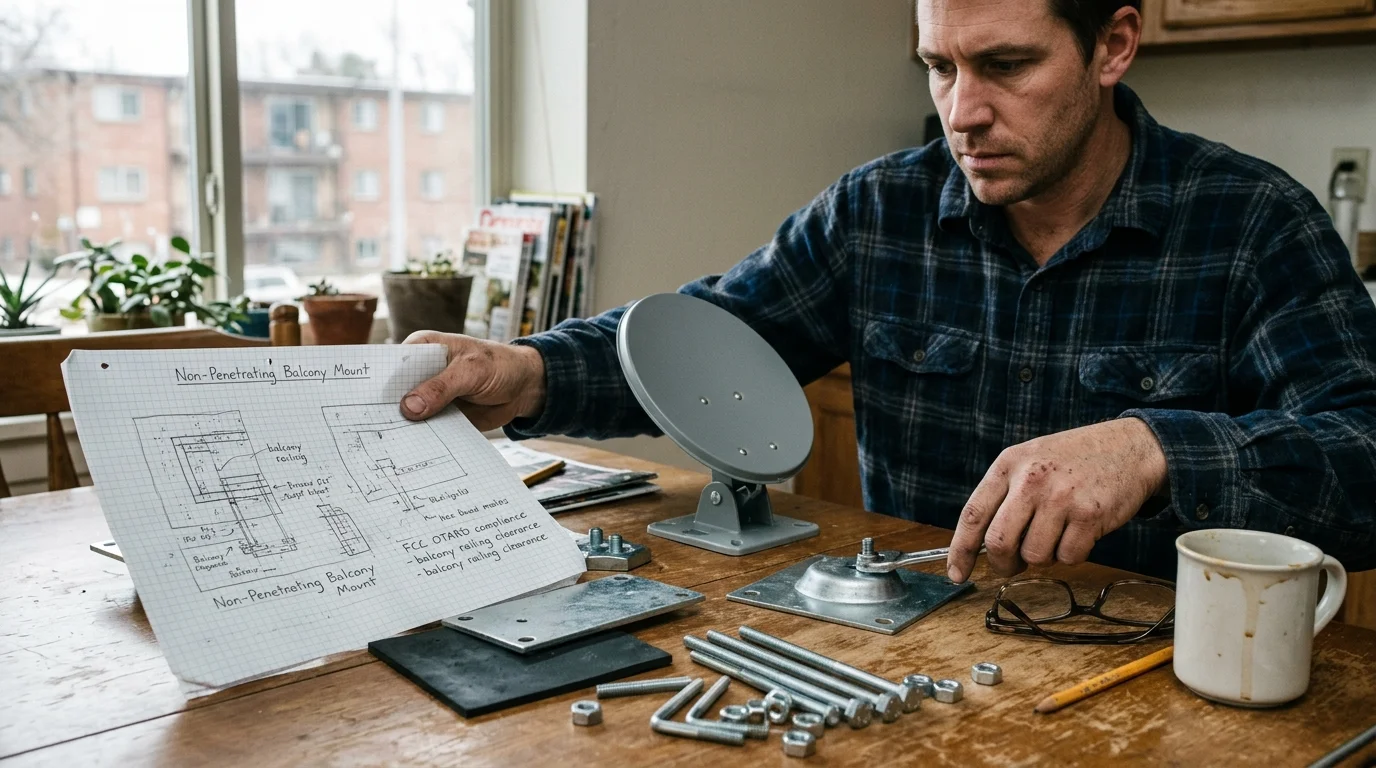
You can secure an antenna outdoors without driving a single bolt into association-owned masonry.
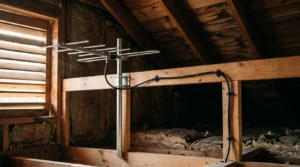
If a previous occupant left exterior cabling intact, you can often save time by repurposing an abandoned satellite dish mast and coaxial wiring for your OTA antenna instead.
A non-penetrating railing mount uses mechanical clamping force to anchor masts securely to metal or composite balcony spindles.
The setup centers around a universal 22-inch J-pole mast, such as the Winegard DS-2000 or RCA VH226E.
Attach the J-pole to the vertical baluster using two 2-inch galvanized steel U-bolts and heavy-duty clamp plates.
Wrap high-density neoprene rubber strips around the metal baluster before tightening the mounting brackets.
This rubber gasket prevents cosmetic marring of the powder-coated finish while dampening wind vibration.
Broadcast television antennas do not face the one-meter size limit applied to satellite dishes under OTARD rules.
However, keeping your mast height below twelve feet avoids triggering local municipal building and safety permits.
Compact multi-directional outdoor antennas like the ClearStream 2MAX fit neatly below handrail level, maintaining complete visual discretion.
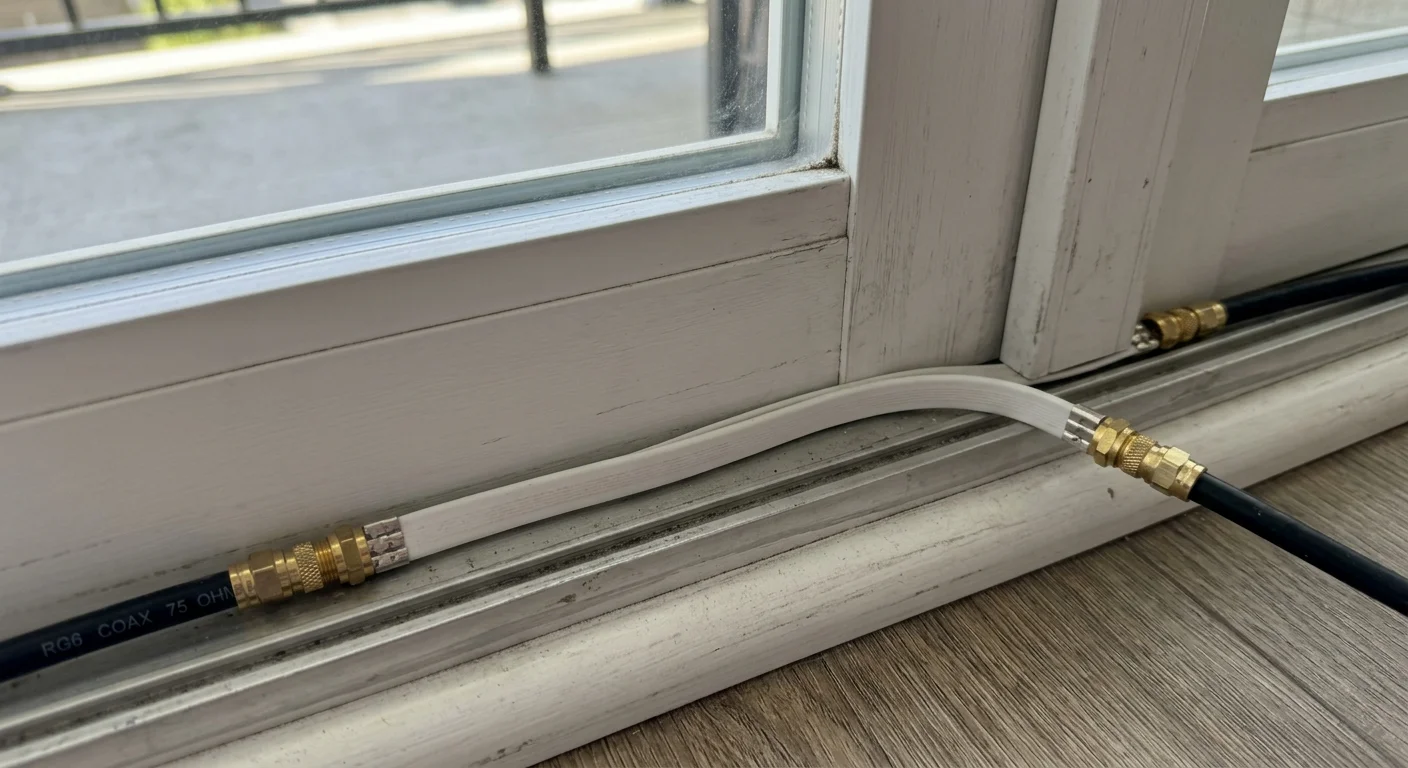
Flat Coax Window Passthrough Setup and Signal Integrity
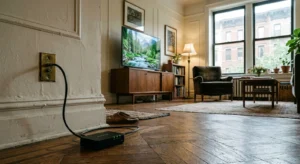
Running coaxial cabling indoors without drilling through exterior frames preserves your rental deposit and avoids HOA conflicts.
A flat coax window passthrough setup solves this challenge by utilizing micro-thin copper tape terminated with standard 75-ohm F-connectors.
These flexible jumpers measure roughly eight to twelve inches in length and compress safely inside closed window sashes or sliding balcony doors.
High-grade flat jumpers introduce only 0.5 dB to 2.0 dB of insertion loss across VHF and UHF frequencies between 54 MHz and 690 MHz.
Modern digital television tuners easily lock onto broadcast signals that remain above 35 dBµV, making minor jumper losses virtually imperceptible.
Testing published by Wirecutter confirms that outdoor antenna placement easily compensates for negligible inline jumper attenuation.
Position the flat jumper along the bottom track of the window frame, ensuring no sharp burrs pinch the ribbon.
Close the window sash firmly against the integrated rubber weatherstripping to maintain thermal insulation and prevent moisture infiltration.
| Routing Method | Insertion Loss (54–690 MHz) | HOA Property Damage Risk | Weather-Seal Impact | Average Hardware Cost |
|---|---|---|---|---|
| Flat Coaxial Jumper (0.2 mm) | 0.8 dB – 1.8 dB | None (Fully reversible) | Zero draft; seals over factory gasket | $8 – $15 |
| Direct RG-6 Masonry Drill-Through | < 0.2 dB | High (Penetrates common elements) | Destroys building envelope seal | $45 – $95 |
| Balcony Wi-Fi Network Tuner | 0.0 dB (Direct IP stream) | None (Freestanding unit) | Requires outdoor weatherproof outlet | $150 – $230 |
| Pinched RG-6 Coax Cable | 7.5 dB – 14.0 dB | Low (Leaves window gap) | Creates 1/4-inch thermal draft gap | $6 – $12 |
As demonstrated by the engineering comparison, flat coaxial passthroughs deliver superior signal integrity without violating leasehold drilling prohibitions.

Cost Analysis: Traditional Cable vs. OTA Antenna and Streaming
Cable providers consistently inflate monthly bills with non-negotiable fees that deliver zero additional programming value.
Tech-savvy households can lower their ongoing expenses even further by building a DIY local channels DVR to distribute recorded OTA programming throughout the home network.
According to reporting from Cord Cutters News, mandatory broadcast TV surcharges regularly surpass thirty dollars per month on standard cable invoices.
When combined with regional sports network fees and mandatory converter rentals, typical cable packages exceed $140 every month.
An outdoor antenna captures local network affiliates—including ABC, CBS, FOX, and NBC—in uncompressed high definition completely free of charge.
You can combine free broadcast channels with modern streaming platforms to customize your personal entertainment bundle.
A smart TV—a television with built-in internet connection and apps—allows you to toggle between broadcast channels and digital platforms instantly.
Alternatively, connect a streaming device—a small box or stick (like Roku or Fire TV) that adds streaming to any TV—via HDMI.
You can select ad-supported tiers (cheaper plans that show commercials) or upgrade to ad-free options that eliminate commercials entirely.
Adding an over-the-air digital video recorder gives you DVR capability, letting you record live sports and prime-time broadcasts.
These tuners also support on-demand functionality, letting you watch whatever you want, whenever you want across all home devices.
Many viewers fear missing major live events, but over-the-air broadcasts air the Super Bowl, World Series, and Olympic Games free.
Consider this worked scenario for an apartment resident in Denver canceling cable service on November 12, 2026.
The resident previously paid $152.40 monthly for an Xfinity double-play bundle containing basic cable and broadcast television fees.
Equipment costs for the new setup totaled $112.46, including an antenna ($59.99), railing clamp ($24.99), flat jumper ($11.49), and RG-6 cable ($15.99).
The resident transitioned to a standalone 100 Mbps internet connection costing $40.00 monthly and added one $9.99 ad-supported streaming subscription.
Monthly entertainment outlays dropped from $152.40 to $49.99, yielding an ongoing monthly savings of $102.41.
Over the first year, total expenditures fell from $1,828.80 to $712.34, pocketing $1,116.46 in net savings after hardware payback.
Responding to HOA Violation Letters and Filing FCC Petitions
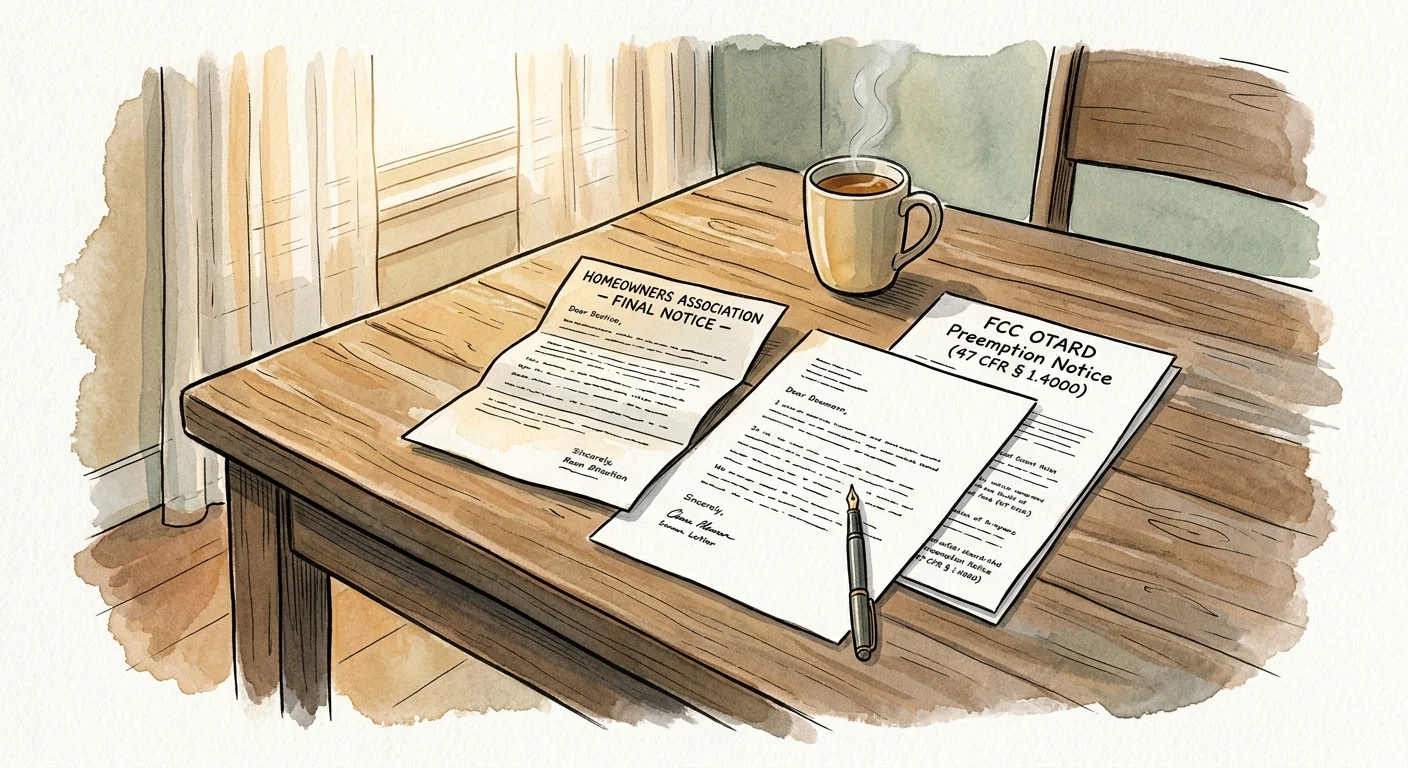
Receiving a formal violation notice from a condominium board can cause unnecessary stress for uninformed residents.
Most property managers issue automated warning templates without verifying whether community bylaws conflict with federal preemption rules.
Research from Consumer Reports shows that presenting governing statutes in writing resolves the vast majority of association disputes quickly.
Respond to any notice within seven business days with a formal letter citing 47 CFR Section 1.4000.
Note that your hardware resides within exclusive-use space, utilizes a clamp mount, and introduces zero structural alterations.
If your condo board refuses to dismiss the citation or threatens monetary fines, file a dispute with federal regulators.
Submit a formal Petition for Declaratory Ruling directly to the FCC Media Bureau by sending an email to OTARD@fcc.gov.
Filing this petition is entirely free and does not require hiring an attorney or attending in-person hearings.
Federal law prohibits the HOA from levying fines, enforcing penalties, or demanding hardware removal while your petition is pending.
“No fine or other penalty may be assessed against an antenna user while a petition for declaratory ruling is pending before the Commission.” — 47 CFR § 1.4000(a)(4)
This automatic statutory freeze protects your reception rights throughout the entirety of the FCC administrative review process.
Step-by-Step Cable Provider Cancellation Strategy
Canceling traditional cable requires deliberate execution to dodge early termination charges and disputed equipment fees.
First, review your customer agreement to confirm your monthly billing cycle cut-off date and contract expiration status.
Because major cable providers no longer prorate final monthly bills, schedule your disconnect for the last day of the cycle.
Next, call customer retention and inform the representative that you are relocating overseas where their service is unavailable.
This precise approach prevents representatives from wasting your time with retention pitches, temporary discounts, and promotional bundles.
If your agreement carries an early termination penalty, calculate whether remaining monthly charges exceed the flat cancellation fee.
Often, paying a $100 early termination fee saves hundreds of dollars compared to maintaining service for several remaining months.
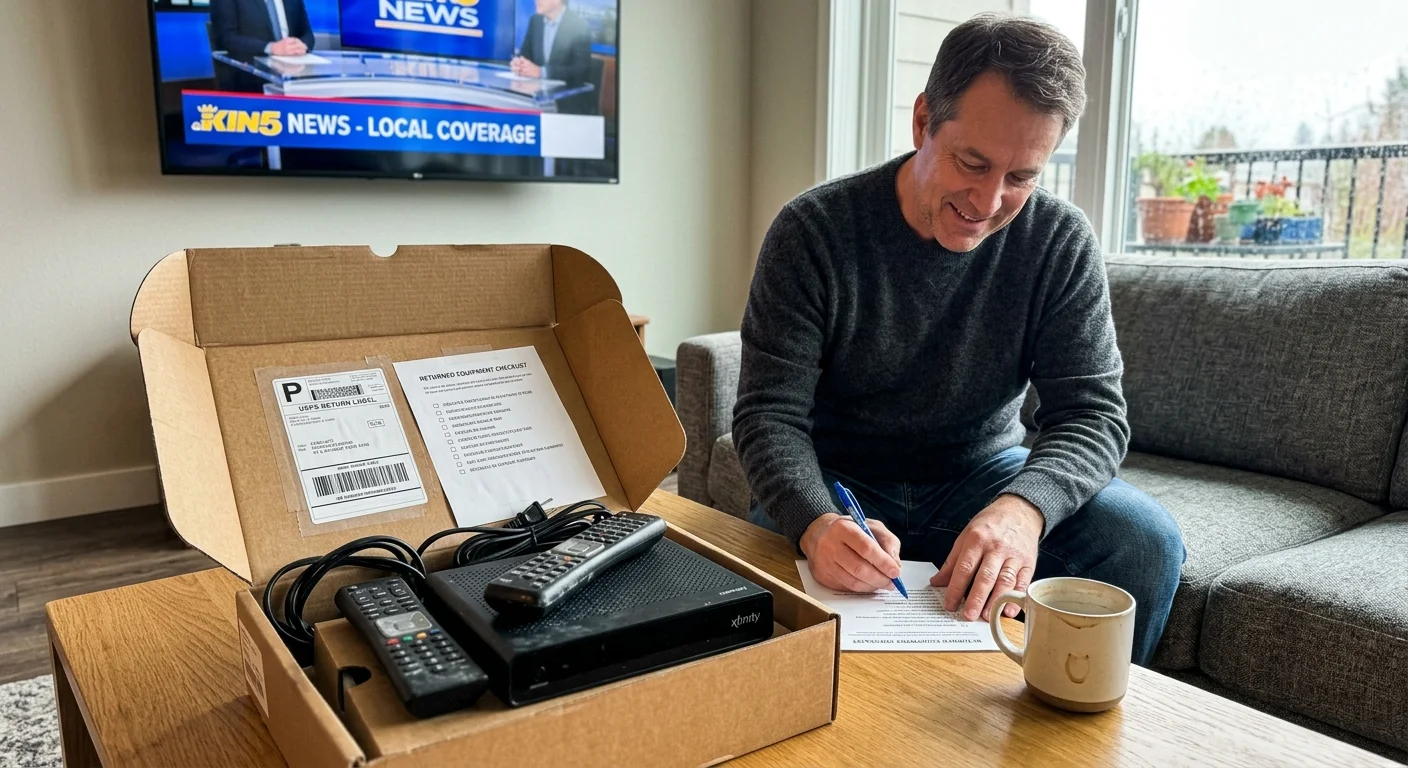
Inventory all leased hardware, including digital set-top boxes, coaxial splitters, original power supplies, and remote controls.
Drop the hardware off at an authorized retail center or partner shipping store, demanding a receipt with scanned serial numbers.
Keep that physical receipt and confirmation email stored safely for two full years to combat automated phantom equipment claims.
For household streaming, verify that your standalone internet connection delivers at least 25 Mbps download speeds per simultaneous 4K stream.
Frequently Asked Questions
Can an HOA ban antennas from being visible from the street?
No. Under the OTARD rule, aesthetic restrictions and street-visibility bans are unenforceable if they impair reception. If your exclusive-use balcony faces the transmission towers, the HOA cannot force antenna relocation.
Does the FCC OTARD rule protect condo renters as well as owners?
Yes. The FCC expanded OTARD protections to include tenants and leaseholders in 1999. If your rental agreement grants exclusive possession of a balcony or patio, your installation rights are fully protected.
What internet download speed is required for streaming after canceling cable?
Antennas do not use internet bandwidth because over-the-air signals broadcast over radio frequencies. For streaming apps, maintain at least 25 Mbps for a 4K stream, or 50 to 100 Mbps for multi-person households.
Will a flat coax window jumper cause pixelation on high-definition channels?
Quality flat jumpers cause negligible signal degradation, typically losing only 0.5 to 1.5 dB. Because outdoor antenna reception is significantly stronger than indoor models, digital tuners maintain crisp, pixel-free HD picture quality.
Disclaimer: Cable and streaming prices vary by location and change frequently; cost comparisons are estimates based on typical pricing. Your actual savings depend on your specific cable package, internet rates, and selected streaming services.