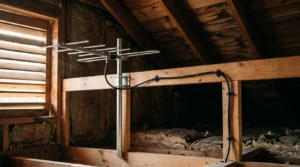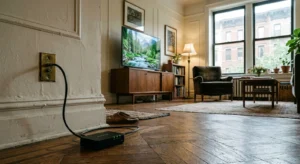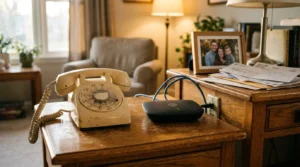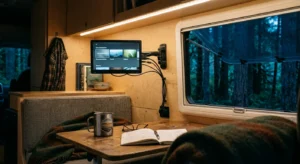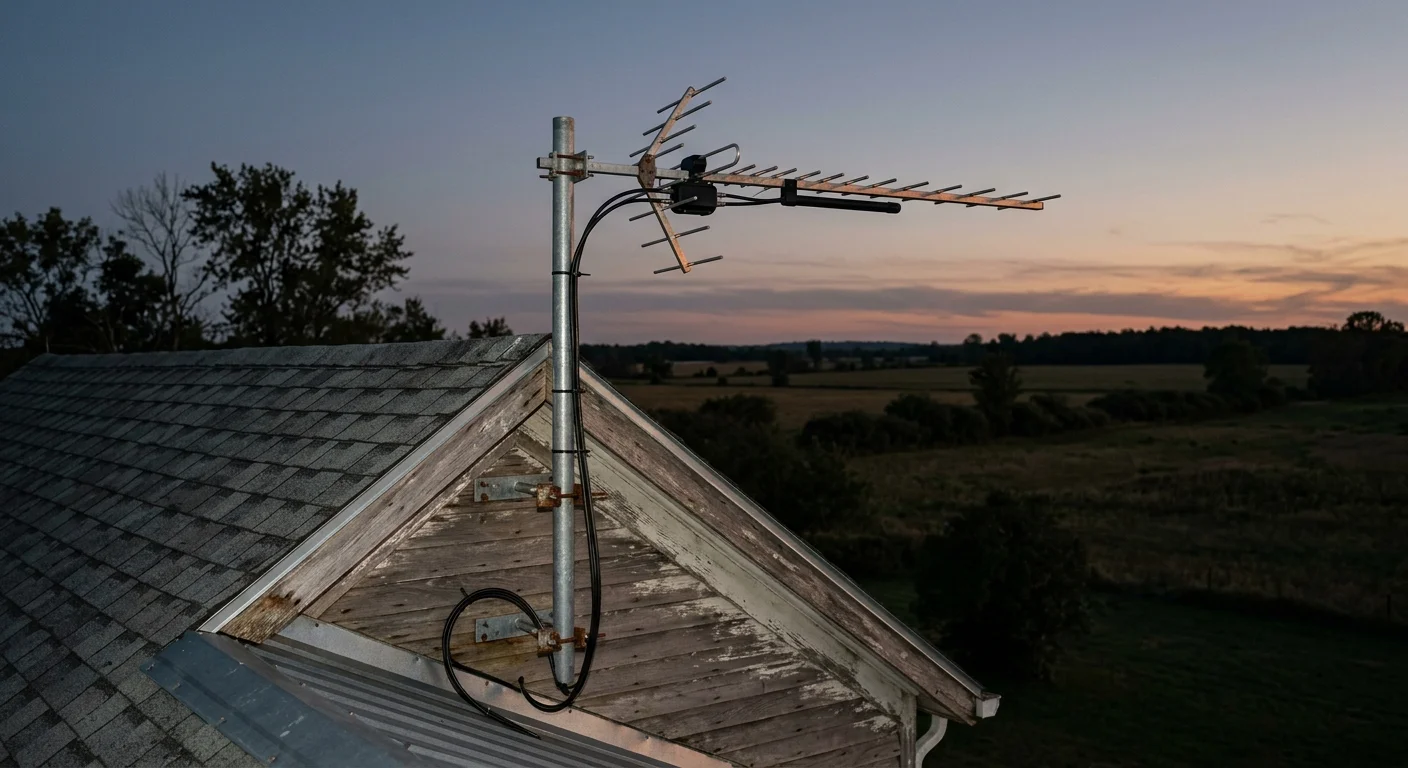
Moving to a rural home 65 miles from city broadcast towers often feels like an immediate ticket back to expensive pay-TV subscriptions. You do not need an unpermitted, commercial-grade 120-foot tower to pull in crisp network television.
Standard broadcast calculations assume you must clear the visual horizon completely to secure a stable signal lock. By pairing high-gain directional UHF antennas with low-noise masthead amplification, you can capture diffracted signals well below the theoretical line of sight.
Modern digital transmission standards slash required signal-to-noise thresholds significantly. This engineering guide shows you how to design an ultra-fringe antenna mast that delivers free high-definition channels without violating local regulations or your budget.

The 65-Mile Rural Reality: Radio Horizons and Earth Curvature Math
Radio signals travel slightly farther than visible light because atmospheric density bends electromagnetic waves downward. Engineers calculate this curved path using an effective Earth radius multiplier of four-thirds.
You can calculate the standard radio horizon distance in statute miles using the formula d = 1.415 × √h, where h represents antenna height above average terrain in feet. Both the transmitter height and your receiving mast height dictate the total line-of-sight distance.
Consider a broadcast transmitter tower standing 1,000 feet above flat rural terrain. Plugging 1,000 into the formula reveals that the transmitter’s radio horizon ends at approximately 44.75 miles.
If your rural homestead sits 65 miles away, you face a 20.25-mile geometric deficit over the bulge of the Earth. To bridge that 20.25-mile curvature gap with pure optical line of sight, your home receiving antenna would need to reach an elevation of 205 feet.
Erecting a 205-foot lattice tower on residential property is neither practical nor financially sensible. Fortunately, over-the-air television broadcast signals do not simply vanish into space when they hit the horizon.
Electromagnetic waves in the UHF spectrum (470 MHz to 608 MHz) bend around terrain obstructions through knife-edge diffraction. Signals also scatter across the lower atmosphere via tropospheric refraction.
These atmospheric phenomena drop signal strength by 15 dB to 25 dB compared to open space. Your installation must overcome this signal deficit through antenna aperture gain and low-noise amplification rather than brute mast height.
FCC OTARD Regulations and Mast Height Safety Limits
Before buying steel poles or scheduling bucket trucks, you must know the federal rules governing residential antennas. The Federal Communications Commission protects your right to receive over-the-air television signals across the United States.
Under the Over-the-Air Reception Devices rule, codified in 47 CFR § 1.4000, homeowners associations and local zoning boards cannot ban outdoor television antennas. According to the FCC Consumer Guide, these federal protections apply nationwide to ensure consumer broadcast access.
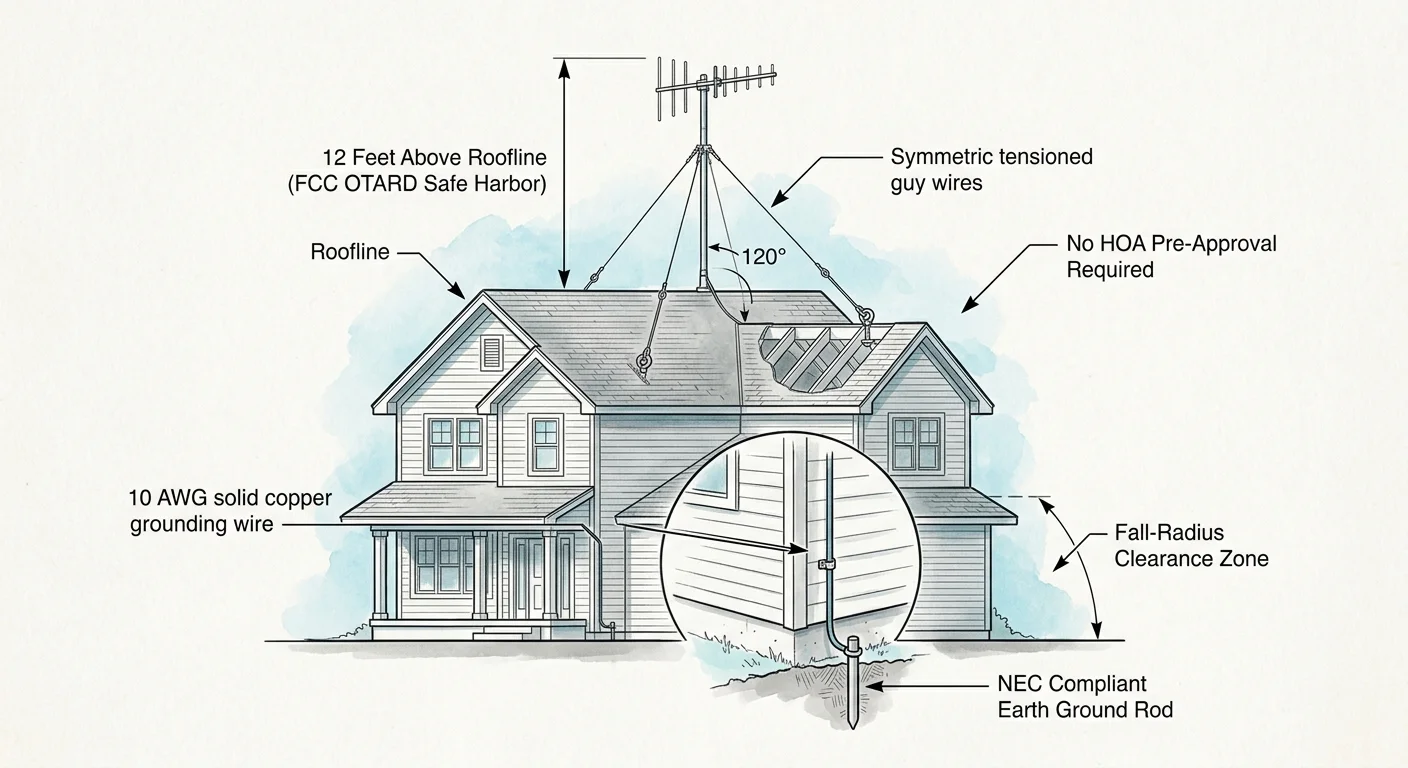
However, this federal preemption contains a critical safety limitation regarding mast height. OTARD protections cover masts extending up to 12 feet above your roofline without requiring prior municipal permits or HOA architectural review.
If you extend a mast more than 12 feet above your roof peak, local governments can enforce building codes, wind-load ratings, and setback mandates. Staying within the 12-foot envelope prevents legal disputes with local authorities and neighbors.
A mast anchored to an apex roof mount at 12 feet gives you a total ground clearance of roughly 28 to 32 feet on a standard two-story home. Raising an antenna higher than 35 feet yields diminishing returns while introducing substantial mechanical risk.
High winds generate massive rotational torque on long-boom fringe antennas. Every foot above the roofline increases leverage on your mounting brackets, rafters, and chimney brickwork.
National Electrical Code (NEC) Section 810 mandates proper grounding for any outdoor antenna installation. You must bond a 10 AWG copper ground wire from the mast directly to your home’s central electrical service ground rod.
You must also route the coaxial line through an outdoor grounding block before the wire enters your home. This dissipates static buildup and prevents lightning-induced surges from destroying your television tuners.
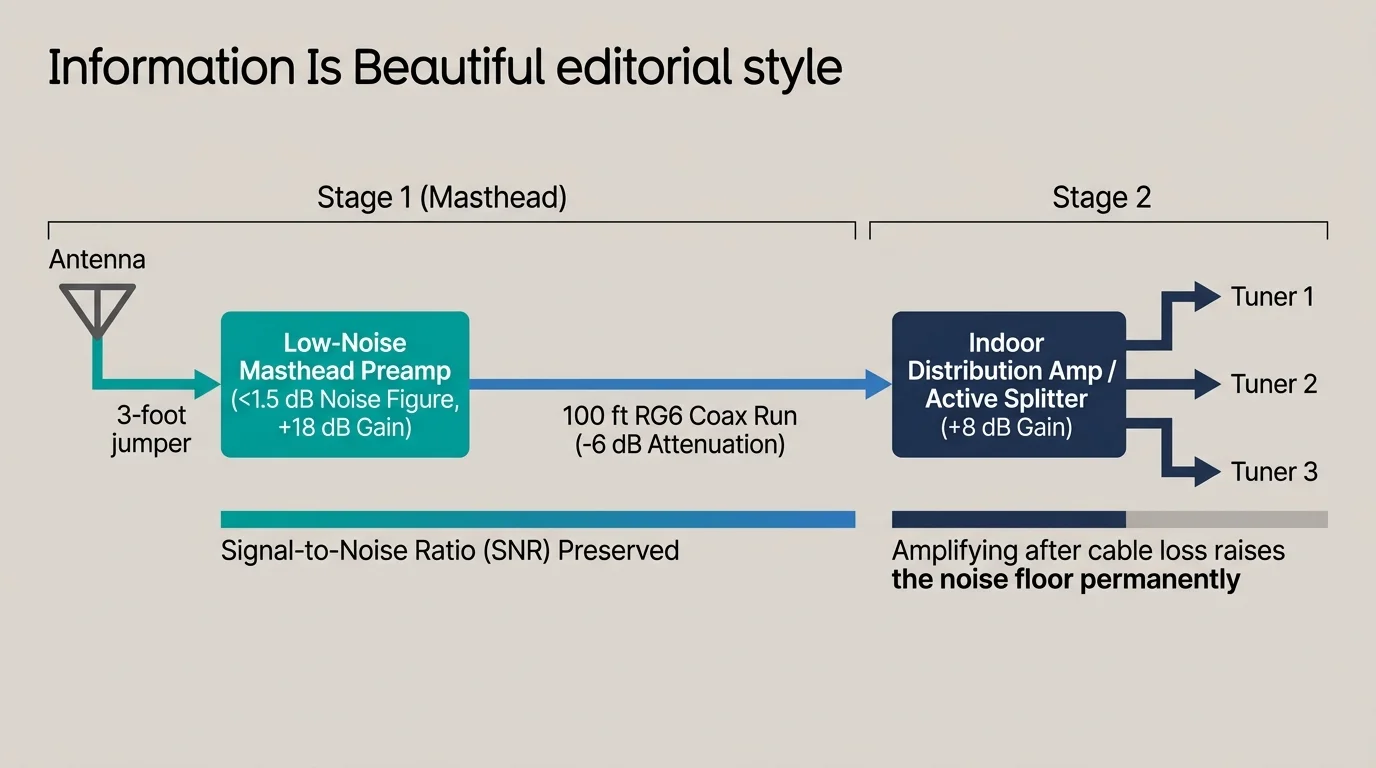
Preamplifier vs. Distribution Amplifier: Noise Figure and Gain Architecture
Ultra-long-distance reception hinges on preserving raw signal quality before system noise ruins digital decoding. Understanding a preamplifier vs distribution amplifier ota setup determines whether your tuners lock onto weak signals or show blank screens.
A preamplifier mounts outdoors directly on the antenna mast, ideally within 1 to 6 feet of the antenna feed point. Its primary job involves amplifying extremely faint broadcast signals before they enter your long coaxial downlead cable.
The crucial specification on any deep-fringe preamplifier is its noise figure, measured in decibels. The noise figure indicates how much internal electrical noise the amplifier adds to the received broadcast wave.
High-end units like the Channel Master CM-7777HD or the Televes Avant series deliver noise figures below 2.0 dB across the UHF band. Budget amplifiers often generate noise figures exceeding 4.5 dB, which obliterates weak digital signals.
Under Friis’s formula for electrical noise, the first active amplifier in a radio frequency chain establishes the noise floor for the entire system. Once an unamplified signal travels through 100 feet of cable, line attenuation degrades the signal-to-noise ratio permanently.
An indoor amplifier cannot restore a signal that has already fallen below the noise floor inside your coaxial line. Amplifying an attenuated, noisy signal indoors merely boosts the noise alongside the broadcast carrier.
“A preamplifier captures weak signals at the masthead to protect signal-to-noise ratio; a distribution amplifier exists solely to divide strong signals among multiple indoor screens.” — BetterStreamingLife Engineering Principle
A distribution amplifier serves an entirely different purpose inside your home network. You place a distribution amplifier indoors at the central media panel to split an already amplified signal among multiple television sets.
Standard passive television splitters create severe signal attenuation. A balanced 4-way splitter reduces incoming signal strength by 7.0 dB to 7.5 dB on every output port.
An active distribution amplifier compensates precisely for these indoor splitter and room-run losses without adding noise at the masthead. For fringe installations 65 miles away, you must never substitute an indoor distribution amplifier for an outdoor masthead preamplifier.
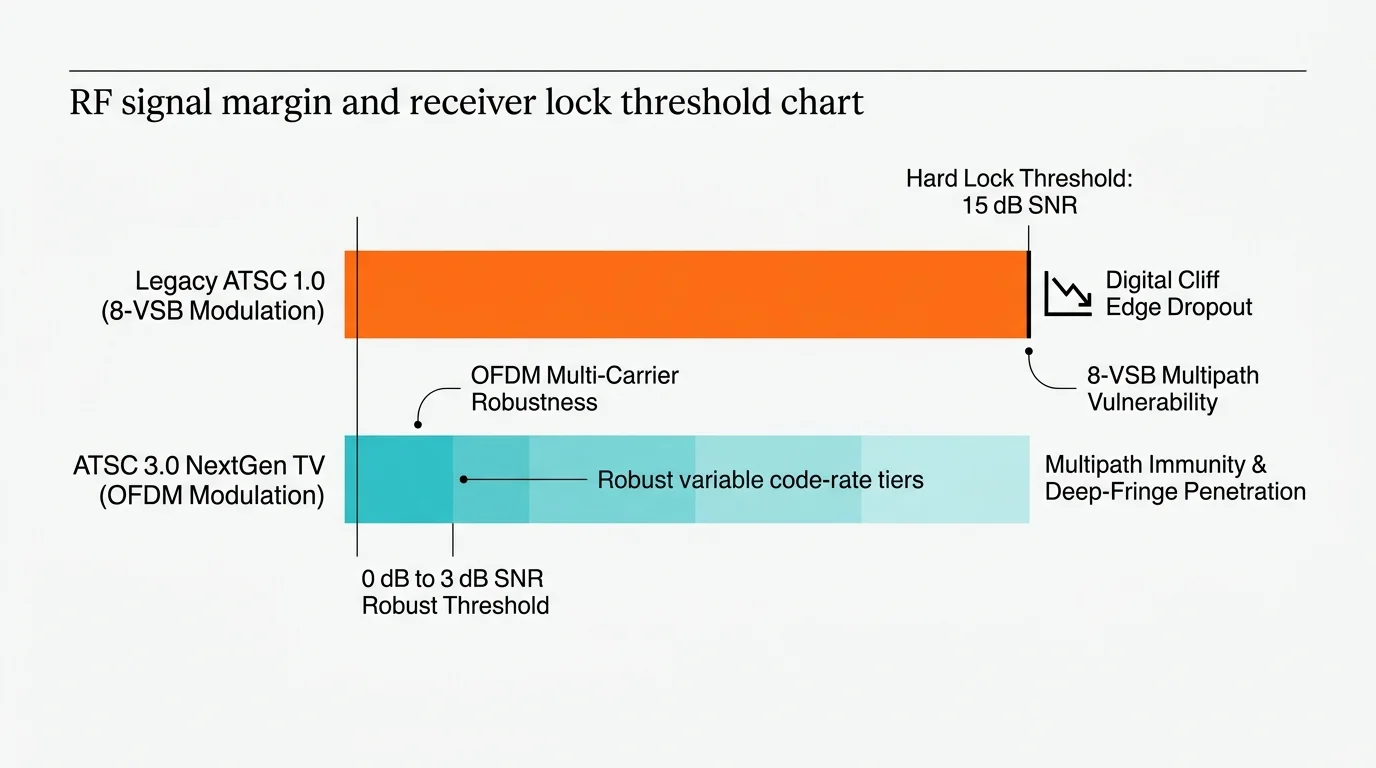
ATSC 3.0 NextGen TV vs. ATSC 1.0 Signal Margins
The transition to NextGen TV reshapes deep fringe tv antenna setup calculations in rural America. The older ATSC 1.0 standard relies on 8-VSB modulation, which requires a minimum Signal-to-Noise Ratio (SNR) of 15.2 dB at the tuner.
If atmospheric conditions drop your ATSC 1.0 signal to 14.8 dB SNR, your screen experiences the digital cliff effect. The image macroblocks, the audio shrieks, and the tuner drops the channel completely.
ATSC 3.0 utilizes Coded Orthogonal Frequency-Division Multiplexing (COFDM) combined with Low-Density Parity-Check (LDPC) forward error correction. Broadcasters can divide their digital transmission stream into multiple Physical Layer Pipes (PLPs) with distinct modulation profiles.
When a station transmits its core news and entertainment channels using QPSK or 16-QAM modulation, tuners achieve a stable lock at 0 dB to 6 dB SNR. This technical difference provides an astounding 9 dB to 15 dB link margin advantage over legacy ATSC 1.0 broadcasts.
In practical terms, atsc 3 long distance reception allows a 65-mile rural viewer to maintain stable picture locks through severe multipath interference and low signal field strengths. Channels that drop out under ATSC 1.0 often play smoothly under ATSC 3.0 NextGen TV protocols.
Rural viewers do not need to panic about legacy equipment becoming obsolete overnight. Under FCC Docket No. 23-53, the federal government extended the mandatory ATSC 1.0 simulcast requirement through July 17, 2027.
Broadcast stations must continue transmitting their primary channels over standard ATSC 1.0 signals alongside their NextGen feeds until mid-2027. Building a high-performance deep-fringe array today secures access to legacy signals now while optimizing your home for NextGen reception.
Deep-Fringe Link Budget: A 65-Mile Worked Calculation
System designers rely on link budgets to verify reception feasibility before purchasing equipment. A link budget sums all signal gains and subtracts all losses between the transmitter antenna and your indoor digital tuner.
Let us work through a concrete mathematical scenario for a rural home 65 miles from a metropolitan broadcast cluster. In this scenario, a major network broadcasts on UHF Channel 28 (center frequency 557 MHz) with 1,000 kW Effective Radiated Power (+90 dBm ERP).
First, we calculate Free Space Path Loss (FSPL) using the standard RF formula: FSPL = 20 × log10(distance in miles) + 20 × log10(frequency in MHz) + 36.6. At 65 miles and 557 MHz, the direct path loss through clear air totals 127.8 dB.
Because the receiving antenna sits behind the radio horizon at a 30-foot roofline height, we add 18.0 dB of knife-edge diffraction and Earth-curvature loss. Subtracting these losses from the +90 dBm transmitter ERP leaves a raw field strength of -55.8 dBm at your property line.
Now we calculate the signal recovery and internal system losses inside your home antenna installation:
- Antenna forward gain (Winegard HD8200U or Televes DAT BOSS): +13.5 dBi
- Balun impedance matching loss (300-ohm to 75-ohm conversion): -0.8 dB
- Raw signal level delivered to the preamplifier input: -43.1 dBm
- Masthead preamplifier gain (Channel Master CM-7777HD set to low mode): +17.0 dB
- Signal level leaving the masthead preamplifier: -26.1 dBm
- Coaxial cable run (120 feet of RG6 at 4.8 dB loss per 100 feet): -5.76 dB
- Indoor passive 4-way splitter feeding bedrooms and living room: -7.5 dB
- Wall plate and jumper barrel connector insertion loss: -1.0 dB
- Net signal power reaching your television tuner input: -40.36 dBm
Modern digital tuners require signal power between -80 dBm and -10 dBm to decode broadcast data cleanly. Our final calculated value of -40.36 dBm lands squarely in the optimal dynamic operating range of consumer tuners.
Next, we verify the thermal noise margin. The ambient thermal noise floor across a 6 MHz television channel bandwidth sits at -106.2 dBm.
Adding the 2.0 dB noise figure of our masthead preamplifier raises the system noise floor to -104.2 dBm. Subtracting this noise floor from our -40.36 dBm tuner signal yields a theoretical carrier-to-noise ratio exceeding 25 dB.
This 25 dB operating margin easily exceeds the 15.2 dB requirement for legacy ATSC 1.0 broadcasts. It provides more than 19 dB of operating headroom above the lock threshold for robust ATSC 3.0 QPSK transmissions.
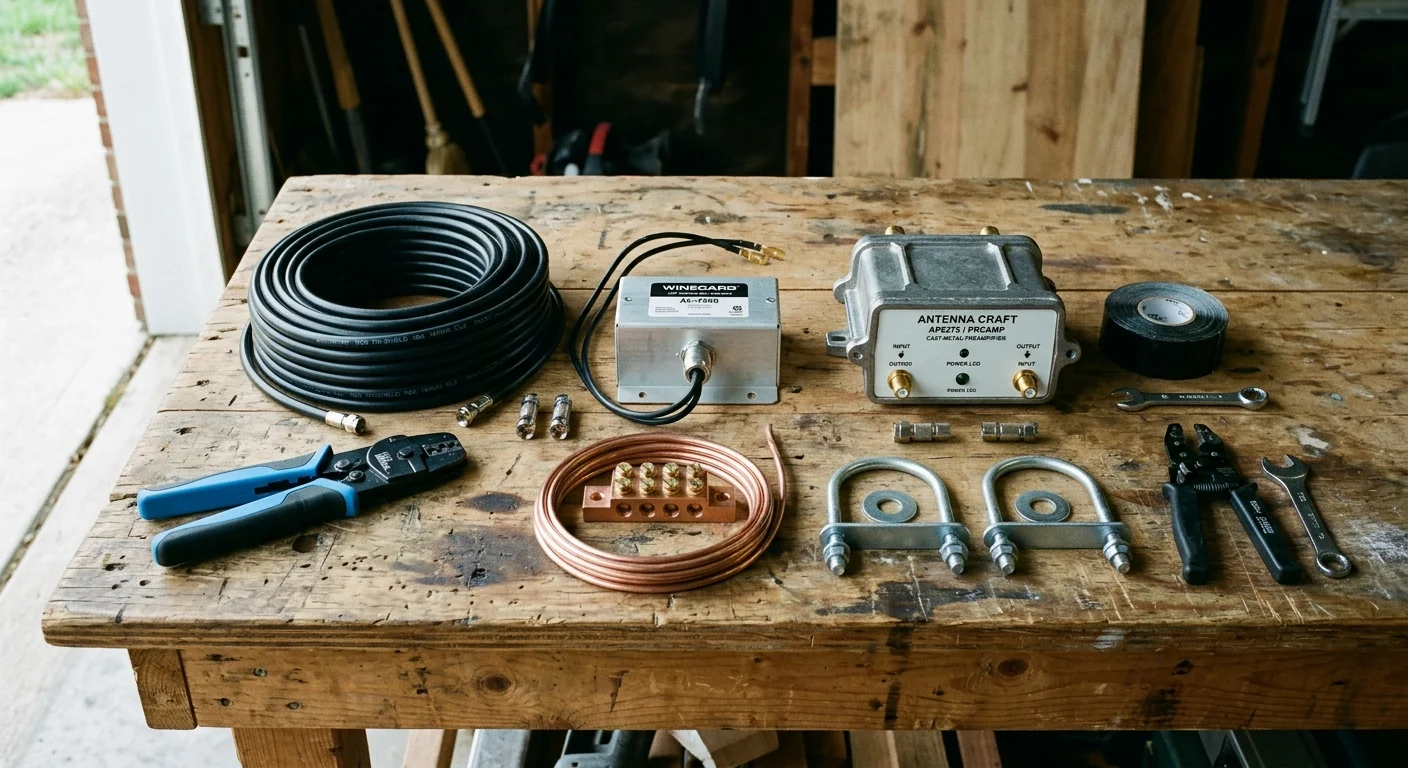
Complete Equipment Checklist and Deep-Fringe Hardware Selection
Succeeding at 65 miles requires commercial-grade components matched to fringe frequency losses. Using bargain hardware store antennas or thin patch cords will lead to immediate reception failure.
Your antenna requires high passive forward gain and high front-to-back rejection ratios to eliminate multipath ghosting. The Televes DAT BOSS LR UHF ($180) and the Winegard HD8200U ($190) represent the gold standards for extreme distance reception.
The choice of coaxial downlead cable directly impacts your link budget over long runs. RG6 dual-shield loses roughly 4.8 dB per 100 feet at 550 MHz, while heavy-duty RG11 cable loses only 3.0 dB per 100 feet.
Upgrading to RG11 over a 120-foot mast run recovers nearly 2.2 dB of precious signal margin before indoor distribution. For deep-fringe homeowners, that 2.2 dB difference often determines whether distant channels broadcast reliably in wet weather.
| Equipment Setup Tier | Component Configuration | Estimated Cost | Net Gain (550 MHz) | ATSC 3.0 Lock at 65 Miles |
|---|---|---|---|---|
| Standard DIY Fringe | ClearStream 4MAX, Internal Amp, 100ft RG6, 2-Way Passive Splitter | $165 | +8.5 dBd | Unstable / Weather Dependent |
| Optimized Deep-Fringe | Winegard HD8200U, CM-7777HD Preamp, 120ft RG6, 4-Way Passive Splitter | $315 | +18.2 dBd | Stable / Full Network Lock |
| Commercial-Grade Rural | Televes DAT BOSS LR, Integrated T-Force Amp, 150ft RG11, Active Distro Amp | $460 | +24.5 dBd | Exceptional / 99.5% Uptime |
Always inspect the physical weatherproofing of your masthead electronics. Moisture seeping into F-connectors increases impedance mismatch and introduces micro-arcing that wipes out tuner sensitivity.
Use compression-molded outdoor brass connectors instead of crimp-on rings. Coat every outdoor threaded connection in dielectric silicone compound and seal them beneath UV-rated compression boots.
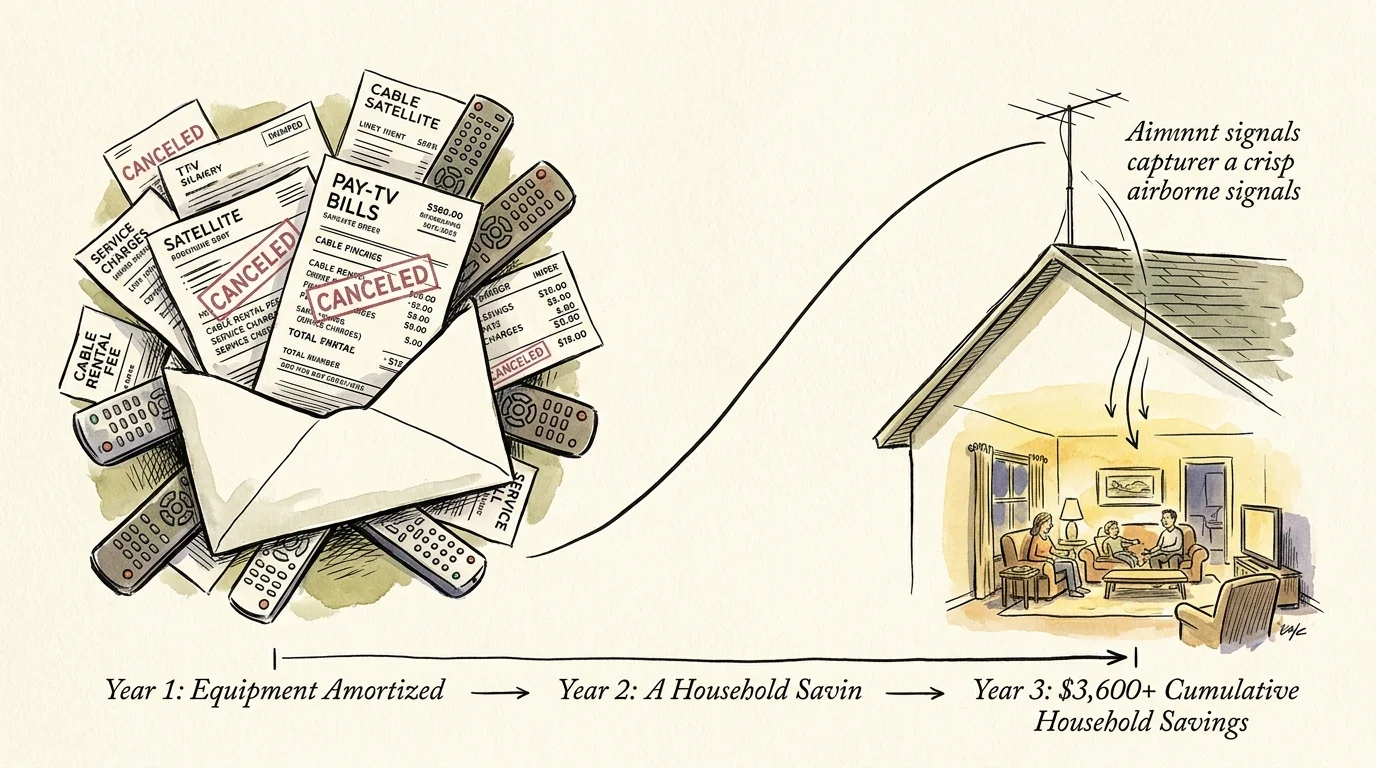
Financial Payoff: Replacing Cable and Satellite with Deep-Fringe OTA
Rural homeowners frequently keep costly satellite or rural broadband TV packages because they believe local broadcasts are out of reach. Understanding the basics of cord-cutting helps you dismantle expensive recurring entertainment bills permanently.
In industry terms, cord-cutting means canceling traditional cable or satellite TV packages in favor of internet delivery and antenna broadcasts. Streaming refers to watching video content delivered dynamically over an active internet connection rather than through proprietary set-top cables.
A smart TV includes a built-in operating system and network connectivity to stream apps directly. If your television lacks modern software, an external streaming device like a Roku Ultra or Apple TV 4K plugs into your HDMI port to provide access.
Traditional rural television packages carry exorbitant monthly recurring costs. Satellite TV subscriptions frequently average $125 to $165 per month once introductory promotional discounts expire.
Hidden hardware rentals worsen these monthly charges. Rural providers routinely assess $15 monthly broadcast relay fees, $14 regional sports surcharges, and $10 monthly rental fees for every set-top box in your home.
Over a full year, a typical rural household spends between $1,800 and $2,400 just to maintain basic network and entertainment television access. As detailed by Cord Cutters News, eliminating mandatory broadcast and box rental fees constitutes the fastest path to slashing household media expenditures.
Investing $350 to $480 in a permanent deep-fringe antenna installation completely eliminates recurring costs for major networks. You receive crystal-clear broadcasts from CBS, NBC, ABC, FOX, The CW, and PBS completely free of charge forever.
Viewers who still want national entertainment channels can supplement their antenna with targeted streaming alternatives. Platforms offer ad-supported plans showing commercials at discounted monthly rates, or premium ad-free plans that remove interruptions entirely.
You can also access on-demand libraries that allow you to watch movies and series whenever you want rather than following a strict broadcast schedule. To capture live sports or prime-time programming on your own timeline, connect your antenna to an over-the-air digital video recorder (DVR).
Network DVR units like the Tablo 4th Gen or HDHomeRun Flex 4K capture broadcast signals from your mast and transmit them across your home Wi-Fi network. This allows you to record live broadcasts and stream free network television to every screen in your house without monthly box fees.
A rural household pairing free antenna television with high-speed home internet and two premium on-demand services typically spends $85 to $105 per month. That represents an immediate net savings of more than $1,100 every single year.
Step-by-Step Transition Checklist: From Cable Cancellation to First Broadcast Scan
Transitioning from a legacy cable or satellite provider to a high-performance deep-fringe setup requires an orderly implementation plan. Following this step-by-step process ensures you never lose access to your favorite programming during the changeover.
- Verify broadcast transmitter bearings: Visit official transmission mapping portals to identify the exact compass azimuth for towers located 60 to 70 miles away.
- Mount the antenna mast: Secure heavy-duty mounting brackets to your roof fascia or gable wall, ensuring the mast plumb line sits perfectly vertical.
- Attach the high-gain antenna: Assemble the directional elements and point the boom directly toward the metropolitan tower coordinates using a sighting compass.
- Install the masthead preamplifier: Mount the amplifier housing to the pole within 3 feet of the antenna balun, securing clean RG6 or RG11 coaxial jumpers.
- Ground the system: Run 10 AWG solid copper wire from the mast frame and coaxial grounding block directly to your house utility grounding rod.
- Power the preamplifier: Plug the internal DC power injector into your indoor coaxial drop before routing the signal into splitters or digital tuners.
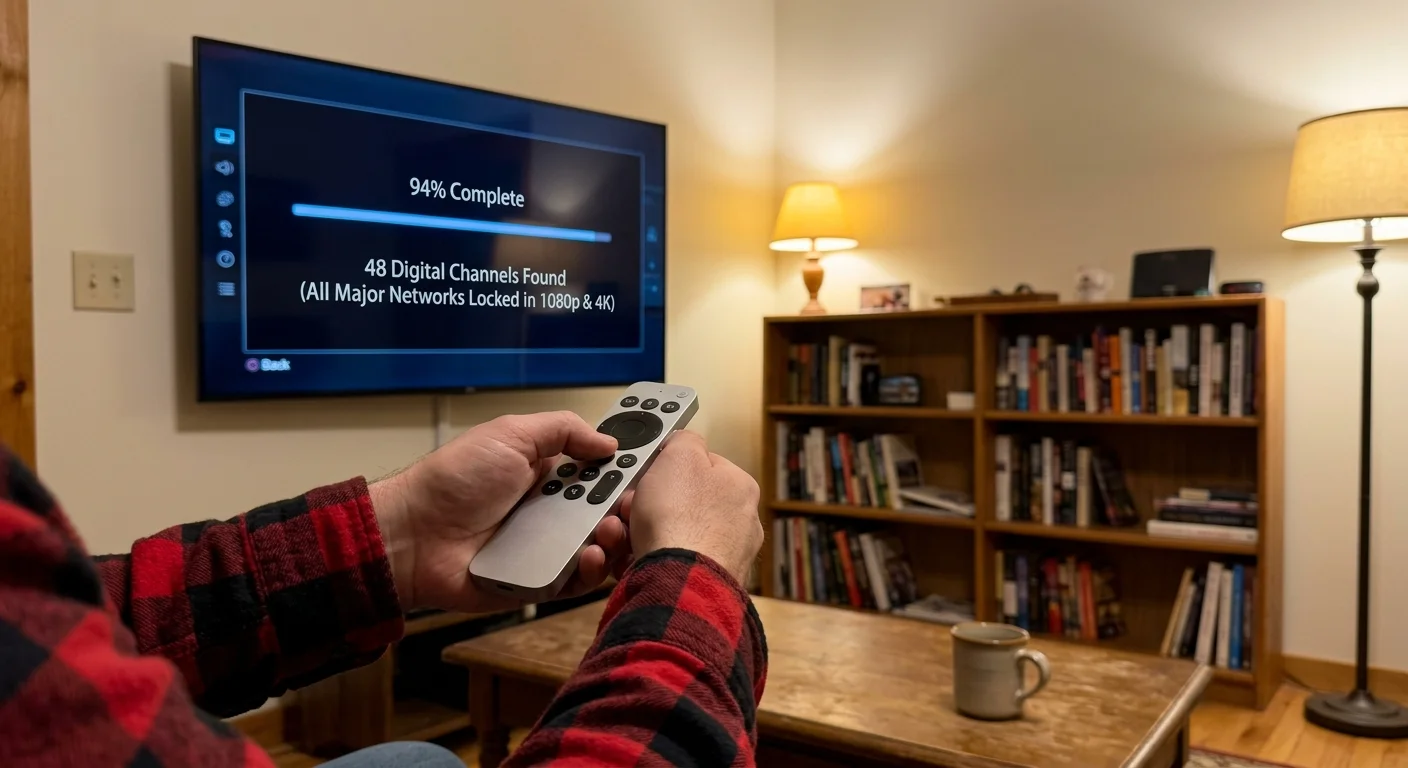
- Execute a channel scan: Access your television or streaming box setup menu, set the tuner source to “Antenna” or “Air,” and run a full channel search.
- Test internet bandwidth: Ensure your rural internet connection delivers at least 25 Mbps download speeds to support 4K streaming streams alongside broadcast viewing.
Once your antenna system scans and locks every major metropolitan network, you are ready to terminate your pay-TV contract safely. Timing your cancellation call properly prevents unexpected carrier penalties.
Contact your cable or satellite provider three days before your monthly billing cycle closes. Most television providers no longer prorate final monthly bills, meaning canceling one day late forces you to pay for an entire unused billing period.
Review your original service agreement to check for active early termination fees. If your fixed-term contract has expired, providers cannot legally penalize you for canceling service.
Ask the customer service representative for a prepaid shipping label and an itemized equipment return checklist. Return all leased set-top converters, external power bricks, and factory remote controls promptly through an official shipping depot.
Always demand a tracked drop-off receipt showing serial numbers for every piece of returned equipment. Pay-TV providers frequently charge automated replacement penalties of $150 to $300 if a warehouse fails to log your returned hardware correctly.
As independent testing from Consumer Reports emphasizes, maintaining physical proof of equipment returns remains the most effective protection against disputed post-cancellation charges.
Frequently Asked Questions
Can I install a 50-foot antenna tower in my backyard without HOA approval?
No. Under FCC OTARD regulations, the federal preemption of HOA and zoning restrictions applies only to masts extending 12 feet or less above your roofline. Freestanding ground towers or masts exceeding 12 feet above your roof require compliance with local zoning permits, setbacks, and structural engineering reviews.
Do I need separate antennas for VHF and UHF channels 65 miles away?
Most metropolitan broadcast clusters locate major networks across both UHF (channels 14–36) and High-VHF (channels 7–13) frequencies. For deep-fringe distances, select an all-channel combination antenna like the Winegard HD8200U or pair a dedicated UHF array with a separate High-VHF antenna using a low-loss signal joiner.
Will bad weather knock out my deep-fringe television signal?
Heavy rain and snow introduce atmospheric moisture attenuation, but proper system engineering mitigates reception drops. Calculating your link budget with at least 10 dB of fade margin above tuner thresholds ensures your digital picture remains stable during standard Midwestern and coastal storms.
Can I split my antenna signal to four televisions without losing signal quality?
Yes, provided you size your amplification properly. A masthead preamplifier overcomes cable attenuation, while an indoor active distribution amplifier or a balanced low-loss splitter maintains adequate signal strength across four indoor drops without degrading your signal-to-noise ratio.
Disclaimer: Cable and streaming prices vary by location and change frequently. The cost comparisons in this article are estimates based on typical pricing. Your actual savings will depend on your current cable package, internet costs, and which streaming services you choose.