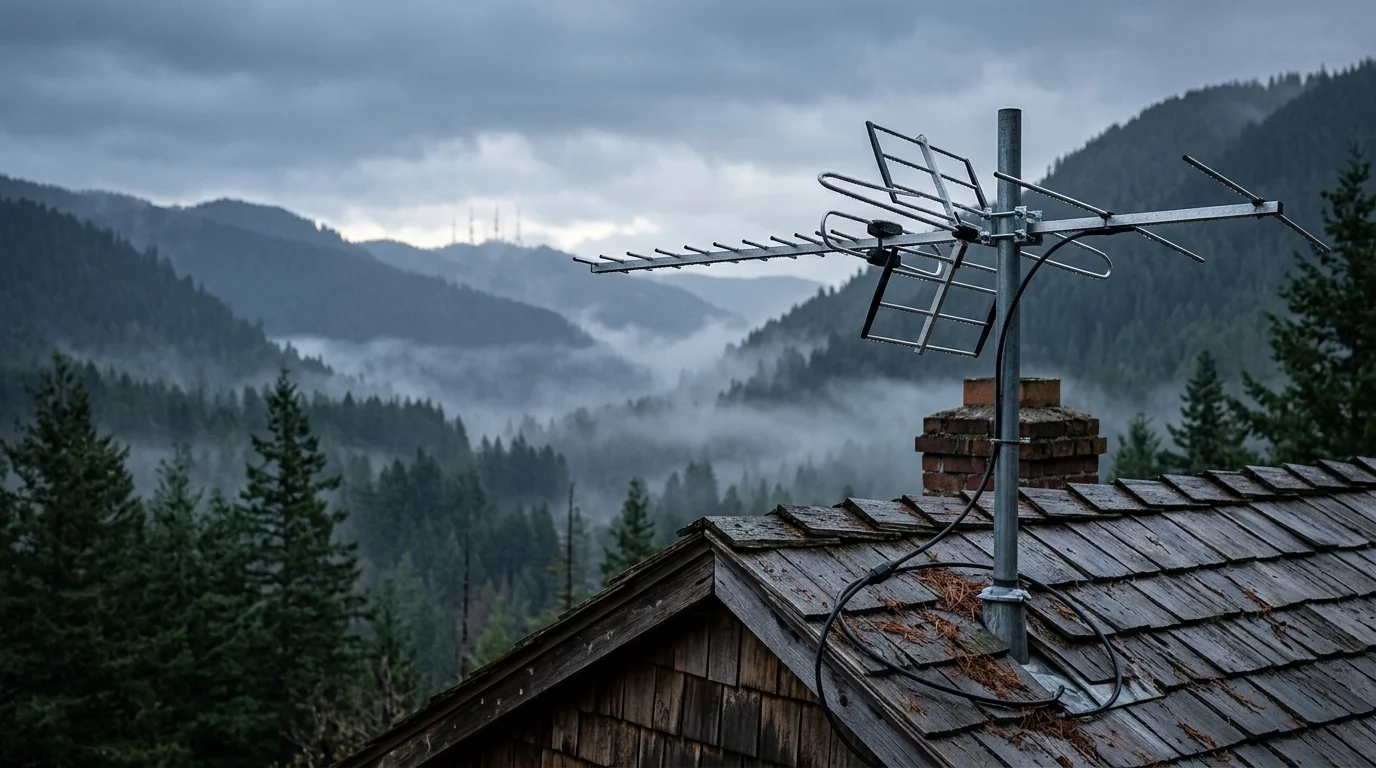
Living in a deep wooded valley 45 miles from broadcast towers makes cutting cable feel impossible when pine trees scatter your over-the-air signals. You do not need the highest-gain amplifier on the market to fix pixelation.
Blindly adding excessive decibels actually overloads your television tuner and amplifies background noise. The real solution requires matching amplifier gain specifically to downlead coaxial losses and tuner noise differentials while demanding a sub-2 dB preamplifier noise figure.
By calculating your exact link budget, you can eliminate choppy reception and permanently cancel costly pay-TV subscriptions.
The Physics of Fringe Signal Loss in Deep Valleys
Fringe television reception begins to fail when terrain and dense foliage obstruct the line of sight between the broadcast transmission tower and your rooftop. When broadcast signals strike ridge tops, they bend downward through a physical phenomenon known as knife-edge diffraction.
If elevating your mast above the tree canopy causes neighborhood friction, keep in mind that federal OTARD protections safeguard your right to install outdoor reception aerials.
This diffraction weakens the electromagnetic wavefront and creates uneven signal pockets across a valley floor. As a result, homes positioned at low elevations receive only a fraction of the original transmitter power.
Coniferous trees introduce additional severe signal attenuation. Pine needles measure between two and six inches in length; this physical dimension closely aligns with the wavelengths of Ultra High Frequency (UHF) television broadcasts.
Because the needles approximate a quarter-wavelength resonator at UHF frequencies, they absorb and scatter incoming RF energy. Wet foliage intensifies this problem because water dramatically alters the dielectric properties of tree bark and needles.
Dense deciduous and pine tree canopies attenuate UHF signals by 10 dB to 20 dB under normal conditions. Soaking rain adds another 3 dB to 5 dB of signal loss across the canopy.
Digital tuners operating under ATSC 1.0 standards drop signals completely when power falls below a strict threshold. Modern tuners require a minimum theoretical input level of -83 dBm to -85 dBm (about -34 dBmV into 75 ohms) to resolve picture data.
They also demand a minimum signal-to-noise ratio (SNR) of 15 dB. If wet pine needles push your received signal below that threshold, the screen instantly snaps to black.
Why High-Gain Preamplifiers Can Destroy Valley Reception
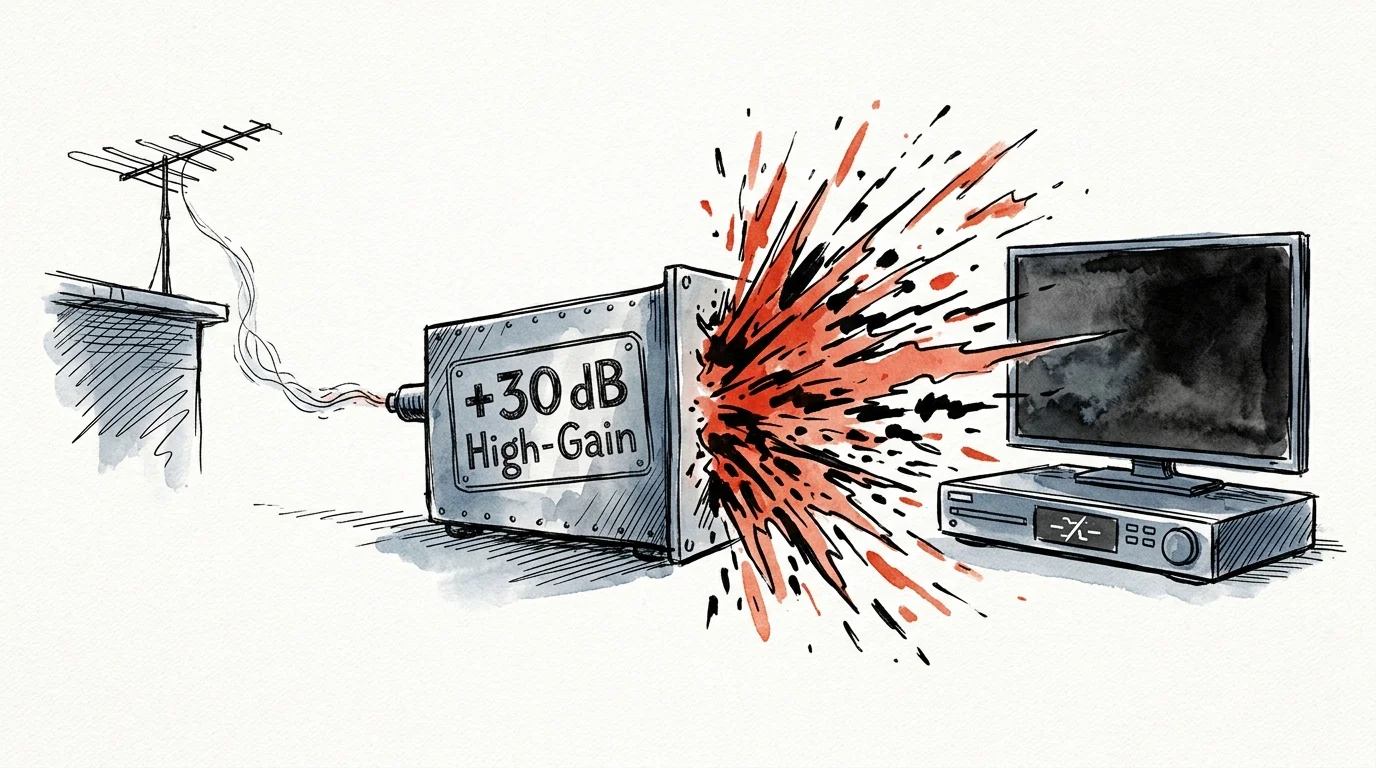
Many valley homeowners assume that a 30 dB preamplifier will rescue weak broadcast signals buried beneath dense trees. This assumption represents one of the most common mistakes in television engineering.
Managing front-end signal levels is a key requirement for viewers learning how to keep your local channels after cutting cable without suffering constant pixelation.
An antenna preamplifier cannot recreate an electromagnetic signal that the physical antenna failed to capture. Its sole purpose is to preserve the signal captured at the masthead and deliver it across coaxial downleads without degrading the signal-to-noise ratio.
Preamplifiers amplify everything entering the antenna terminals, including ambient background noise and out-of-band cellular transmissions. Cellular carriers transmit high-power mobile broadband data on spectrum directly adjacent to television channels.
According to the FCC Consumer Guide on broadcast spectrum rules, the federal repack relocated UHF broadcast channels to terminate at channel 36 (608 MHz). Frequencies above 608 MHz now handle 5G and LTE commercial mobile traffic.
If you install a wideband preamplifier lacking a sharp 608 MHz low-pass filter, nearby cellular towers will flood the amplifier circuit. This flood drives the unit into non-linear operation and causes severe intermodulation distortion.
Intermodulation generates phantom interference frequencies across your desired VHF and UHF bands. Your tuner then experiences front-end desensitization, commonly referred to as tuner overload.
Excessive gain also causes dynamic range clipping inside your television receiver. If one local valley station delivers a moderately strong signal while another is deeply buried, high gain forces the strong station to clip the tuner.
Clipping destroys the digital modulation constellation and causes the tuner to lose lock on all channels simultaneously. You must balance the gain precisely rather than maximizing it.
“A preamplifier cannot pull a missing signal out of the woods; it simply prevents the signal your antenna collected from dying in the coax.”
The Exact Preamplifier Decibel Gain Math
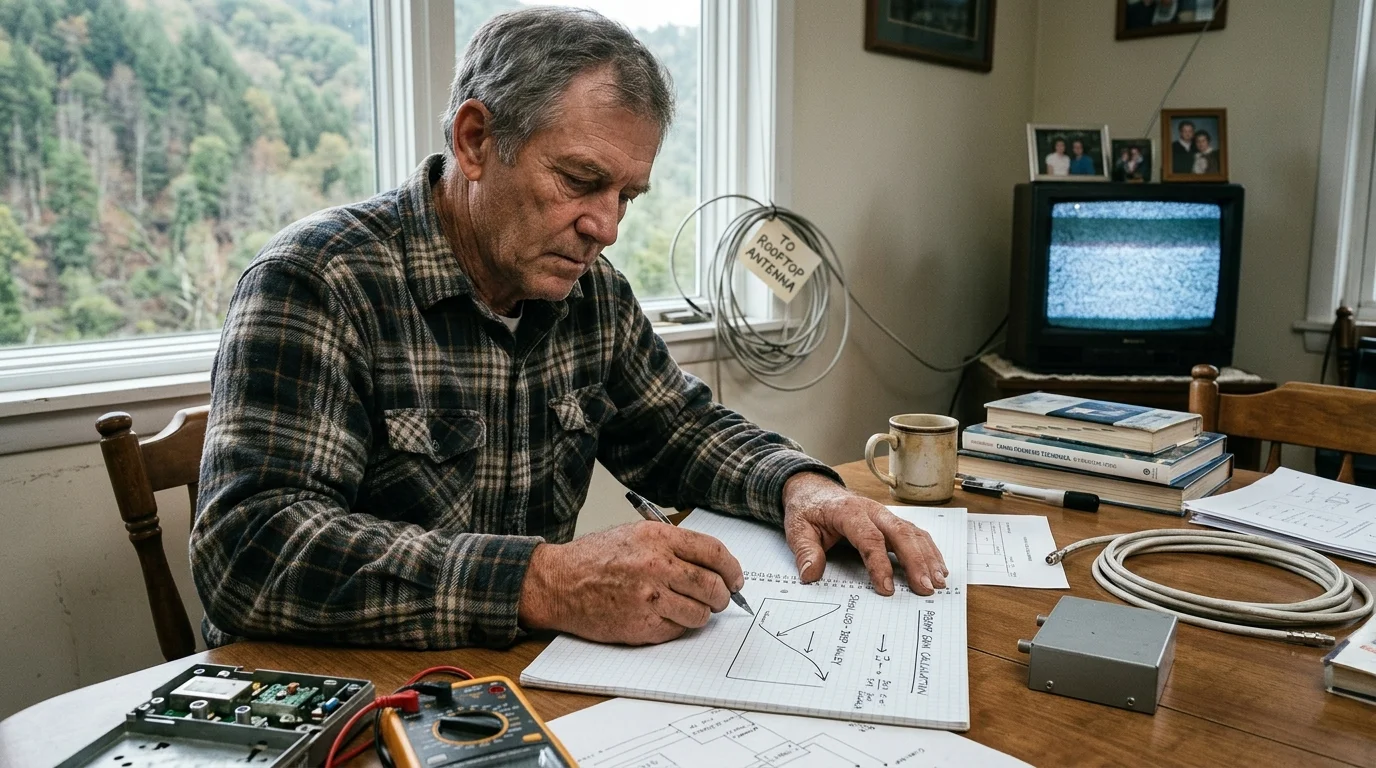
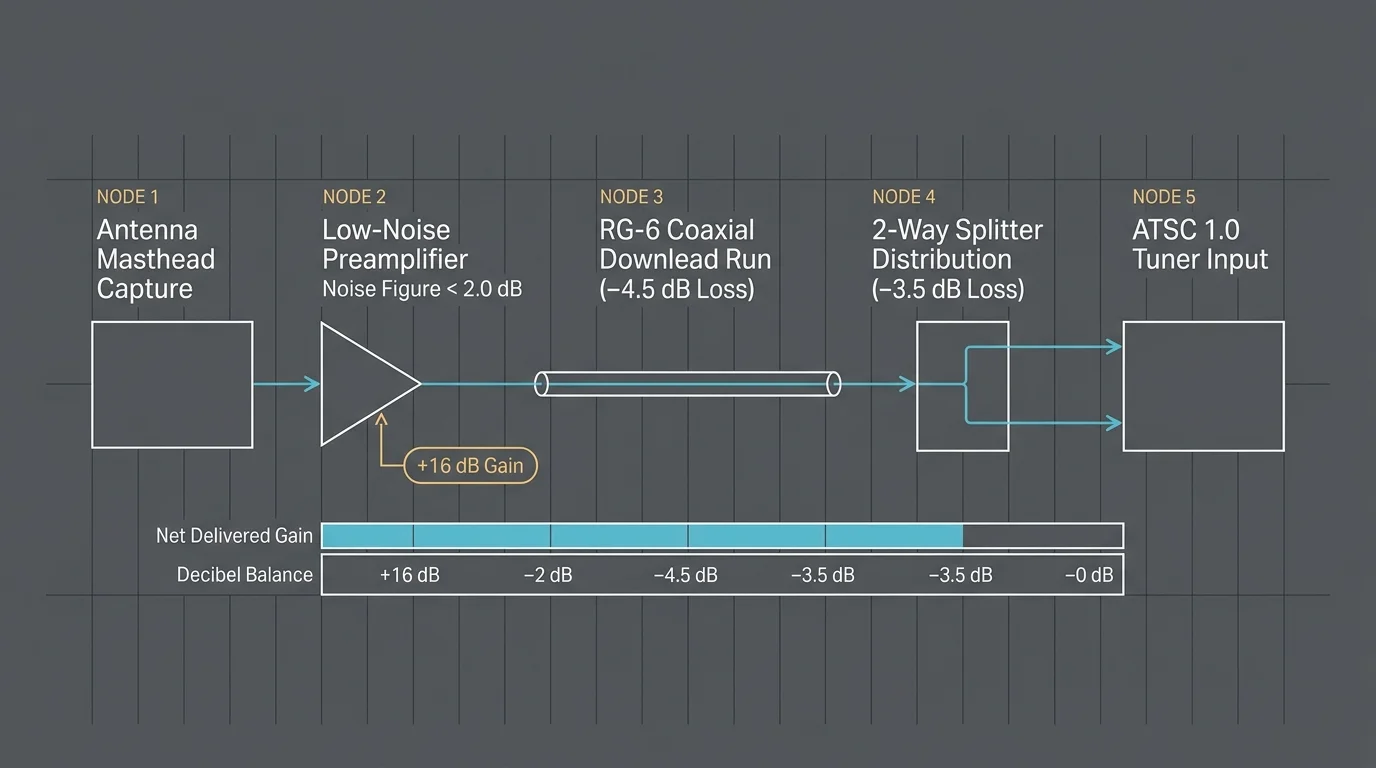
Determining the correct preamplifier gain requires calculating a baseline transmission link budget. This mathematical process accounts for every decibel lost between the antenna output terminals and your television tuner.
Before budgeting amplifier decibels, audit your splitters and coaxial lines against an essential cord-cutting equipment checklist to avoid unneeded passive attenuation.
If you are repurposing an old satellite dish mast and coaxial wiring, inspect legacy splitters and grounding blocks for hidden attenuation before finalizing your calculations.
The engineering formula for minimum required preamplifier gain is expressed as:
Required Gain = Cable Loss + Splitter Loss + Connector Loss + Tuner Noise Factor Differential + Fade Margin
Cable loss depends directly on coaxial construction and broadcast frequency. At mid-UHF frequencies (550 MHz), standard RG-6 coaxial cable loses roughly 4.8 dB of signal strength per 100 feet.
Heavier RG-11 coaxial cable reduces mid-UHF attenuation to approximately 3.0 dB per 100 feet. Very High Frequency (VHF-Hi) signals (174 to 216 MHz) experience less downlead loss, dropping roughly 3.0 dB per 100 feet of RG-6.
Passive RF splitters introduce substantial, unalterable insertion loss into your distribution network. A standard two-way splitter loses 3.5 dB, a four-way splitter loses roughly 7.5 dB, and an eight-way splitter introduces roughly 11.5 dB of insertion loss.
Inline F-type barrel connectors and grounding blocks add roughly 0.5 dB of loss per junction. Over a long run with multiple wall plates and splitters, passive component losses accumulate rapidly.
The tuner noise factor differential represents the difference between your television tuner noise figure and your preamplifier noise figure. A typical smart TV—a television with a built-in internet connection and streaming apps—contains an integrated tuner with an average noise figure of 7 dB.
A high-quality mast-mounted preamplifier features an ultra-low noise figure between 1.5 dB and 2.0 dB. The difference between these figures (approximately 5.0 dB to 5.5 dB) defines the sensitivity improvement the preamplifier provides.
Finally, your link budget requires a practical fade margin of 4 dB to 6 dB. This margin prevents signal drops caused by wind gusts swaying wet tree limbs across your antenna line of sight.
Worked Engineering Example: 45 Miles Through Pine Foliage
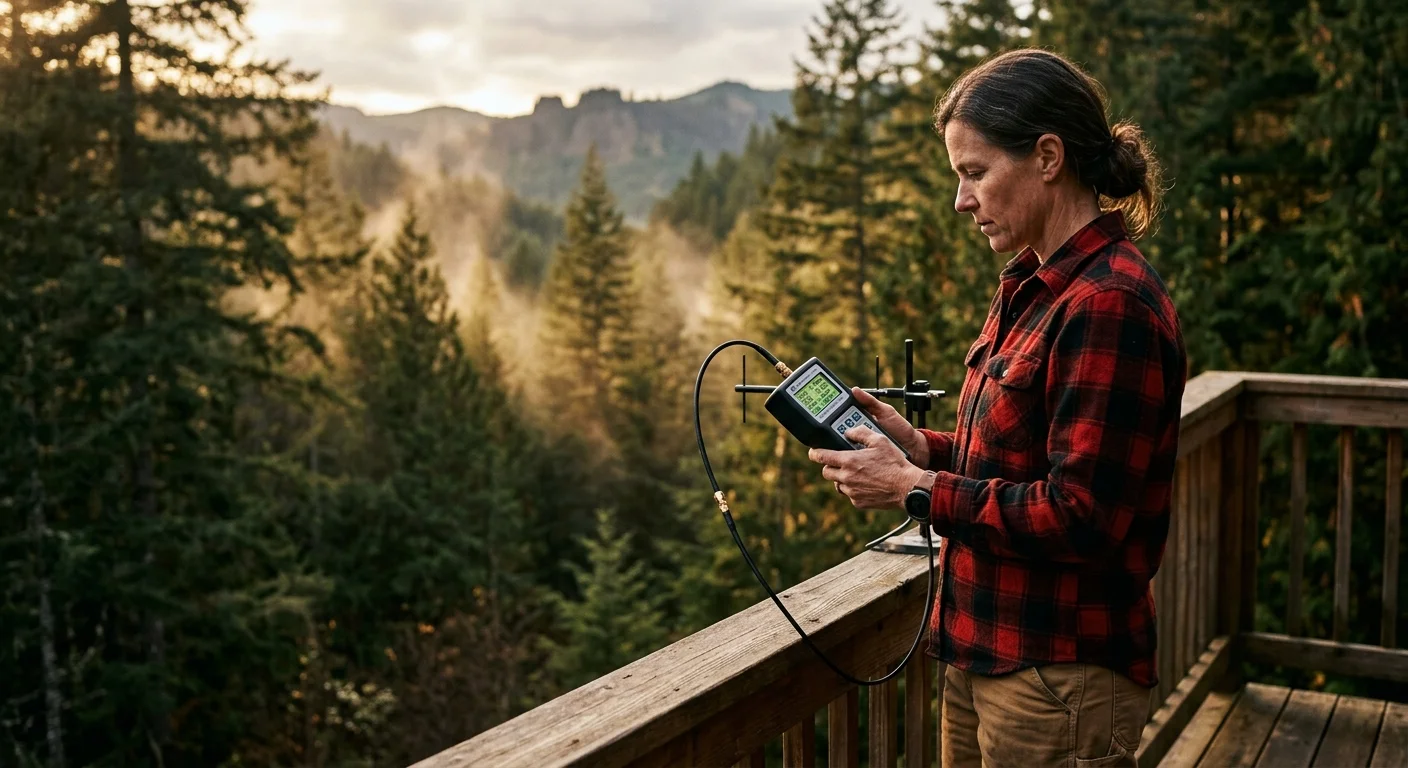
Consider a practical scenario involving a rural homeowner located 45 miles from regional broadcast towers in a deep pine valley. The broadcast mix features UHF stations (channels 14–36) and VHF-Hi stations (channels 7–13).
Once your whole-home RF distribution is stable, consider building a DIY local channels DVR to stream and record live network broadcasts across all your household devices.
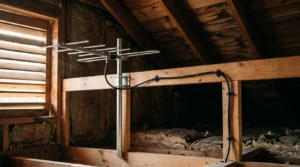
The homeowner installs an 8-bay bowtie UHF antenna paired with a high-gain VHF-Hi yagi masthead assembly. The installation uses 100 feet of RG-6 coaxial cable running from the roof to an indoor distribution panel.
At the distribution point, a 4-way passive splitter feeds three bedrooms and the primary living room. The coaxial line uses four F-type barrel connectors across grounding blocks and wall plates.
Let us calculate the exact distribution downlead loss for the UHF band:
- 100 feet of RG-6 cable at 550 MHz: 4.8 dB loss
- 4-way passive RF splitter: 7.5 dB loss
- Four inline barrel connectors (0.5 dB each): 2.0 dB loss
- Total passive hardware attenuation: 14.3 dB loss
Next, we determine the noise differential between the system components. The television tuner inside the home has a measured noise figure of 7.0 dB.
The homeowner selects a premium masthead preamplifier with an ultra-low noise figure of 1.5 dB. Subtracting 1.5 dB from 7.0 dB establishes a noise figure improvement requirement of 5.5 dB.
To secure uninterrupted reception during heavy storms, we assign a 4.0 dB fade margin for foliage movement. Now, we sum these values to establish the minimum necessary preamplifier gain:
Minimum UHF Gain = 14.3 dB + 5.5 dB + 4.0 dB = 23.8 dB
Now let us calculate the corresponding requirement for the VHF-Hi spectrum over the same run:
- 100 feet of RG-6 cable at 200 MHz: 3.0 dB loss
- 4-way passive RF splitter: 7.5 dB loss
- Four inline barrel connectors: 2.0 dB loss
- Total passive VHF attenuation: 12.5 dB loss
- Noise differential plus fade margin: 9.5 dB
- Minimum VHF-Hi Gain = 12.5 dB + 9.5 dB = 22.0 dB
This math reveals that a preamplifier providing 22 dB to 24 dB of clean gain will perfectly overcome downlead and tree losses. Installing an unshielded 32 dB amplifier would deliver roughly 8 dB of superfluous power, increasing the likelihood of tuner clipping.
A model delivering only 15 dB of gain would leave the signal below the tuner sensitivity floor. Precision sizing delivers reliable signals without distortion.
Fringe Preamplifier Comparison and Technical Benchmarks
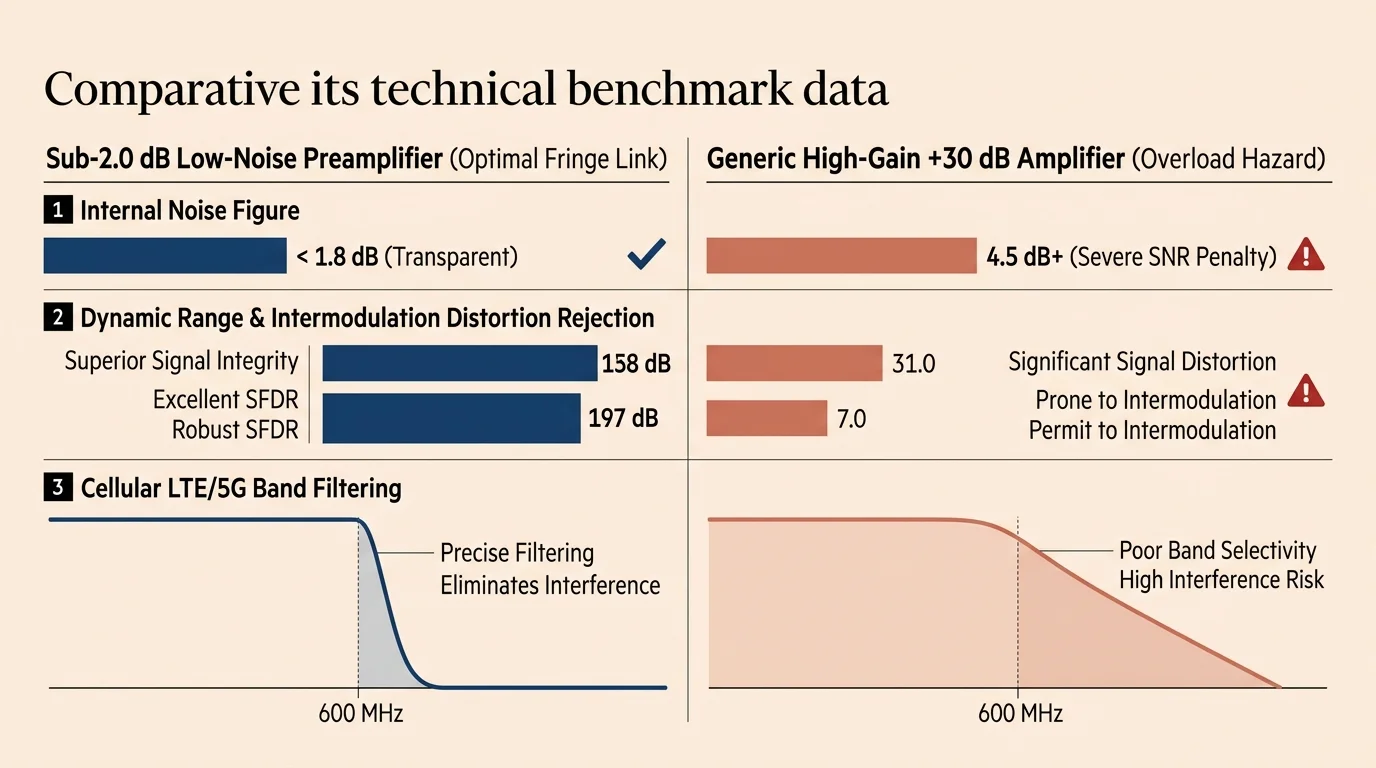
Selecting the right preamplifier requires balancing decibel gain, input noise figure, and cellular bandpass filtering. Low noise figures remain far more important than raw gain when pulling fringe signals out of tree canopy diffraction.
If an amplifier introduces 4 dB of internal circuit noise, it permanently destroys weak digital packets before downlead amplification occurs. The unit must also filter cellular frequencies above 608 MHz.
The following table compares leading fringe-capable preamplifiers based on engineering specifications relevant to wooded valley environments:
| Preamplifier Model | VHF-Hi / UHF Gain (dB) | Noise Figure (dB) | 5G/LTE Filter (Cutoff) | Approximate Retail Price |
|---|---|---|---|---|
| Televes SmartKom (Ref 531981) | VHF: 18 / UHF: 25 (Auto-AGC) | 1.5 dB UHF / 2.0 dB VHF | Yes (Active 608 MHz low-pass) | $115 |
| Channel Master Amplify+ (CM-7777HD) | Switchable 16 dB or 26 dB | 1.5 dB UHF / 2.0 dB VHF | Yes (Internal 608 MHz trap) | $99 |
| Winegard Boost XT (LNA-200) | 18 dB Fixed Gain | 1.0 dB Typical | Yes (Passive 600 MHz bandpass) | $65 |
| Antennas Direct ClearStream Juice | 19 dB Fixed Gain | 1.8 dB Typical | Yes (Low-pass cellular shield) | $80 |
The Televes SmartKom provides automated gain control (AGC) that adjusts channel levels individually. This feature prevents nearby valley repeaters from overloading your tuner while boosting distant fringe transmitters.
The Channel Master Amplify+ provides an adjustable gain toggle switch. Setting the switch to the 26 dB position matches our 45-mile pine valley worked example almost perfectly.
Equipment Checklist and Realistic Cord-Cutting Costs
Cord-cutting means canceling traditional cable or satellite TV in favor of internet streaming and free over-the-air broadcasts. Moving to an over-the-air antenna setup requires an upfront investment in durable hardware.
However, eliminating recurring equipment rental fees and broadcast retransmission surcharges quickly offsets that equipment cost. A comprehensive fringe-reception setup includes several core components:
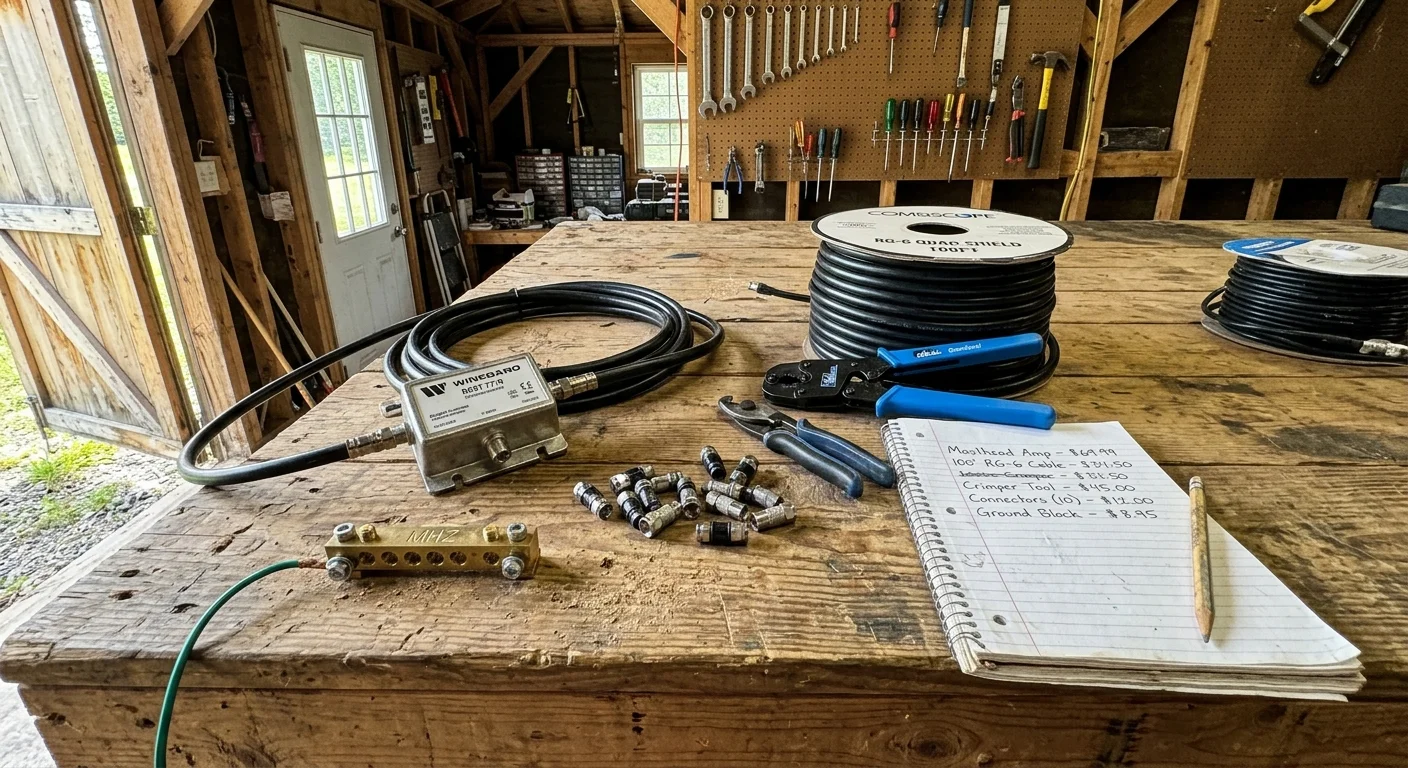
- Directional VHF-Hi/UHF Antenna (such as the Televes DAT BOSS LR or Winegard HD7698P): $150–$220
- Ultra-low-noise preamplifier with 608 MHz filter: $65–$115
- 100-foot spool of solid copper RG-6 or RG-11 coaxial cable: $35–$65
- Heavy-duty mast, roof mount, and grounding hardware: $40–$75
- Over-the-air digital video recorder (DVR): $150–$250
- Dedicated streaming device: $30–$50
A DVR (digital video recorder) lets you pause, rewind, and record free over-the-air television broadcasts without paying monthly fees. A streaming device—such as a Roku or Fire TV—connects to your television to run internet streaming services.
Streaming services allow you to watch video content over your home broadband connection instead of a coaxial cable line. Content options range from ad-supported tiers to ad-free subscriptions.
Ad-supported plans offer lower monthly prices in exchange for commercial interruptions. Ad-free plans cost more each month but eliminate all advertising breaks.
On-demand entertainment platforms let you watch whatever movies or series you want, whenever you want. According to research from Cord Cutters News, the average cable customer pays more than $140 per month for pay-TV bundles loaded with hidden regional sports fees.
Replacing traditional cable with an antenna for local networks and two ad-supported streaming services (roughly $16 per month total) slashes your entertainment costs. The upfront hardware investment of roughly $470 pays for itself within four months of service termination.
How to Cancel Cable and Avoid Hidden Penalty Fees
Canceling traditional cable requires careful planning to prevent unnecessary penalty fees and unexpected billing extensions. Begin by reviewing your current billing statement to confirm whether you remain under a multi-year term agreement.
Early termination fees often cost between $10 and $20 for every month remaining on your service contract. If your contract ends within two months, paying the remaining regular service charges may cost less than paying contract penalties.
Call your provider and ask to be transferred directly to the customer retention department. Clearly state that you are moving to an area where they do not offer service or that you are eliminating pay-TV entirely.
Retention representatives will attempt to offer promotional bundles featuring lower monthly fees. Decline these promotions firmly; promotional discounts expire quickly and lock you into future rate hikes.
Request an immediate downgrade to an internet-only plan. Most modern streaming setups require a broadband download speed of at least 25 to 50 Mbps per simultaneous stream.
Independent evaluation from Consumer Reports reveals that standard standalone internet plans priced between $50 and $70 per month offer plenty of bandwidth for multiple concurrent streams. You do not need to purchase expensive gigabit broadband plans to support streaming video.
Document every cancellation interaction by writing down the representative name, badge identification, and cancellation confirmation code. Schedule your disconnection date at the end of your current billing cycle to avoid paying for unused days without receiving a prorated refund.
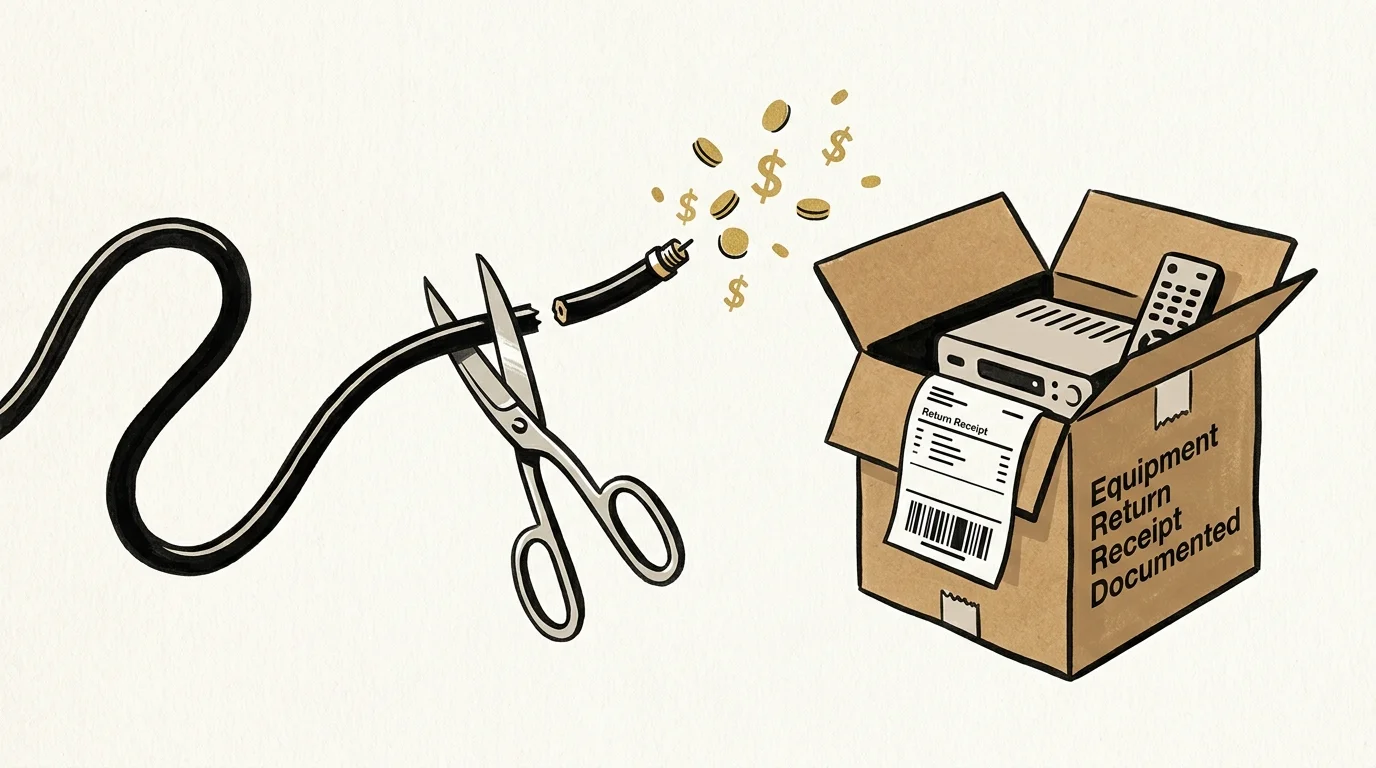
Return all rented cable set-top boxes, remotes, and modems directly to a company retail center rather than using mail dropboxes. Demand an itemized equipment receipt containing serial numbers for every returned unit, and store that receipt safely for at least two years.
Frequently Asked Questions
Can a preamplifier compensate for trees blocking my antenna?
No, a preamplifier cannot replace raw signal lost to tree trunks and wet needles before the wavefront reaches your mast. It only prevents the signal your antenna collected from degrading across downleads and splitters.
Do I need an ATSC 3.0 tuner to receive signals in wooded valleys?
No, current broadcast requirements ensure that standard ATSC 1.0 signals will remain available for reception. The FCC mandates that television stations simulcast ATSC 1.0 programming alongside ATSC 3.0 broadcasts through at least July 17, 2027.
What is the difference between a preamplifier and a distribution amplifier?
A preamplifier mounts directly at the antenna mast to boost weak signals before downlead noise enters the line. A distribution amplifier installs indoors immediately before splitters to distribute an already clean signal across multiple television sets.
Will wet pine trees cause pixelation even with a preamplifier installed?
Wet pine needles absorb radio frequency energy and can drop signal power by an extra 3 dB to 5 dB during rainstorms. Sizing your preamplifier system with a 4 dB to 6 dB fade margin prevents that rain loss from triggering pixelation.
Disclaimer: Cable and streaming prices vary by location and change frequently. The cost comparisons in this article are estimates based on typical pricing. Your actual savings will depend on your current cable package, internet costs, and which streaming services you choose.