Wireless carriers advertise “free” streaming bundles, but hidden downgrades quietly strip away your 4K resolution and force commercials onto your screen. You might think you are saving money while your viewing experience gets degraded behind the scenes.
Our audit reveals the mobile industry’s double-throttling trap: even when paying for high-tier wireless data, carrier-issued streaming licenses actively block Ultra HD and ad-free playback.
By examining the fine print from T-Mobile and Verizon, this guide shows you how carrier perks actually cost more than buying standalone subscriptions.
The Illusion of Free: How Carrier Streaming Bundles Quietly Shifted
Major wireless providers spent years using entertainment perks to lure subscribers into expensive unlimited plans. They subsidized streaming—watching video content over the internet instead of cable or satellite—to reduce customer turnover.
This strategy accelerated cord-cutting, which is canceling traditional cable or satellite TV in favor of streaming services. Consumers happily traded bloated pay-TV packages for unlimited cellular lines bundled with premium entertainment.
That generous promotional era has ended. Wireless carriers now face slowing subscriber growth and higher debt loads, while media companies demand higher licensing fees for their video catalogs.
Instead of absorbing these recurring expenses, carriers quietly restructured their contracts. They shifted subscribers away from premium commercial-free tiers and forced them into entry-level tiers subsidized by advertising revenue.
You may believe your wireless plan protects your entertainment budget. In reality, telecom carriers have transformed from generous entertainment sponsors into aggressive distribution channels for ad networks.
T-Mobile On Us Audit: Forced Commercials and the Netflix Ad Tier Shift
T-Mobile built much of its “Un-carrier” brand equity on its popular “Netflix On Us” campaign. For years, premium plan subscribers enjoyed commercial-free video on standard or basic plans without paying anything extra.
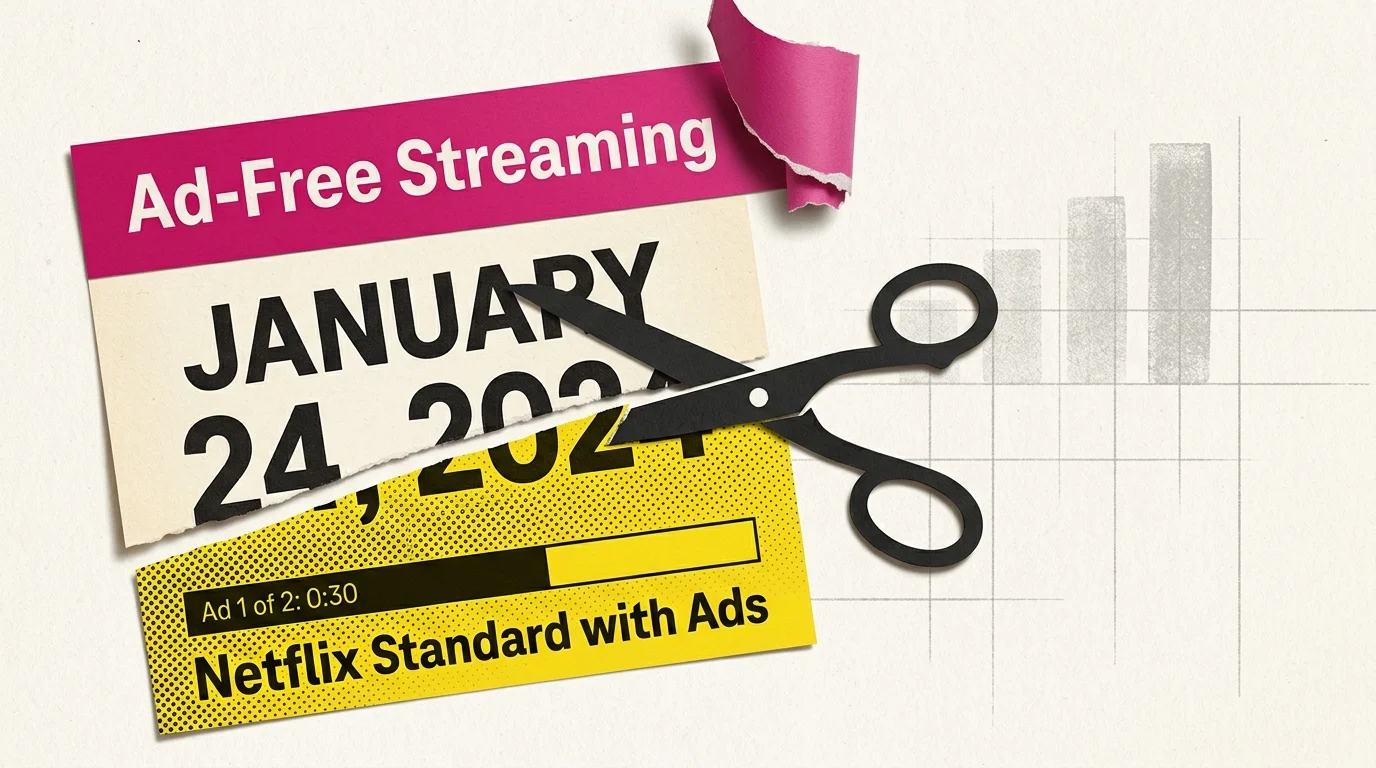
That customer-friendly policy changed abruptly on January 24, 2024. T-Mobile officially downgraded its legacy “Netflix On Us” promotion from ad-free plans down to Netflix Standard with Ads.
We define ad-supported as cheaper plans that show commercials, while ad-free describes higher-priced tiers that run uninterrupted video. T-Mobile’s transition forced millions of loyal subscribers straight into an ad-supported model overnight.
According to reporting from The Verge, customers who refused to watch commercials faced mandatory out-of-pocket surcharges on their monthly wireless statements.
If you want to restore ad-free Standard streaming on T-Mobile, you must pay an $11 monthly surcharge. If you want 4K Ultra HD resolution on Netflix Premium, T-Mobile bills you an extra $18 every single month.
T-Mobile applied this same restrictive strategy when launching Hulu “On Us” for Go5G Next subscribers. The carrier restricts the benefit exclusively to Hulu (With Ads), a tier carrying a retail value of $7.99 per month.
The carrier completely blocks customers from applying this $7.99 credit toward Hulu’s ad-free tier. If you attempt to upgrade your Hulu plan directly on Hulu’s website, you forfeit your T-Mobile promotional billing entirely.

Verizon myPlan Perks: Unbundling Entertainment for Ten Dollars a Month
Verizon adopted an even more aggressive monetization strategy with its “myPlan” cellular lineup launched in May 2023. The carrier dismantled its legacy 5G Play More and 5G Get More plans, which originally bundled streaming services directly.
As providers unbundle cellular freebies, exploring new streaming service bundles directly through media platforms often yields better long-term pricing.
Under current myPlan options—Unlimited Welcome, Unlimited Plus, and Unlimited Ultimate—Verizon offers zero included entertainment perks. Instead, the company markets third-party entertainment add-ons as $10 monthly perks.
Our audit of the verizon myplan streaming perks review reveals substantial functional limitations inside these $10 bundles. The headline $10 Netflix and Max bundle delivers only Netflix Standard with Ads and Max Basic with Ads.
Industry data reported by Variety demonstrates how entertainment providers rely on these discounted carrier wholesale agreements to inflate their total ad-tier subscriber counts.
Neither service inside Verizon’s discounted bundle provides 4K UHD playback or High Dynamic Range (HDR) profiles. Both platforms permanently lock your playback resolution to 1080p Full HD unless you pay separate platform upgrade fees.
The same restrictions govern Verizon’s $10 Disney Bundle perk. That add-on includes Disney+ (With Ads), Hulu (With Ads), and ESPN+ (With Ads), leaving you stuck with commercial interruptions across all three platforms.
“Carriers no longer discount streaming to reward loyalty; they package cheap ad-supported licenses to generate high-margin wholesale affiliate revenue.”
The Double Throttling Trap: Network Limits Versus Platform Resolution Caps
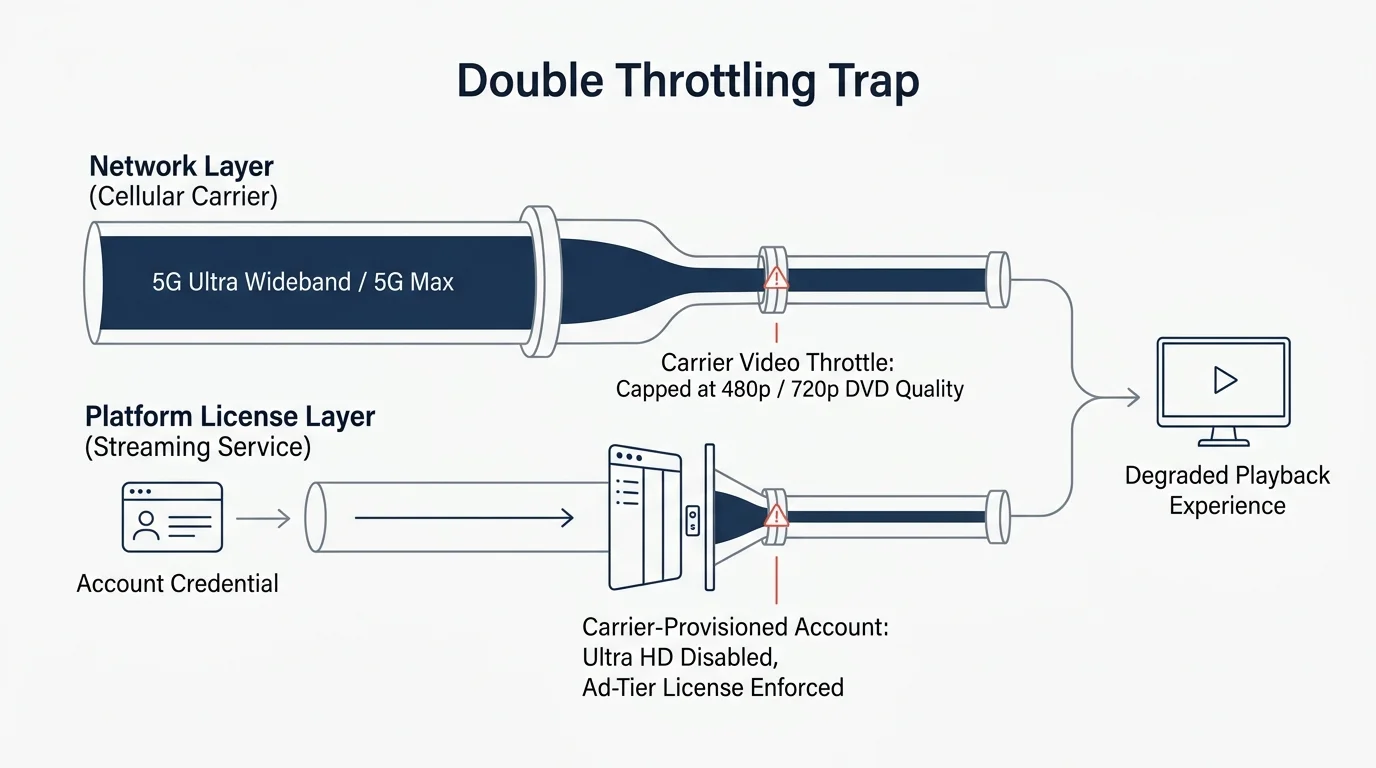
When you evaluate carrier streaming, you face a technical barrier we call double throttling. Your video quality suffers from two independent restrictions working against your equipment at the same time.
Managing your video resolution is equally critical on home internet, where staying under monthly data caps requires balancing bitrate limits across multiple screens.
The first restriction happens at the cellular network level. Wireless carriers restrict the data transmission speed assigned to video streams to conserve cellular tower bandwidth.
Verizon Unlimited Welcome strictly limits cellular video bandwidth to 480p Standard Definition. You cannot stream high-definition video over mobile data on that tier under any circumstances.
Verizon Unlimited Plus and Ultimate permit 720p HD streaming on standard 5G, and up to 4K on 5G Ultra Wideband. However, Verizon disables 4K transmission by default; you must manually toggle on “Maximum Video Streaming” in account settings.
T-Mobile implements identical restrictions on its base Go5G tiers by throttling cellular streaming to 480p DVD quality. Go5G Plus and Go5G Next support 4K, but only after you manually activate UHD video inside the T-Life application.
The second restriction happens at the streaming service platform level. Even if you enable 4K transmission on your phone plan, your carrier-provided subscription license prohibits 4K output.
Netflix Standard with Ads and Max Basic with Ads restrict encoding output to 1080p maximum. They also strip away premium Dolby Vision metadata and Dolby Atmos spatial audio formats.
This limitation impacts home entertainment equipment directly. Even when viewing on a smart TV—a television with a built-in internet connection and apps—the carrier-provided account remains capped at 1080p.
Connecting a dedicated streaming device—a small box or stick like a Roku or Fire TV—cannot bypass this rule. Your carrier-billed credentials dictate what the streaming server delivers, locking you into lower resolution and commercial interruptions.
Mobile Carrier Streaming Bundle Fine Print: Auto-Renewals and Hidden Fees
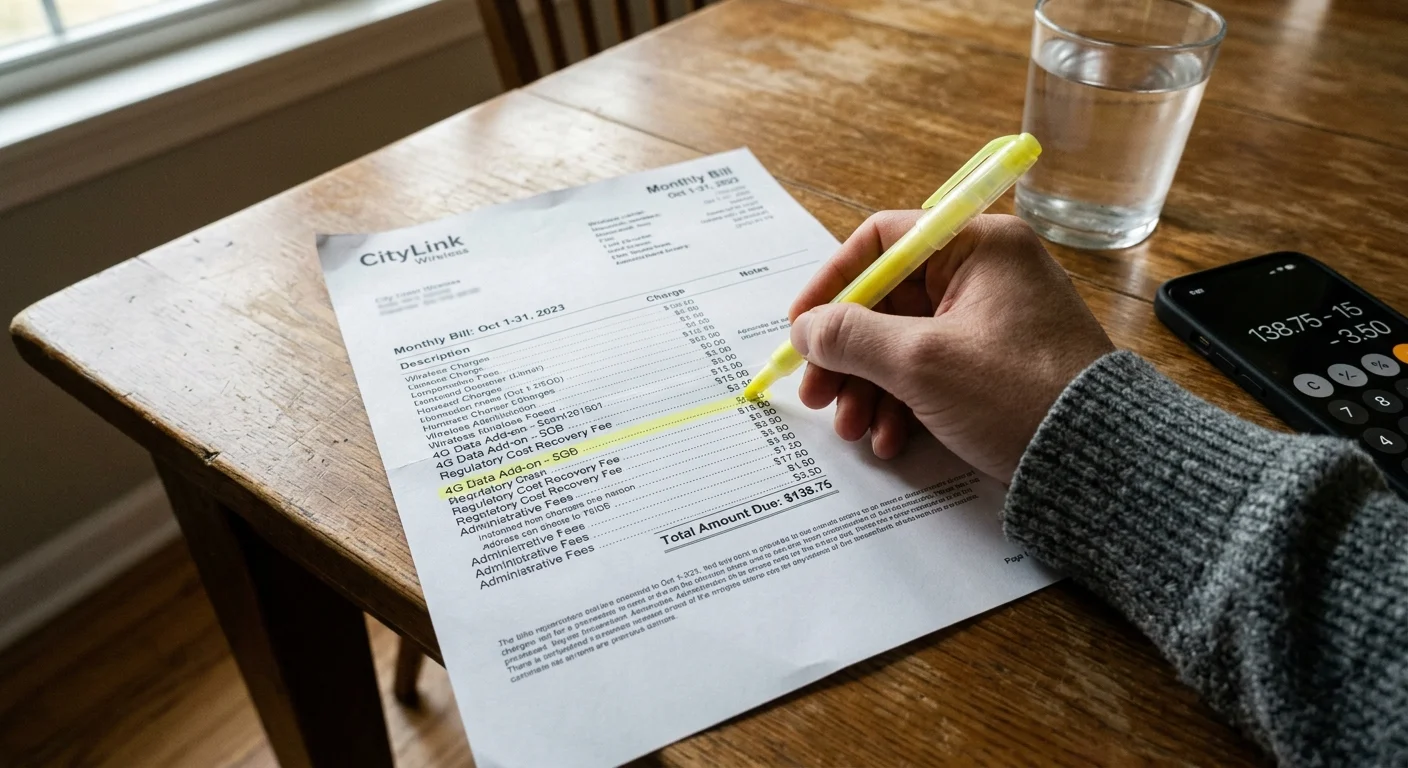
Scrutinizing the mobile carrier streaming bundle fine print exposes traps designed to extract recurring revenue from inattentive subscribers. Promotional credits often expire without clear smartphone notifications, causing surprise charges on your wireless bill.
Before cutting ties with wireless-linked entertainment, check the realities of streaming service cancellation fees so you are not caught off guard by unexpected termination costs.
T-Mobile’s Hulu “On Us” promotion includes a strict annual renewal clause. The credit runs for exactly twelve months, requiring manual renewal confirmation before your promotional anniversary date.
If you miss that renewal window, T-Mobile automatically converts your Hulu access into a standard paid monthly subscription. The carrier then bills the full retail price directly to your cellular account statement.
Carrier billing also limits your access to on-demand features, which allow you to watch whatever you want, whenever you want. Ad-supported carrier credentials frequently lock out offline content downloads on mobile devices.
According to analysis from Cord Cutters News, third-party billing agreements complicate customer service disputes. When playback errors or billing discrepancies occur, both the streaming platform and the cellular carrier routinely disclaim responsibility.
If you cancel or alter your wireless service, carriers terminate your promotional entertainment credits instantly. You can easily lose grandfathered streaming rates, promotional profiles, and viewing histories established over multiple years.
Resolution and Cost Audit: Wireless Perks Versus Direct Subscriptions
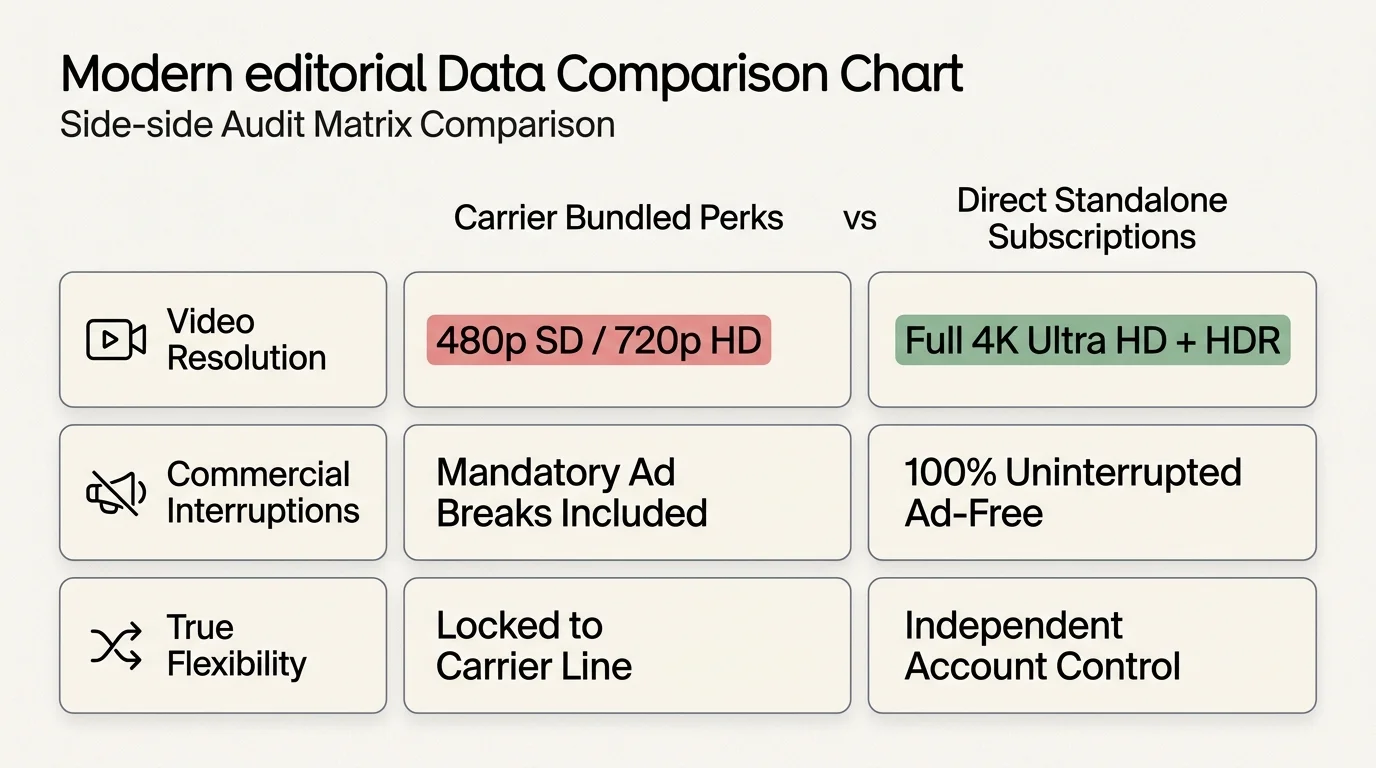
The following comparison table details the resolution ceilings, network restrictions, and out-of-pocket upgrade costs across major carrier packages and direct retail subscriptions.
| Subscription / Carrier Plan | Included Video Tier | Max Platform Resolution | Cellular Network Cap | Monthly Upgrade to 4K / Ad-Free |
|---|---|---|---|---|
| T-Mobile Go5G Next ($100/mo single line) | Netflix Standard w/ Ads, Hulu w/ Ads | 1080p Full HD | 4K UHD (Manual toggle required) | +$18.00 (Netflix 4K); Hulu upgrade blocked |
| T-Mobile Go5G ($75/mo single line) | None (Legacy plans got Netflix Ads) | 1080p Full HD | 480p SD Throttle | +$11.00 (Ad-Free) / +$18.00 (4K UHD) |
| Verizon myPlan Perk ($10/mo add-on) | Netflix Standard w/ Ads & Max Basic w/ Ads | 1080p Full HD | Plan dependent (480p on Welcome) | +$16.00 to +$22.00 (Upgrades via portals) |
| Verizon Disney Bundle Perk ($10/mo add-on) | Disney+, Hulu, ESPN+ (All with Ads) | 1080p Full HD (Selected 4K on Disney+) | Plan dependent (720p/4K on Plus/Ultimate) | +$14.99 (Requires separate ad-free plan) |
| Direct Netflix Premium ($22.99/mo direct) | Standalone Netflix Premium | 4K UHD + HDR + Spatial Audio | Uncapped by platform license | Included in base price (No commercials) |
| Direct Max Ultimate 4K ($20.99/mo direct) | Standalone Max Ultimate 4K | 4K UHD + Dolby Vision + Atmos | Uncapped by platform license | Included in base price (No commercials) |
The data reveals that carrier discounts apply exclusively to entry-level, ad-supported licenses. Premium home theater formats like 4K resolution, Dolby Vision, and ad-free viewing require full retail upgrade fees.
Financial Audit: Real-World Math on Upgrades Versus Standalone Accounts
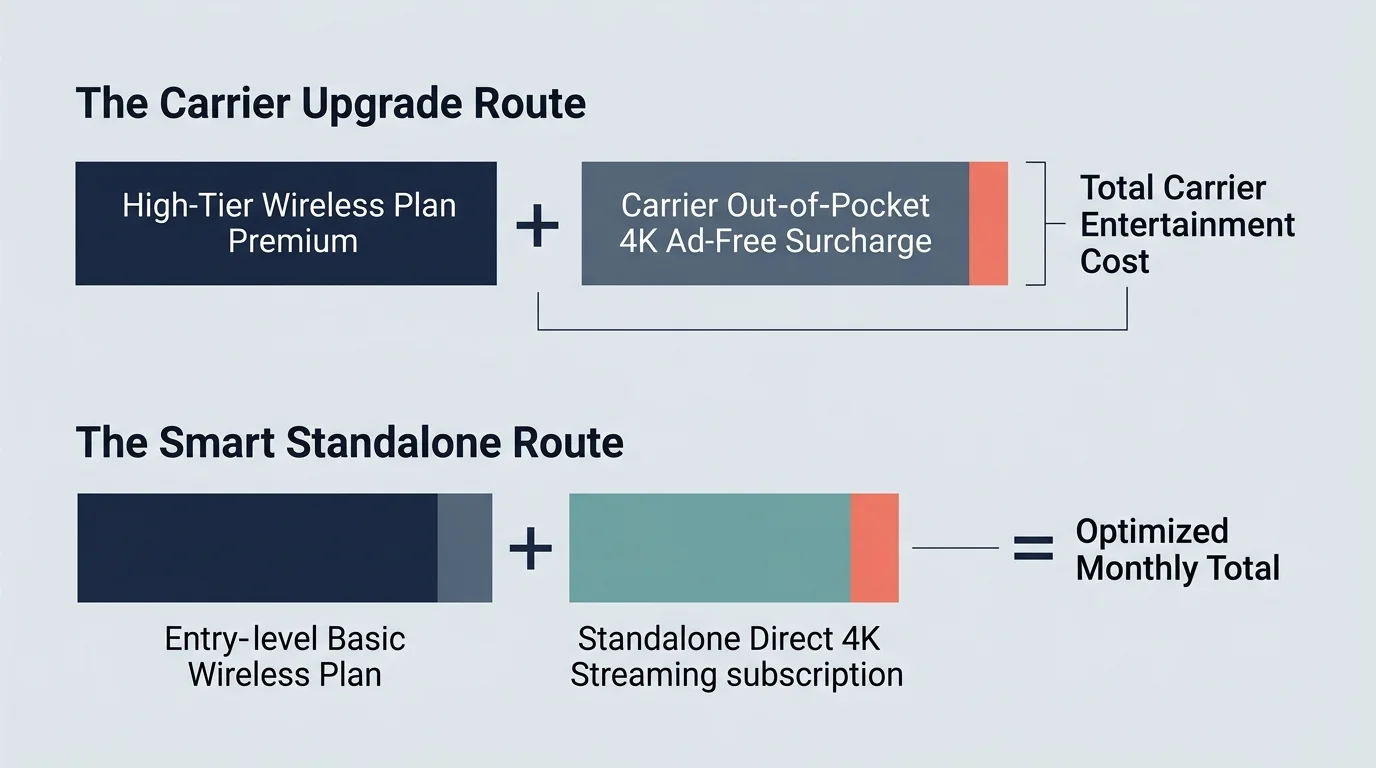
Let us examine a concrete scenario involving a two-line account to evaluate real-world costs. This scenario exposes how carrier bundles generate higher total bills than buying services independently.
Consider the Smith household. They maintain two smartphone lines on T-Mobile Go5G Next, paying $170 monthly with AutoPay discounts enabled.
They selected Go5G Next specifically for included entertainment perks: Netflix Standard with Ads and Hulu (With Ads). However, the Smiths own an OLED 4K television and refuse to watch commercial interruptions.
To acquire 4K resolution on Netflix, the family pays T-Mobile’s $18 monthly upgrade fee for Netflix Premium. That brings their monthly streaming surcharges to $18 immediately.
Next, they want ad-free Hulu. Because T-Mobile forbids upgrading its promotional Hulu perk to an ad-free tier, the Smiths cannot apply their carrier benefit toward an upgraded account.
They must forfeit the promotional credit entirely and purchase standalone Hulu (No Ads) directly for $17.99 monthly. Their total monthly entertainment expenditure through this hybrid configuration reaches $35.99.
Adding $35.99 in streaming fees to their $170 wireless bill yields an ongoing monthly outlay of $205.99. Over a full calendar year, the Smiths spend exactly $2,471.88.
Now consider the practical alternative. The Smiths downgrade their cellular service to an independent mobile virtual network operator (MVNO) or base tier offering reliable 5G data for $60 monthly across two lines.
They then purchase standalone subscriptions directly from the providers: Netflix Premium 4K at $22.99 monthly and ad-free Hulu at $17.99 monthly. Their standalone entertainment cost totals $40.98 per month.
Combining their $60 cellular bill with $40.98 in premium streaming totals $100.98 monthly. That equals $1,211.76 annually, yielding a net savings of $1,260.12 every year.
The Smiths save over $1,200 annually while enjoying genuine 4K HDR playback and skipping commercials entirely. Premium wireless plans bundled with ad tiers serve carrier profit margins, not your home theater experience.
“Buying premium wireless tiers solely for included streaming is a financial trap; standalone streaming paired with lower-cost data plans saves hundreds annually.”
Action Plan: How to Reclaim 4K and Ad-Free Streaming
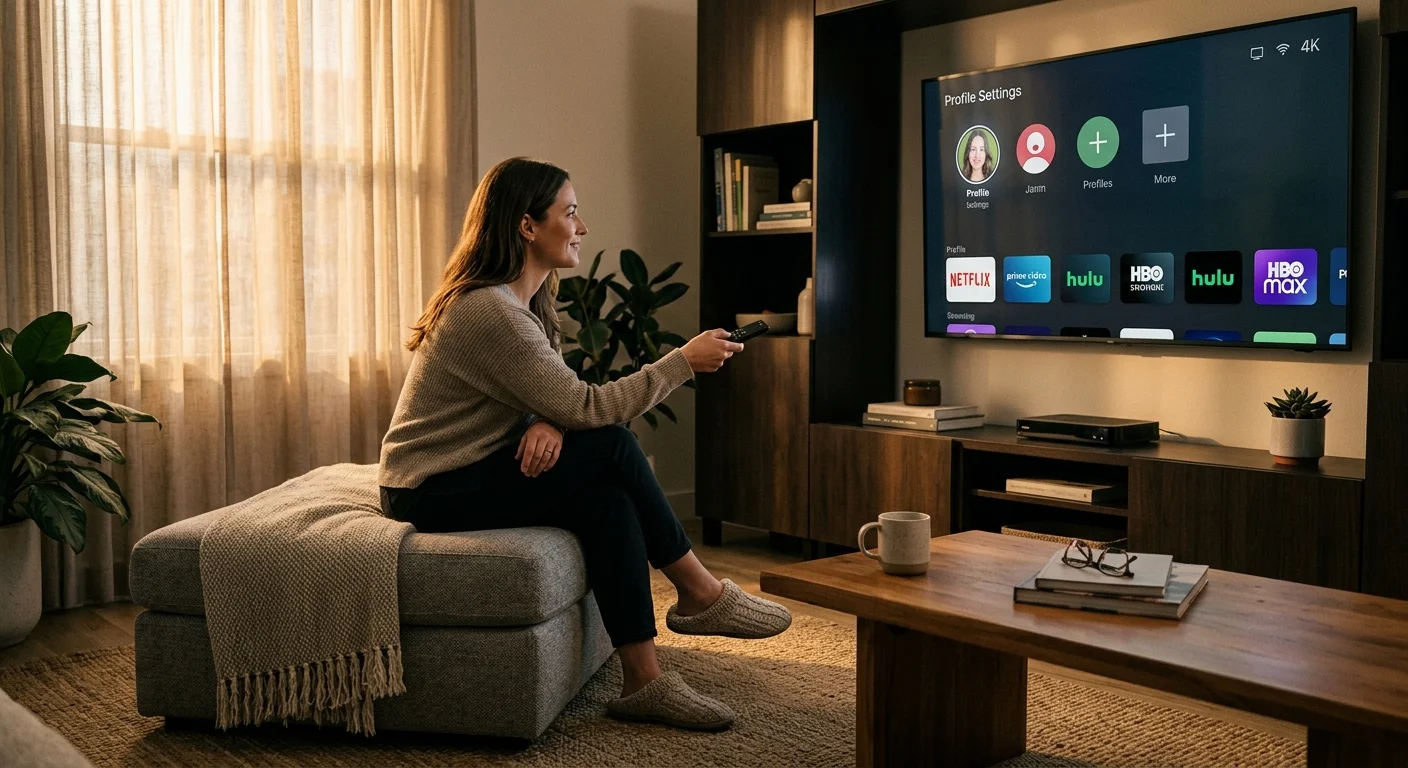
If you want to eliminate commercials and enjoy true 4K resolution across your devices, execute these concrete steps immediately. You can optimize your mobile settings and restructure your streaming subscriptions in under thirty minutes.
First, audit your mobile network video throttling settings to ensure your phone receives maximum bandwidth. Wireless carriers intentionally hide these toggles deep inside customer management portals.
If you subscribe to T-Mobile Go5G Plus or Go5G Next, open the T-Life application on your mobile device. Navigate to Account, select your mobile line, tap Profile Settings, and activate the “HD Video” or “UHD Video” switch.
If you use Verizon Unlimited Plus or Unlimited Ultimate, launch the My Verizon application on your device. Navigate to Account, choose Plans, select your active device, and toggle on “Maximum Video Streaming” to permit 4K delivery on 5G Ultra Wideband.
Second, review your credit card and cellular billing statements for third-party add-ons. Identify whether you pay monthly upgrade fees to convert carrier-provided ad tiers into ad-free or 4K packages.
If you pay $11 to $18 monthly to upgrade carrier perks, cancel those bundled perks inside your carrier dashboard. Uncouple your entertainment accounts from cellular billing entirely to regain direct subscription control.
Third, explore direct annual streaming subscriptions rather than paying month-to-month through your phone carrier. Most streaming platforms offer annual plans that discount the effective monthly price by fifteen to twenty percent.
According to consumer technology recommendations from CNET, direct billing protects your account from third-party provisioning errors and ensures rapid customer support resolution.
Fourth, take advantage of modern cloud DVR functionality if you subscribe to live television packages. A DVR—a digital video recorder that lets you record and watch shows later—allows you to bypass commercials during broadcast events.
Finally, evaluate whether you actually need an expensive postpaid unlimited wireless plan. Downgrading to a mid-tier data plan and purchasing the exact ad-free streaming tiers you watch consistently saves substantial money over time.
Frequently Asked Questions
Can I watch 4K video on my TV using T-Mobile’s Netflix perk?
No, you cannot stream 4K video using the standard included perk. T-Mobile’s “Netflix On Us” provides only Netflix Standard with Ads, which caps resolution at 1080p Full HD. You must pay an $18 monthly surcharge to unlock Netflix Premium 4K.
Why does video look blurry on my phone even though I pay for unlimited data?
Carriers enforce cellular streaming throttles by default across mobile plans. T-Mobile Go5G and Verizon Unlimited Welcome throttle cellular video to 480p Standard Definition. On higher-tier plans, you must manually enable high-definition or UHD streaming toggles in your account settings.
Can I upgrade my Verizon myPlan $10 Disney Bundle perk to ad-free?
You cannot upgrade the $10 Verizon Disney Bundle perk to an ad-free tier directly through Verizon billing. The discounted perk strictly provisions Disney+, Hulu, and ESPN+ with commercials. Getting ad-free viewing requires canceling the perk and subscribing directly through Disney.
Does watching streaming over home Wi-Fi bypass carrier resolution restrictions?
Wi-Fi bypasses your mobile carrier’s cellular network throttle, but it cannot bypass your streaming subscription’s resolution cap. Because carrier-provided licenses restrict accounts to ad-supported 1080p tiers, your stream remains limited to 1080p with commercials on home Wi-Fi.
Disclaimer: Streaming industry news changes rapidly. This article reflects information available at the time of publication. Check official service announcements for the most current information.