If your favorite free shows feel weighed down by relentless commercials, you are not imagining the disruption. While actual hourly ad caps have remained steady, dynamic insertion glitches and repeat ad frequency make viewing feel significantly more congested.
Industry data reveals that total commercial minutes on Tubi and Pluto TV have not dramatically expanded this year. Instead, ad-server frequency capping failures repeatedly blast the exact same commercial within identical pods, doubling your cognitive fatigue.
This guide tracks measured ad-load minutes, analyzes the real time-cost across platforms, and explains how to minimize commercial disruptions on your home screen.

Tracking Ad Minutes: Tubi vs. Pluto TV Benchmarks
Cord-cutting—canceling traditional cable or satellite TV in favor of streaming services—often leads cost-conscious viewers to free ad-supported platforms. Streaming refers to watching video content over the internet instead of through cable wires.
Free Ad-Supported Streaming Television (FAST) platforms rely entirely on commercial revenue. However, individual platforms manage their hourly commercial volume very differently.
Fox Corporation’s Tubi maintains one of the lightest commercial footprints in the free streaming industry. Tubi caps its commercial load at 4 to 6 minutes per viewing hour.
On Tubi, commercial breaks appear roughly every 12 to 15 minutes. The platform packages these breaks into short pods containing 3 to 5 commercials, totaling 60 to 90 seconds per break.
This restrained approach has paid off with massive audience adoption. According to reporting from Variety, Tubi surpassed 97 million monthly active users while capturing over 2% of total U.S. television viewing time.
Paramount’s Pluto TV operates with a distinctly different programming structure. Pluto TV averages 8 to 10 minutes of commercials per viewing hour, with some linear channels reaching 12 minutes.
Pluto TV models its linear streaming channels on legacy broadcast syndication clocks. Consequently, breaks hit every 10 to 12 minutes and last between 2 and 3 minutes each.
Pluto TV serves 5 to 8 commercials per break to fill traditional linear ad windows. While Pluto TV reaches over 80 million global monthly users, its heavier ad density creates noticeably more friction.

A Worked Example: Logging a Two-Hour Prime-Time Movie
To understand the real time-cost of free streaming, consider a scenario where you watch a 120-minute feature film. On-demand streaming lets you watch whatever title you want, whenever you choose.
As programmatic ad targeting evolves, exploring the future of streaming and ad-supported models suggests that dynamic ad frequency will face tighter regulation and smarter delivery.
Watching this two-hour movie on-demand through Tubi produces a predictable viewing schedule. Over the 120 minutes of narrative, Tubi triggers 8 commercial breaks.
Each break averages 75 seconds. Your total commercial interruption time equals 10 minutes, extending your total session to 130 minutes.
Out of 32 total commercial slots served during the film on Tubi, 28 represent distinct brands. You encounter only 4 repeat commercials across the entire two-hour run.
Now consider that same 120-minute movie running on a linear Pluto TV channel during prime time. The broadcast schedule must accommodate traditional syndication blocks.
Pluto TV inserts 10 commercial breaks across the broadcast. Each break lasts an average of 110 seconds, delivering 6 to 8 commercials per pod.
Your total commercial interruption time climbs to 18.3 minutes. The full broadcast requires nearly 139 minutes of your evening.
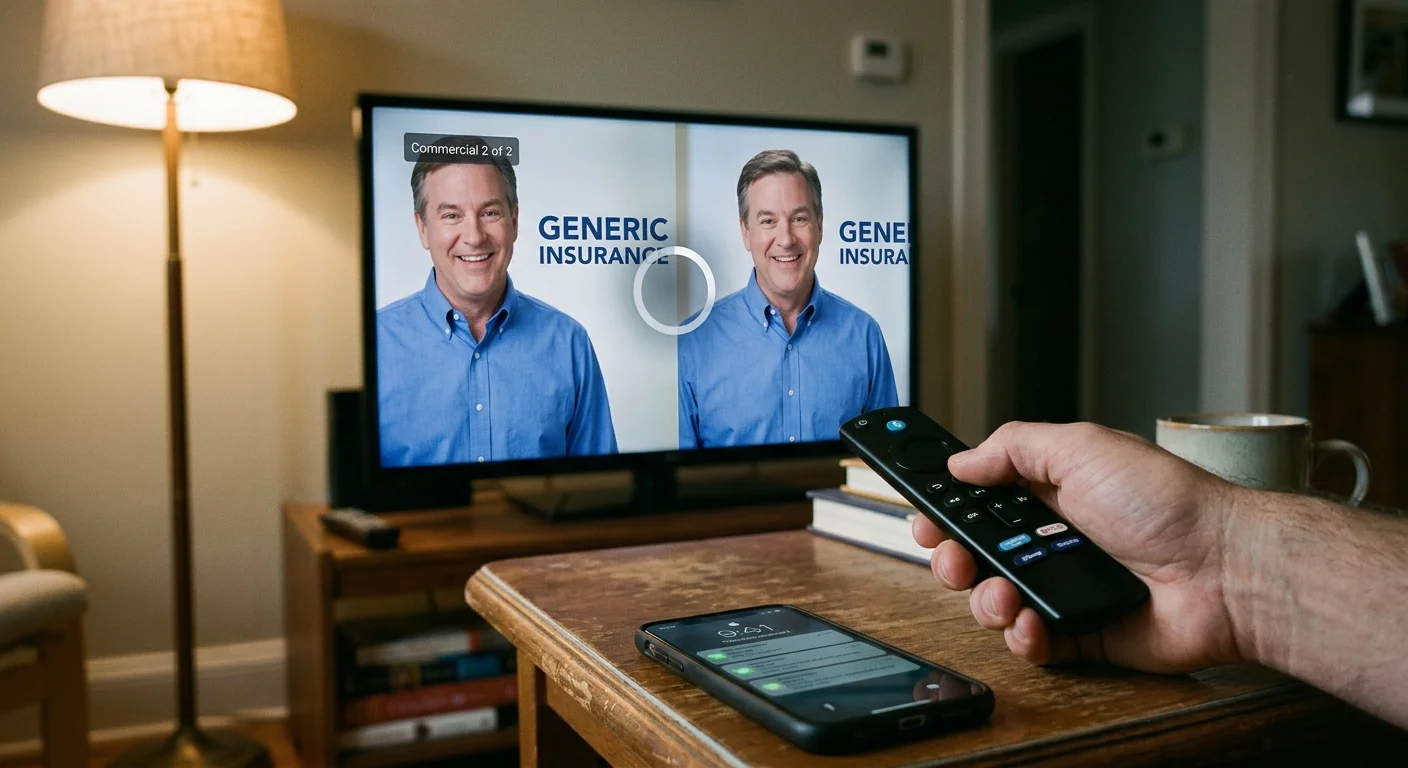
More importantly, you receive 48 total commercial slots, but only 24 are unique advertisements. You watch the same auto insurance ad 6 times and the same mobile game promo 5 times.
By contrast, traditional broadcast television running a 120-minute movie inserts 34 minutes of commercials. Cable stretches that identical film into a 154-minute block.
Why Commercial Breaks Feel Longer: Frequency Capping and Ad Fatigue
When viewers complain about a Pluto TV ad load increase, they are rarely reacting to added runtime. The actual culprit is algorithmic repetition.
Free platforms rely on Dynamic Ad Insertion (DAI). DAI software swaps commercials into video streams in real time based on your viewer profile and location.
Streaming ad servers use automated frequency capping rules to prevent identical ads from running back-to-back. Unfortunately, programmatic ad-bidding systems regularly fail to enforce these limits.
When local ad inventory runs thin, the server defaults to the highest available bidder. That bidder’s commercial airs multiple times within the exact same break.
According to coverage from Cord Cutters News, ad duplication remains the leading complaint among viewers using free streaming apps. Seeing three identical 30-second spots in a single 90-second break creates immense viewer irritation.
“Repetition fatigue damages viewer attention far more than overall ad duration. When the same commercial loops constantly, your brain registers the interruption as twice as long.”
Research across Connected TV platforms shows that overall FAST channel ad frequency has held steady at roughly 9 minutes per hour. However, high repetition inflates the perceived commercial density.
Tubi commercial break length remains easier to tolerate because Fox enforces stricter frequency limits. Pluto TV’s reliance on linear schedules exposes viewers to far more frequent duplicate slots.
Market Pressure: How Prime Video’s Ad Shift Impacted FAST Channels
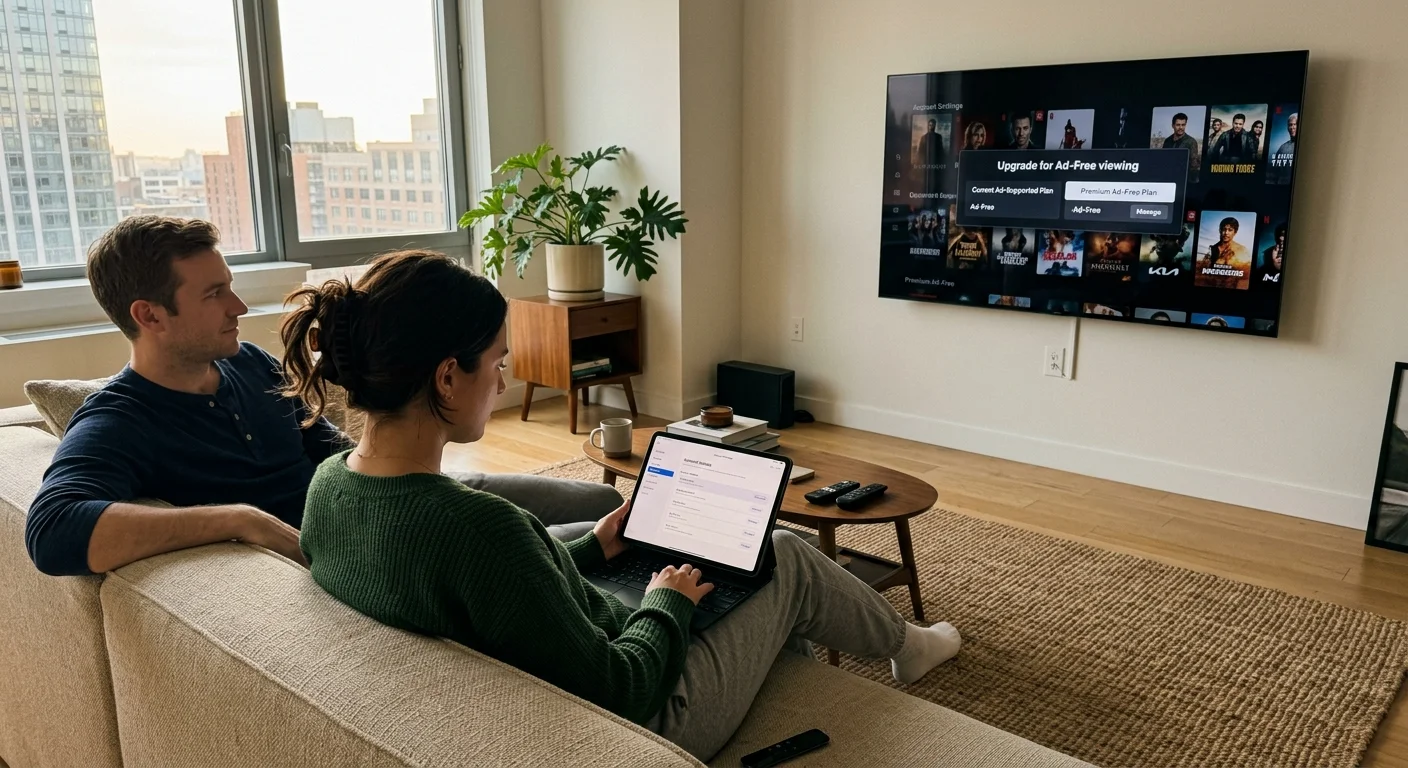
The free streaming market experienced a massive shift in early 2024. Amazon Prime Video converted an estimated 115 million accounts directly into an ad-supported tier.
This transition also changed the landscape for standalone FAST platforms, including Amazon’s own ad-supported hub detailed in our Freevee complete guide.
Ad-supported tiers are free or discounted plans that include commercials. Ad-free plans cost more money each month but eliminate all commercial interruptions.
Prime Video launched its commercial tier with an ultra-light ad load of 2 to 3.5 minutes per hour. Over subsequent quarters, Amazon expanded its volume closer to 4 to 6 minutes per hour.
This sudden influx of hundreds of millions of premium ad impressions overwhelmed the digital advertising market. Premium brand advertisers shifted substantial budgets directly to Amazon.
As reported by The Verge, major streaming platforms rapidly adjusted their ad infrastructure to compete against Amazon’s massive reach. The glut of available commercial inventory caused programmatic prices to tumble.
Because ad prices dropped, free streaming platforms struggled to fill every available pod with high-paying advertisers. Unsold inventory forced platforms to fill breaks with station promos or low-tier programmatic ads.
This dynamic directly caused the surge in repetitive commercials on Pluto TV and Tubi. The platforms did not raise their hard ad-minute caps; they simply ran out of diverse advertisers to fill the existing slots.
Side-by-Side Comparison: FAST Services vs. Paid Ad Tiers and Cable
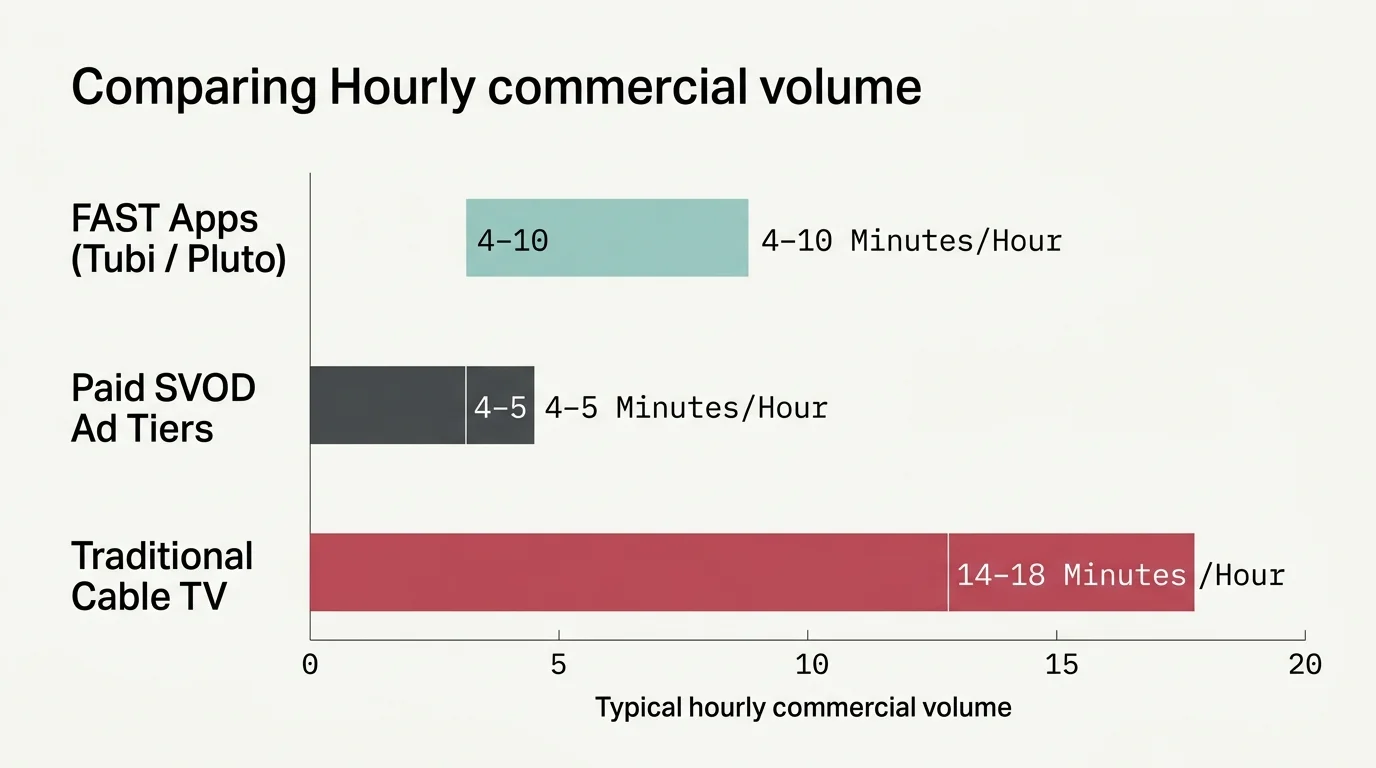
Evaluating your entertainment setup requires comparing the real time-cost across both free and paid platforms. Commercial volume varies dramatically depending on the service model you select.
Keep in mind that many paid ad tiers are now bundled into mobile plans, though our carrier perk audit shows these tiers often downgrade perks alongside serving commercials.
Paid streaming services charge monthly subscription fees while still showing commercial breaks. Free platforms charge zero dollars but claim slightly more of your time.
The table below outlines real-world hourly commercial loads, typical break intervals, and financial costs across major viewing options.
| Platform / Service Model | Average Ad Minutes Per Hour | Break Interval | Average Pod Duration | Monthly Cost |
|---|---|---|---|---|
| Tubi (FAST On-Demand) | 4 to 6 minutes | Every 12 to 15 mins | 60 to 90 seconds | $0.00 |
| Pluto TV (FAST Linear & On-Demand) | 8 to 11 minutes | Every 10 to 12 mins | 120 to 180 seconds | $0.00 |
| Amazon Prime Video (Ad Tier) | 4 to 6 minutes | Every 15 to 20 mins | 45 to 75 seconds | $8.99 to $14.99 |
| Netflix (Standard with Ads) | 4 to 5 minutes | Every 15 to 20 mins | 30 to 75 seconds | $6.99 |
| Hulu (Ad-Supported) | 7 to 10 minutes | Every 10 to 14 mins | 90 to 120 seconds | $9.99 |
| Traditional Cable / Broadcast TV | 14 to 17 minutes | Every 8 to 12 mins | 150 to 240 seconds | $75.00+ |
This data reveals that Tubi delivers an ad load equivalent to paid subscription platforms like Netflix and Prime Video. You receive the exact same commercial density without paying a recurring monthly fee.
Pluto TV carries roughly double the ad load of Tubi. However, Pluto TV still serves approximately 40% fewer ad minutes than traditional cable television.
Practical Tactics to Reduce Ad Clutter on Free Streaming Apps
You cannot completely eliminate commercials on free services, but you can configure your hardware to reduce jarring repetitions. Smart settings adjustments improve the delivery of automated ad servers.
Keeping your hardware updated with recent streaming device updates and firmware also ensures ad-insertion scripts process properly without freezing.
Implementing a few simple streaming hacks can significantly improve playback stability and reduce intrusive interruptions across free platforms.
A smart TV is a television with built-in internet connectivity and integrated streaming apps. A streaming device is an external player, like a Roku Ultra or Fire TV Stick 4K, that connects to your display.
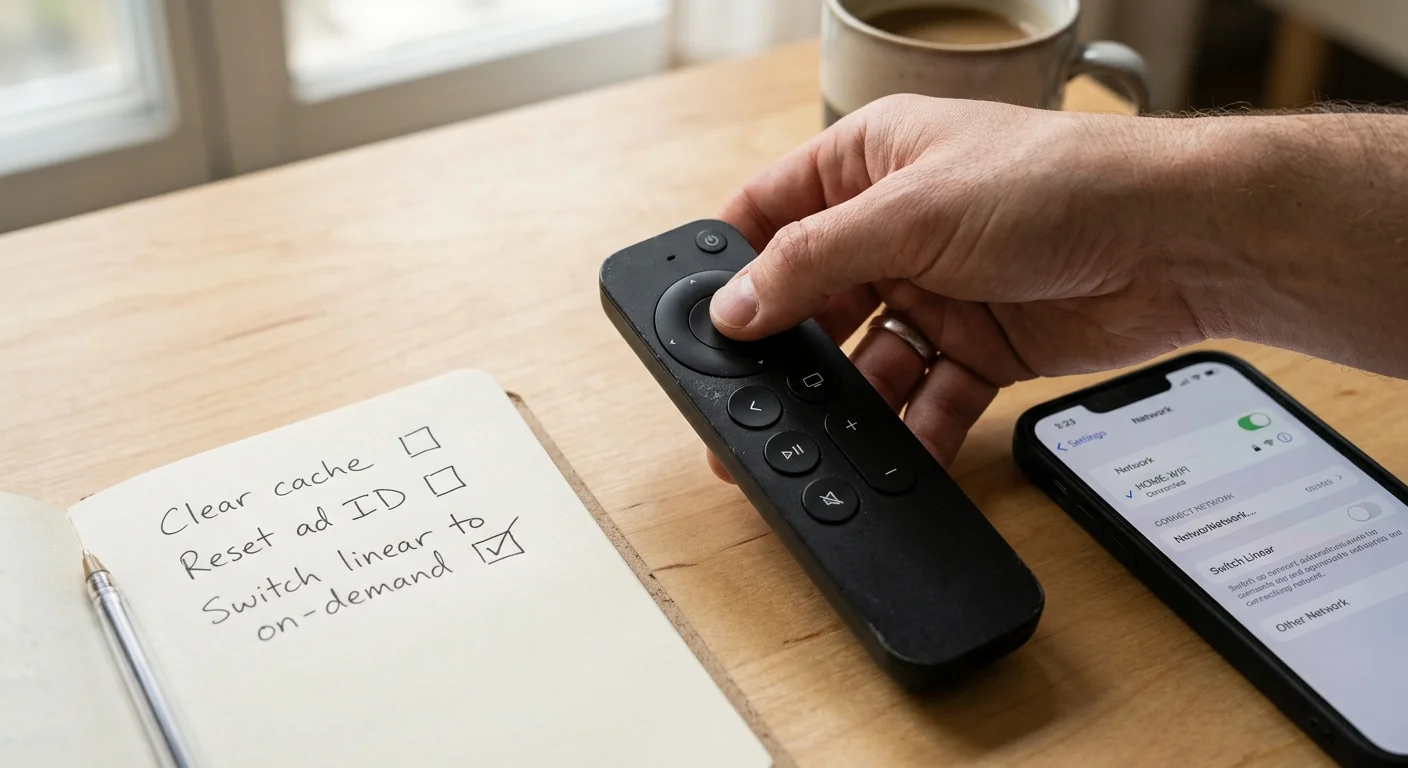
Reset your device’s advertising identifier every few months. Ad servers track this anonymous code to build a profile, and corrupted profiles frequently cause severe frequency capping loops.
On a Roku streaming player, open Settings, select Privacy, choose Advertising, and click Reset advertising ID. This forces ad networks to treat your hardware as a fresh endpoint.
On an Amazon Fire TV Stick, open Settings, choose Preferences, select Privacy Settings, and toggle Reset Advertising ID. Restart your device immediately after resetting the identifier.
Prioritize on-demand library titles over live linear FAST channels whenever possible. On-demand video assets feature strict software caps that trigger significantly shorter ad pods.
“Switching from a linear FAST stream to an on-demand title on the same platform instantly cuts your hourly commercial load by up to 40%.”
For broadcast networks, consider installing an over-the-air antenna paired with an external DVR. A DVR (digital video recorder) records free broadcast signals onto a hard drive so you can fast-forward past commercials entirely.
Frequently Asked Questions
Why do I keep seeing the exact same commercial repeatedly on Pluto TV and Tubi?
Repetitive commercials stem from programmatic frequency capping glitches rather than intentional programming. When ad networks lack a diverse inventory of sponsors targeting your demographic profile, the automated server fills empty slots with the same winning bidder.
Are Tubi and Pluto TV adding more total ad minutes than last year?
No, official platform ad caps have remained stable over the past 12 months. Tubi continues to cap ad loads at 4 to 6 minutes per hour, while Pluto TV averages 8 to 10 minutes per hour.
Which free streaming service has the shortest commercial breaks?
Tubi maintains the shortest commercial breaks among dedicated free platforms, averaging 60 to 90 seconds per pod. In contrast, Pluto TV breaks frequently run 2 to 3 minutes or longer.
Does watching on-demand content show fewer ads than live FAST channels?
Yes, on-demand titles generally feature substantially lighter ad loads than live streaming channels. On-demand movies use strict digital insertion rules, whereas linear channels must mirror legacy broadcast syndication schedules.
Disclaimer: Streaming industry news changes rapidly. This article reflects information available at the time of publication. Check official service announcements for the most current information.