Finding genuine bilingual entertainment for your children on domestic streaming platforms often feels like an exercise in frustration. While platforms claim massive international libraries, audio tracks and subtitles frequently vanish between seasons or fail to match spoken dialogue.
Most catalog overviews simply tally total Spanish titles, but standard counts lie. What matters for language acquisition is profile-level dub retention, Latin American dialect fidelity, and subtitle synchronization that matches the spoken Spanish script.
If your goal is reinforcing heritage Spanish at home without constant remote-control troubleshooting, this audit reveals how major domestic platforms actually perform.
The Bilingual Streaming Landscape: Why Audio Indexing Matters
Modern families increasingly rely on streaming—watching video content over the internet instead of cable or satellite—to build immersion at home. This shift forms the backbone of cord-cutting, which means canceling traditional cable or satellite TV in favor of flexible online apps.
Data highlights the scale of this habit. Hispanic children aged 2 to 11 spend approximately 88% of their total TV viewing time on connected TV devices rather than linear broadcast networks.
Overall, streaming accounts for 55.8% of total television time among Hispanic viewers in the United States. That figure significantly outpaces the general domestic population average of 46%.
During the first half of 2026, Hispanic audiences generated 1.2 trillion minutes of streamed content. That volume represents 19.1% of all domestic viewing minutes nationwide.
According to Nielsen research, 77% of Gen Z Hispanics speak Spanish at home. As PCMag’s streaming service evaluations show, platform interfaces still treat secondary audio settings as an afterthought.
For parents pursuing dual-language fluency, tracking down reliable spanish audio streaming services requires looking past marketing promises. You need platforms that reliably retain your language preferences across multiple viewing sessions.
Evaluating Dub Depth: Methodology and Audio Sync Standards
Assessing a library requires evaluating how on-demand video—content you watch whenever you want rather than on a broadcast schedule—handles language tracks. Total title counts tell you very little about day-to-day usability.
Beyond audio fidelity, families relying on captions should also consider visual legibility across apps, as explored in our guide to streaming subtitle customization.
First, dialect localization matters immensely for developing ears. You should not have to expose your toddler to Peninsular Spanish idioms when your household practices Mexican or Colombian phrasing.
We evaluate whether a platform distinguishes between Español (Latinoamérica) and Español (España). Conflating these distinct dialects confuses early language learners during crucial developmental windows.
Second, we audit closed-caption synchronicity. Subtitles often reflect literal translations of the original English script rather than the actual words spoken by Latin American voice actors.
When the text on screen says one phrase while the voice actor says another, early readers experience severe cognitive friction. True bilingual kids streaming requires synchronized dub-and-sub tracks that mirror each other verbatim.
“Accurate subtitle transcription that matches voice dubbing is essential for early reading development in bilingual households.” — Language Acquisition Specialist
Finally, we assess automated profile persistence. A family-friendly app must preserve Spanish audio preferences permanently instead of reverting to English whenever a new episode autoplays.
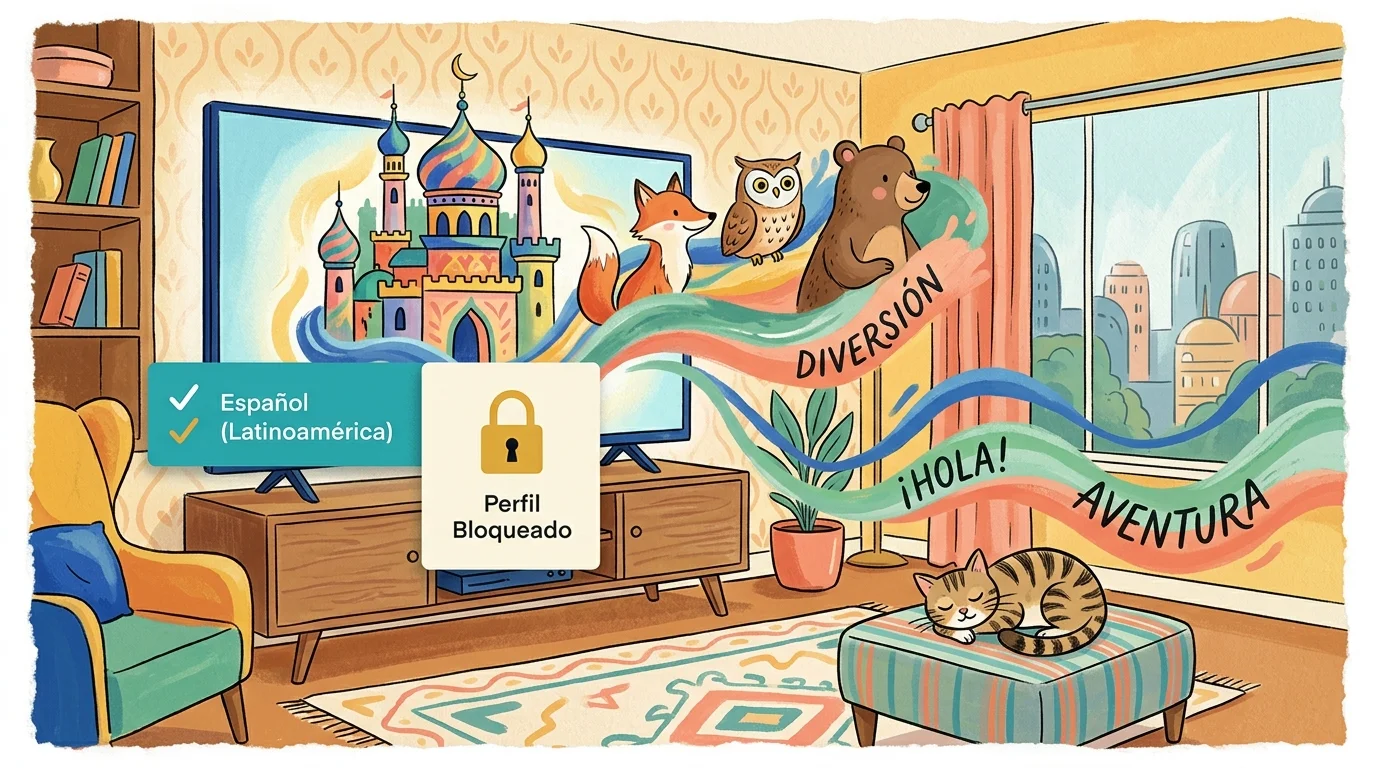
Disney+: The Gold Standard for Dialect Separation and Profile Locking
Disney+ dominates family entertainment, and its technical infrastructure reflects decades of international localization. The platform delivers the most consistent dialect separation in the domestic marketplace.
Alongside audio settings, parents can also configure streaming parental controls to keep mature catalog entries locked behind age-appropriate restrictions.
Virtually 100% of animated features from Disney, Pixar, and Marvel provide distinct tracks for Latin American Spanish and Castilian Spanish. The disney plus spanish audio track matches corresponding closed captions with unmatched precision on flagship titles.
Iconic films like Encanto, Coco, Moana, and Frozen feature complete cultural adaptations rather than robotic translations. Musical numbers feature rhymes and cadence adapted natively for Latin American audiences.
Crucially, Disney+ offers true profile language pinning. When you switch a child’s profile interface language to Spanish, every compatible title automatically plays in Spanish audio by default.
Pricing remains a central consideration for budget-conscious parents. Disney+ Basic with ads costs $12.49 monthly, while the ad-free Premium tier runs $21.49 per month.
Here, ad-supported means a cheaper plan that shows commercials during playback. In contrast, ad-free tiers cost more each month but eliminate all commercial interruptions.
You can also choose the Disney+ and Hulu Duo bundle. That package costs $12.99 monthly with commercials or $21.99 per month for ad-free streaming.
As Wirecutter reports in its streaming guide, Disney+ offers the strongest catalog cohesion for households with toddlers and grade-school children.

Max: Deep Catalog Compromised by Inconsistent Localization
Max hosts an incredible vault of animation through its ownership of Cartoon Network, Studio Ghibli, and Warner Bros. Animation. Shows like Craig of the Creek and Adventure Time offer rich cultural stories.
This inconsistency mirrors similar indexing gaps across platforms, such as trying to find native French audio content on Max and Prime.
However, Max stumbles when handling audio delivery. While early seasons of flagship children’s shows carry Latin American dubs, subsequent seasons frequently drop Spanish options entirely without warning.
Furthermore, subtitle synchronization on Max remains erratic. Closed captions frequently default to Castilian syntax even when the audio track plays Latin American voice acting.
This mismatch causes confusion when a child reads European Spanish terms that conflict directly with Latin American voice tracks. Interface profile locking also suffers from periodic bugs on connected televisions.
Max offers three pricing options for domestic households. The Basic with Ads tier costs $10.99 monthly or $109.99 annually.
The Standard ad-free plan costs $18.49 per month or $184.99 per year. If you want 4K UHD resolution, the Premium tier runs $22.99 monthly or $229.99 per year.
Max does not offer a free trial. For bilingual families, paying premium rates for broken audio continuity across serialized kids’ shows remains hard to justify.
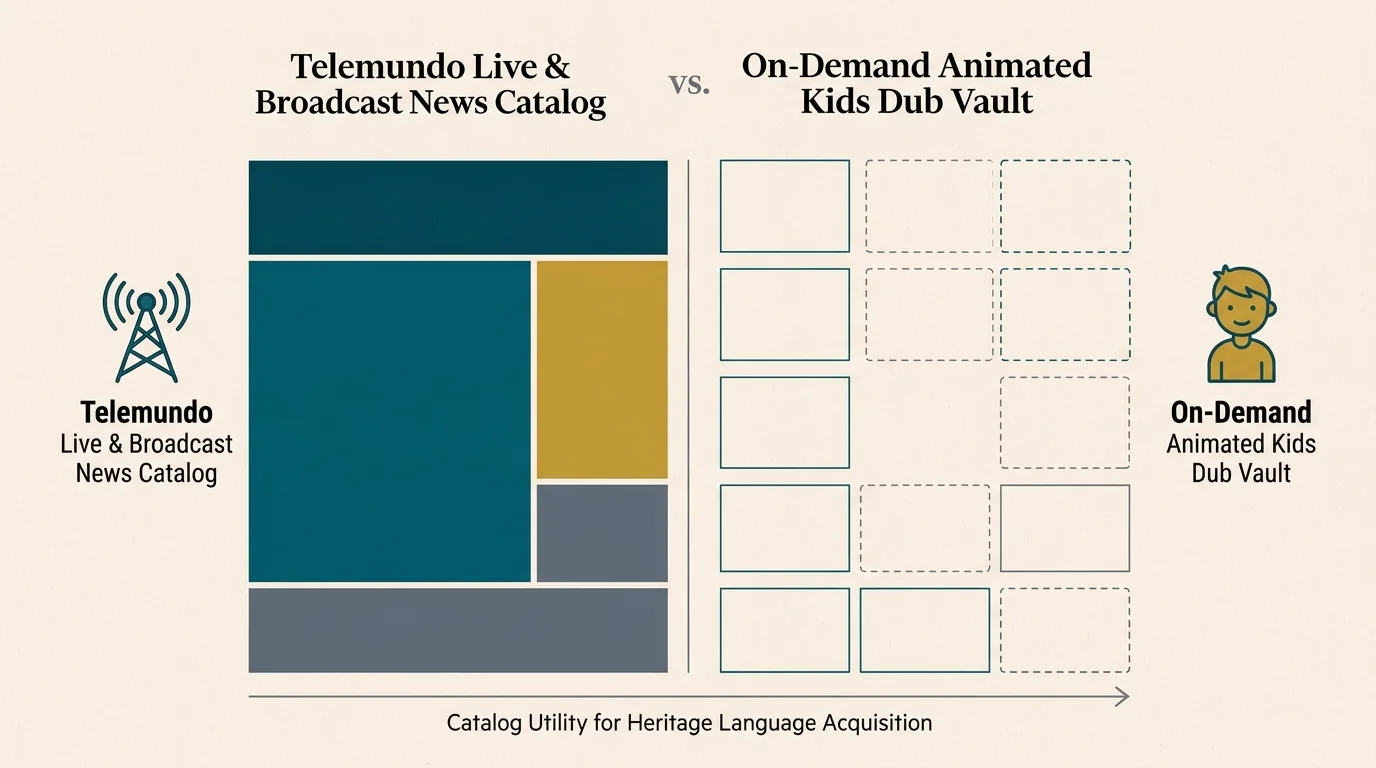
Peacock: Native Spanish Roots Countered by Thin On-Demand Animation
Peacock benefits from NBCUniversal’s Telemundo network, giving it immediate cultural credibility with adult viewers. Its adult Spanish library includes thousands of hours of current news, sports, and telenovelas.
Unfortunately, that investment does not translate cleanly to its children’s animation catalog. While Illumination films like Despicable Me and The Super Mario Bros. Movie feature Spanish tracks, the broader television vault is sparse.
Archival television series frequently lack Spanish tracks altogether on Peacock. When dubs exist, the app often buries language selection inside playback menus rather than offering a profile-level setting.
Peacock costs $7.99 per month for its Premium ad-supported plan. Upgrading to Premium Plus for ad-free viewing costs $13.99 per month.
Peacock eliminates traditional free trials, though it periodically runs promotional entry-level discounts. While cost-effective, Peacock serves bilingual households best as a secondary service for live sports rather than a dedicated kids’ immersion tool.

Head-to-Head Comparison: Audio Tiers, Profiles, and Monthly Costs
Choosing the right provider requires weighing localization performance against monthly subscription expenses. The following index compares the major services across critical immersion benchmarks.
Managing simultaneous audio streams and multiple household profiles is easier when comparing your options in our guide to streaming service family plans.
| Streaming Service | Entry Price (With Ads) | Ad-Free Monthly Price | Latin American Dub Integrity | Profile Audio Pinning | Subtitle-to-Audio Match |
|---|---|---|---|---|---|
| Disney+ | $12.49 | $21.49 | 98% of animated catalog | Yes (Persistent) | High (Script-accurate) |
| Netflix | $8.99 | $19.99 | 92% of original catalog | Yes (Persistent) | Moderate to High |
| Max | $10.99 | $18.49 | 64% of kids’ catalog | Inconsistent | Poor (Frequent Castilian mismatch) |
| Peacock | $7.99 | $13.99 | 45% of kids’ catalog | No (Manual per title) | Moderate |
Netflix provides valuable competition for Disney+. You can access a dedicated Spanish indexing directory directly at netflix.com/browse/audio/es on your browser to filter titles instantly.
Netflix charges $8.99 monthly for Standard with Ads, $19.99 for Standard ad-free, and $26.99 for Premium 4K. It supports two concurrent streams on Standard and four streams on Premium.
Disney+ allows four simultaneous streams even on its basic tier, making it more generous for larger families. Max limits simultaneous viewing to two streams on Standard and four on Premium.
Worked Household Scenario: Optimizing an Immersion Setup on a Budget
Consider the Alvarez family in Chicago, raising a four-year-old and a seven-year-old in a Spanish-immersion home. The children watch roughly 15 hours of animated content every week.
Previously, the family subscribed to traditional cable with a Spanish channel add-on, paying $128.50 every month. Linear broadcasts forced the children to watch whatever aired at that moment, complete with advertisements.
To cut costs, the family canceled cable and bought a dedicated streaming device. A streaming device is a compact player, such as a Roku or Fire TV stick, that connects directly to any television.
They paired their hardware with an entry-level smart TV, which is simply a television with built-in internet capability and streaming applications. They replaced their $128.50 monthly cable bill with Disney+ Basic at $12.49 monthly.
Over a four-week test involving 60 hours of screen time, the children streamed 140 episodes across various animated series. Because Disney+ preserves language preferences, 137 episodes loaded the Latin American dub instantly without adult intervention.
By dropping traditional cable for Disney+, the Alvarez family cut their entertainment expenses from $1,542.00 to $149.88 annually. That transition delivered an exact annual savings of $1,392.12 while raising their Spanish immersion continuity to 97.8%.
“Switching from bloated cable tiers to a single, well-localized streaming app saves over $1,000 annually while dramatically improving language exposure.” — Cord-Cutting Analyst
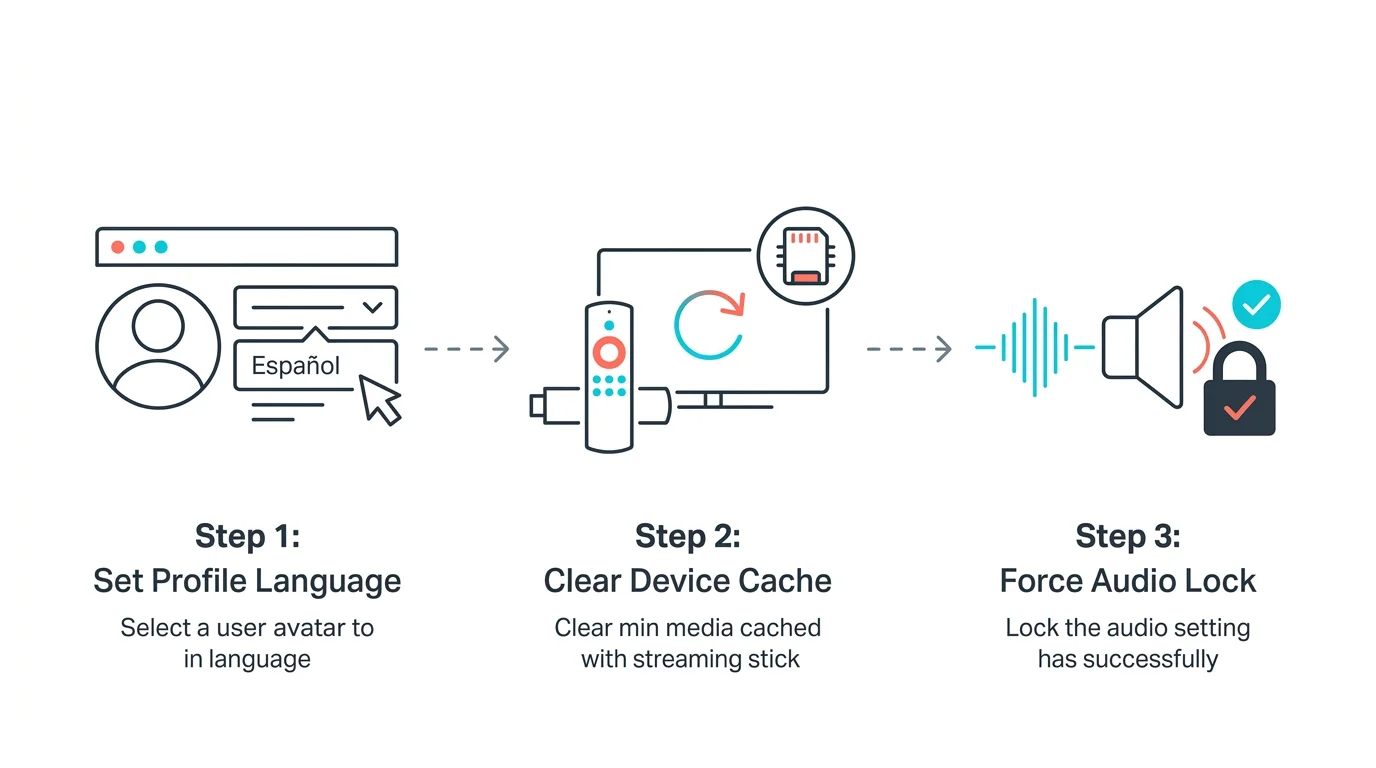
How to Lock Profiles and Fix Dub Desync on Connected Devices
Even robust platforms occasionally drop audio settings after system updates. Following specific setup protocols prevents your children from reverting to English audio tracks.
First, configure the primary profile settings directly inside the native mobile app or web browser before launching on your TV. Desktop changes sync across cloud servers more reliably than television interfaces.
On your connected streaming stick, open your device’s global audio settings. Change your preferred digital audio output from stereo passthrough to Dolby Digital to avoid audio delay issues.
According to Consumer Reports’ streaming device analysis, keeping hardware firmware updated minimizes audio-track sync drift on third-party apps.
Unlike old broadcast setups using a DVR—a digital video recorder that stores television programs on an internal hard drive—streaming apps load tracks over dynamic internet streams. Poor Wi-Fi causes apps to drop secondary audio tracks first during bandwidth throttling.
If an app repeatedly reverts to English, connect your streaming device directly via Ethernet or restart your router. Clear the application cache from your device settings menu to restore saved language preferences.
Frequently Asked Questions
Which streaming service has the most Latin American Spanish content for young children?
Disney+ offers the highest concentration of premium Latin American Spanish audio tracks for children. Nearly its entire animated catalog provides native dubbing alongside matching Spanish subtitles.
Can I lock a kids’ profile so it only plays Spanish audio automatically?
Disney+ and Netflix both allow profile-level language locking. Changing the profile’s default interface language to Spanish forces all compatible titles to play in Spanish audio automatically.
Why do the Spanish subtitles rarely match the Spanish voice dubbing?
Subtitles often translate original English scripts directly for deaf and hard-of-hearing viewers. Voice dubs adapt lines separately for cultural flow, syllable length, and lip-sync timing, creating noticeable text differences.
Are free ad-supported streaming apps worth using for bilingual children?
Free ad-supported options like ViX offer thousands of native Spanish hours, but their children’s catalogs lack parental controls. Premium platforms provide safer curation and higher-quality educational dubs.
Disclaimer: Streaming service prices, content libraries, and features change frequently. Prices shown were accurate at time of writing but may have changed. Always verify current pricing on the official service website before subscribing.