
Living in an urban studio apartment on an entry-level salary means keeping fixed expenses lean without sacrificing entertainment. You can secure Disney+, Hulu, and Max together for under $6 monthly out-of-pocket by pairing two cards you already carry.
While mainstream guides suggest expensive cards with steep annual fees, your zero-fee American Express Blue Cash Everyday and Chase Sapphire Preferred can slash this bundle below its $16.99 sticker price.
By syncing monthly billing cycles with direct-merchant rebates and rotating cash-back promotions, you create a sustainable 65% discount on premium entertainment.
The Disney+, Hulu, and Max Bundle Breakdown
Streaming—watching video content over the internet instead of cable or satellite—has fragmented into dozens of separate monthly invoices. That constant price creep frustrates cord-cutting viewers trying to trim monthly expenses.
Cord-cutting means canceling traditional cable or satellite TV in favor of internet services. However, subscribing to individual apps often costs just as much as old television packages.
On July 25, 2024, Disney Entertainment and Warner Bros. Discovery officially launched a combined streaming bundle. This official partnership unites Disney+, Hulu, and Max under a single, discounted monthly bill.
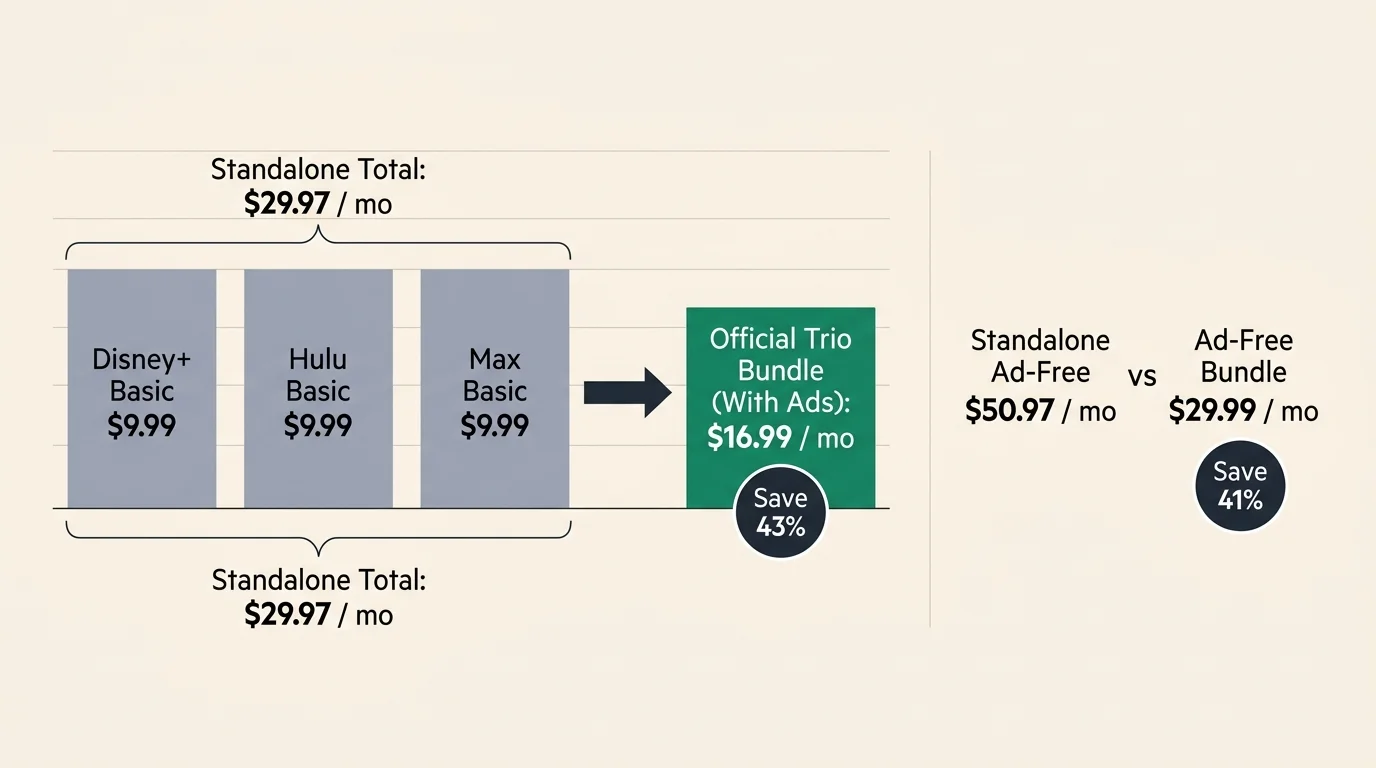
Purchased standalone, Disney+ Basic costs $9.99 monthly, Hulu with ads costs $9.99, and Max Basic runs $9.99. Subscribing to all three separately demands $29.97 every single month.
The joint ad-supported package costs $16.99 per month. Ad-supported plans show short commercials before and during your shows, delivering a 43% baseline savings over standalone pricing.
The ad-free package costs $29.99 monthly. Ad-free plans eliminate commercials entirely during playback, which saves 41% compared to standalone ad-free plans totaling $50.97 per month.
As Wirecutter’s streaming service reviews emphasize, combining services through bundled pricing represents the single most reliable hedge against ongoing subscription rate hikes.

Credit Card Streaming Credits and Card Mechanics
You do not need a luxury travel card with a $695 annual fee to lower your entertainment bill. Everyday consumer cards feature built-in credit card streaming credits that eliminate most of the cost.
The American Express Blue Cash Everyday card features a $0 annual fee. It includes an amex blue cash streaming rebate providing up to $7 per month in statement credits for eligible Disney Bundle purchases.
You must spend $9.99 or more each month on eligible subscriptions to trigger this $7 credit. Because the ad-supported trio bundle costs $16.99, it cleanly satisfies that spending threshold every billing cycle.
The credit applies automatically against your statement once enrolled. Over twelve billing cycles, this single benefit returns $84 back into your bank account.
Your Chase Sapphire Preferred card carries a $95 annual fee. While it lacks a static monthly streaming credit, it earns 3x Chase Ultimate Rewards points on streaming services.
Chase also provides rotating “Chase Offers” inside its mobile dashboard. These targeted digital coupons frequently feature 10% to 20% statement credits on direct entertainment subscriptions.
Other cards offer streaming perks as well. The American Express Blue Cash Preferred card provides an upgraded $10 monthly credit alongside 6% cash back, though it carries a $95 annual fee after year one.
Similarly, the U.S. Bank Altitude Go Visa Signature card offers a $15 annual statement credit. However, it requires eleven consecutive months of qualifying charges before triggering that credit.
Direct Billing Rules and Storefront Traps
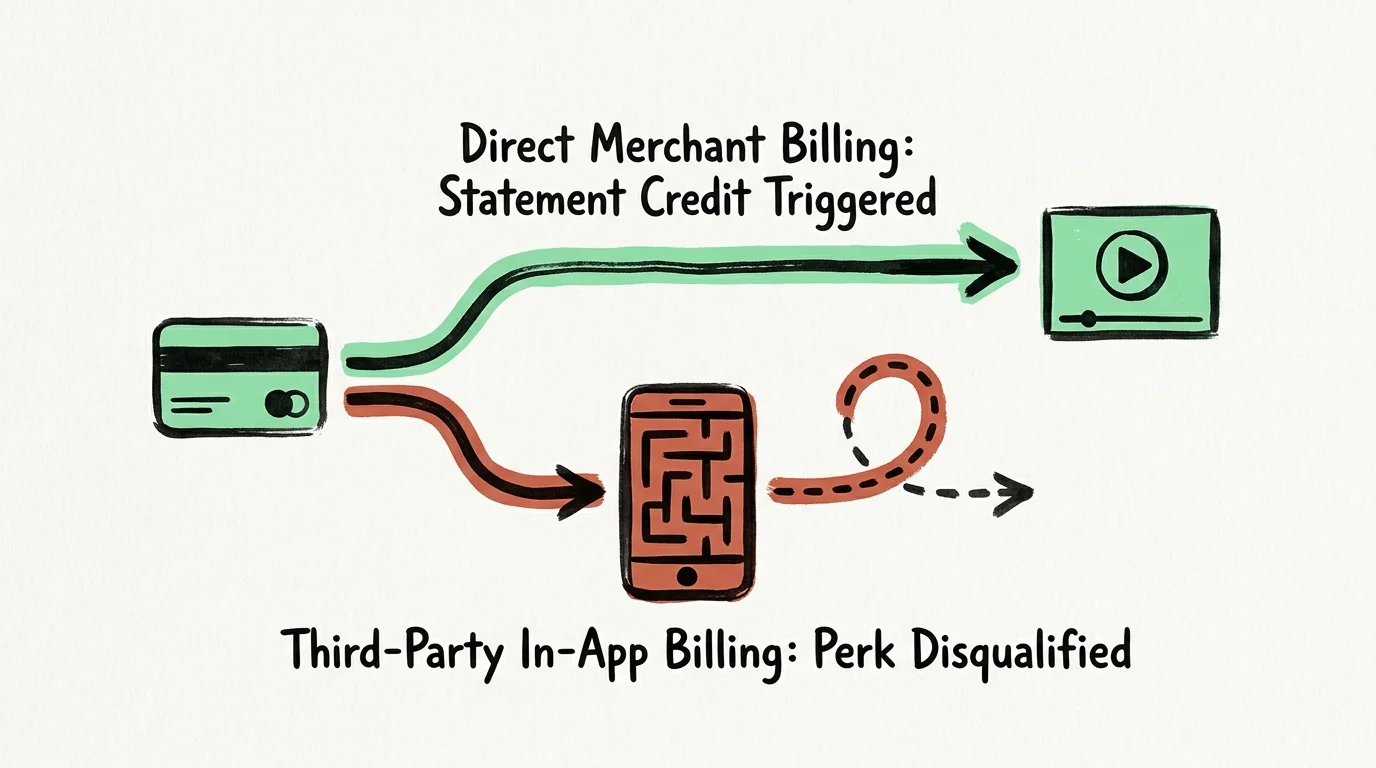
Automated statement credits rely strictly on merchant category codes transmitted during checkout. If the merchant description does not match American Express criteria, your monthly $7 credit will fail.
You must buy your subscription directly through DisneyPlus.com or Hulu.com. Transactions initiated on Max.com bill as WarnerMedia, which disqualifies you from the Amex Blue Cash Everyday rebate.
Third-party in-app purchases are the most common pitfall for cord-cutters. Signing up inside an Apple iOS app routes the transaction through the Apple App Store instead of Disney directly.
Apple bills your card as an App Store digital purchase. That charge does not trigger entertainment merchant credits, leaving you paying the full $16.99 out-of-pocket.
Google Play Store, Amazon Prime Video Channels, and Roku Channel Store billing present the same problem. These app marketplaces disguise your subscription under their own generic corporate billing umbrellas.
Cellular carrier bundles present another common billing conflict. Billing through Verizon or T-Mobile bundles charges into your phone bill, completely wiping out direct credit card streaming credits.
“Direct merchant billing is non-negotiable for card perks; passing a streaming subscription through an app marketplace strips the transaction code that unlocks your monthly statement credit.” — Payment Systems Analyst

The Calendar Stacking Strategy: Driving Costs Under $6 Monthly
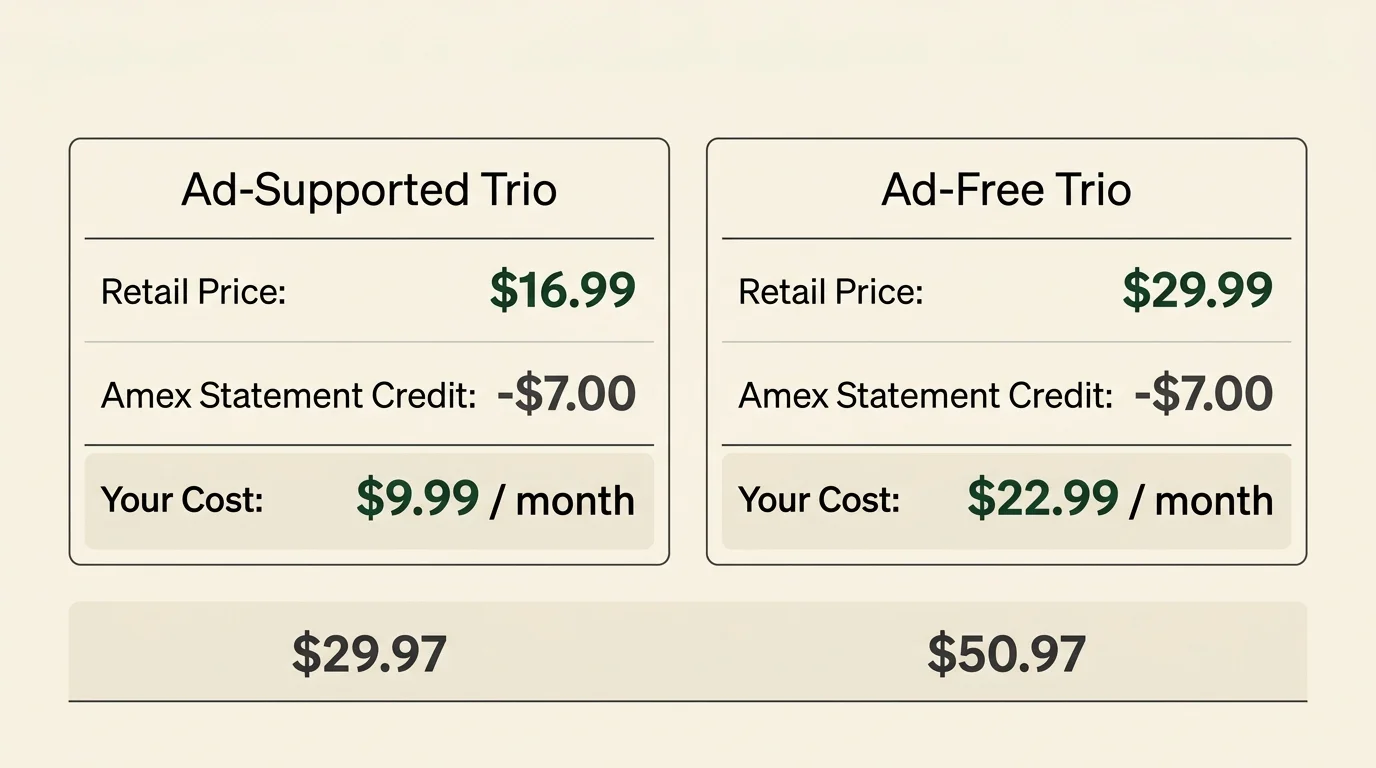
Applying the standard $7 Amex rebate reduces the $16.99 trio bundle down to $9.99 monthly. To push your out-of-pocket expenses below $6 monthly, you must execute a calendar-based stacking schedule.
This worked example shows an urban studio renter holding an Amex Blue Cash Everyday and a Chase Sapphire Preferred. Your goal is minimizing cash outlay across a twelve-month lease.
In month one, activate your bundle through DisneyPlus.com via an online rebate portal like Rakuten. New accounts routinely yield an immediate $12.50 cash rebate deposited to PayPal or your bank.
That initial $12.50 welcome rebate amortizes to an effective $1.04 monthly discount across your entire year. Your baseline effective cost drops immediately from $9.99 to $8.95 monthly.
Throughout months one, two, four, five, eight, nine, eleven, and twelve, bill your Amex Blue Cash Everyday. The reliable $7 statement credit keeps your regular baseline cost locked at $9.99.
In months three and ten, American Express historically issues targeted merchant offers. These offers grant $5 back on $15 or more spent directly with Disney or Hulu.
Activating those Amex Offers stacks on top of your baseline $7 rebate. That dual discount produces an out-of-pocket expense of just $4.99 during those two individual billing cycles.
In months six and seven, check your Chase Sapphire Preferred dashboard. Chase routinely publishes targeted Chase Offers granting $10 back on streaming transactions exceeding $15.
Temporarily update your billing method on DisneyPlus.com to your Chase Sapphire Preferred card for those two months. The $10 Chase statement credit drops your net monthly cost to $6.99.
Switch your primary payment card back to the Amex Blue Cash Everyday immediately after month seven bills. That swap reactivates your uninterrupted $7 monthly rebate loop.
Across twelve months, your total out-of-pocket cash spend equals exactly $71.88. Dividing $71.88 by twelve billing cycles produces an average net cost of $5.99 per month.
Bundle Tier and Card Rebate Comparison
Comparing your options helps you save money on streaming subscriptions without paying for unused services. The table below outlines standard prices alongside credit card stacking outcomes.
| Subscription Setup | Standard Retail Price | Amex Credit Applied | Targeted Offer Stacking | Net Monthly Out-of-Pocket | Annual Total Cost |
|---|---|---|---|---|---|
| Separate Standalone (Ad-Supported) | $29.97 / mo | $0.00 | None | $29.97 / mo | $359.64 |
| Disney, Hulu, Max Trio (Standard Ad-Supported) | $16.99 / mo | $0.00 | None | $16.99 / mo | $203.88 |
| Trio Bundle + Amex BCE Perk (Baseline) | $16.99 / mo | -$7.00 / mo | None | $9.99 / mo | $119.88 |
| Trio Bundle + BCE / CSP Calendar Stacking | $16.99 / mo | -$7.00 / mo (8 mos) | Chase & Amex Offers + Portal | $5.99 / mo (Average) | $71.88 |
| Disney, Hulu, Max Trio (Standard Ad-Free) | $29.99 / mo | $0.00 | None | $29.99 / mo | $359.88 |
| Trio Bundle (Ad-Free) + Amex BCE Perk | $29.99 / mo | -$7.00 / mo | None | $22.99 / mo | $275.88 |
According to PCMag’s streaming service ratings, evaluating total annual savings rather than monthly bills protects your budget from unmonitored entertainment spending.

Content Comparison, Stream Limits, and Feature Specs
Understanding playback limits ensures the bundle accommodates your setup. Urban studio living often involves streaming across laptops, phones, and a smart TV without running into playback roadblocks.
A smart TV is a television with a built-in internet connection and streaming apps. If your TV lacks built-in software, you can attach an external streaming device.
A streaming device is a standalone stick or box, such as an Apple TV or Roku, that plugs into your HDMI port. It lets you run modern apps smoothly on older screens.
Consumer Reports notes in their streaming device evaluations that dedicated streaming players deliver faster navigation and more reliable updates than budget television processors.
Disney+ allows four concurrent streams on separate screens. Its catalog features exclusive releases from Star Wars, Marvel Studios, Pixar, and National Geographic, alongside classic animated Disney films.
Hulu permits two simultaneous screens on the ad-supported tier. Its library shines with award-winning FX productions like The Bear and Shōgun, alongside next-day access to major network shows.
Max offers two simultaneous streams under the ad-supported bundle. It provides prestige HBO originals like House of the Dragon and The Last of Us, alongside Warner Bros. movies.
All three platforms operate on-demand. An on-demand service lets you watch any title whenever you want, eliminating the scheduling constraints of traditional cable broadcasts.
Because everything remains stored online, you do not need a DVR. A DVR, or digital video recorder, records live broadcasts, whereas streaming platforms host entire seasons in cloud archives.
None of the services offer free trials for this joint trio bundle. However, the month-to-month agreement means you can cancel anytime without early termination penalties.

Is the Disney, Hulu, and Max Bundle Worth It for Studio Living?
If you live alone in a small apartment, you do not need multiple sprawling entertainment packages. You need high-density catalogs that prevent you from cycling through empty apps.
This bundle excels for movie enthusiasts. Warner Bros. theatrical films arrive quickly on Max, while Marvel and 20th Century Studios titles populate Disney+ and Hulu.
Prestige drama fans also benefit heavily. HBO and FX produce some of the most acclaimed series on television, making this bundle ideal for viewers who prioritize storytelling.
However, live sports fans will notice gaps. While select ESPN content appears within the Disney ecosystem, major live events still require dedicated sports packages or digital antennas.
Commercial length on the ad-supported tier is another consideration. You will encounter approximately four to six minutes of advertisements for every hour of content you view.
If commercial interruptions ruin your relaxation time, you can upgrade to the ad-free tier. Your Amex $7 credit still applies directly, dropping the ad-free price from $29.99 to $22.99.
“The secret to cord-cutting on a budget is consolidating your libraries into a single discounted billing hub rather than paying five separate ten-dollar invoices.” — Consumer Finance Columnist
Step-by-Step Setup Guide: Triggering the Rebate Loop
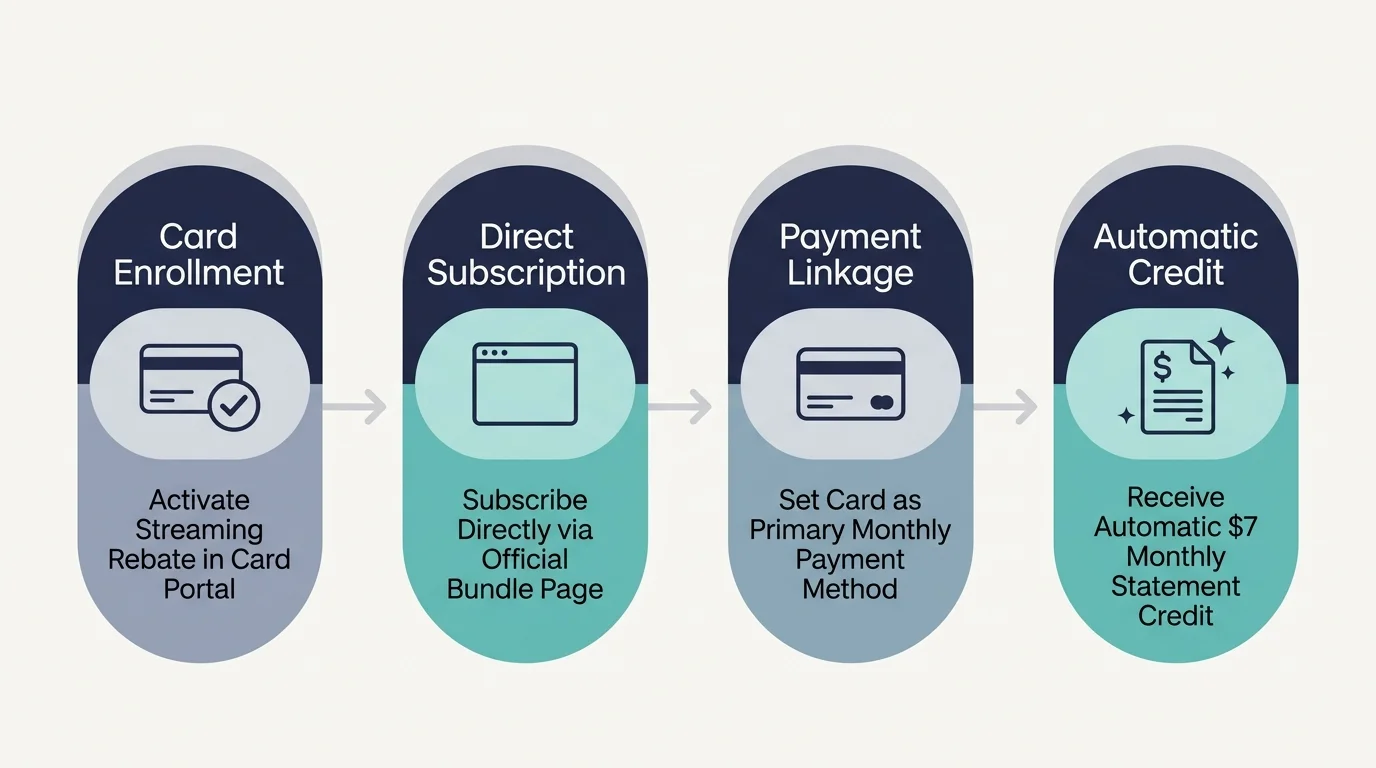
Executing this strategy requires five straightforward steps. Follow this sequence precisely to ensure every charge codes properly and triggers your statement credits.
- Log in to your American Express dashboard via desktop or mobile app. Navigate to the “Offers & Benefits” tab on your Blue Cash Everyday card and enroll in the Disney Bundle perk.
- Clear your browser cache, open your cash-back shopping portal, and search for Disney+. Click the affiliate link to earn your upfront welcome bonus.
- Select the Disney+, Hulu, and Max bundle on DisneyPlus.com. Enter your Amex Blue Cash Everyday card details as the primary payment method.
- Open your confirmation email to activate your bundled Hulu and Max accounts. Log in to Max using your newly created Disney credentials under the provider login option.
- Set a calendar reminder for five months out. Check your Chase Sapphire Preferred portal for targeted 20% streaming offers before temporarily rotating payment methods.
Frequently Asked Questions
Do I have to cancel my existing standalone Disney+ or Hulu account to get this bundle?
No, you do not need to cancel your existing accounts. Enter your current Disney or Hulu email address during signup, and the system will automatically consolidate your billing into the new bundle.
What happens if I sign up for the bundle directly through the Max website?
Signing up on Max.com bills your card as WarnerMedia. That charge will fail to trigger the $7 monthly statement credit on your American Express Blue Cash Everyday card.
Can I pay for the Disney bundle with gift cards and still get the credit?
No, paying with gift cards bypasses your credit card billing cycle. To earn your monthly credit card streaming credits, you must charge the recurring fee directly to your card.
Does the ad-supported tier allow offline downloads on mobile devices?
No, offline downloads are restricted to ad-free subscription tiers. If you commute on the subway without cellular service, you must stream content while connected to Wi-Fi at home.
Disclaimer: Streaming service prices, content libraries, and features change frequently. Prices shown were accurate at time of writing but may have changed. Always verify current pricing on the official service website before subscribing.