You can cut $270 to $360 from your annual entertainment budget without sacrificing a single stage production. Stacking BroadwayHD, Marquee TV, and Met Opera on Demand simultaneously drains over $449 to $539 each year.
Unlike general entertainment platforms, niche performing arts platforms upload major new productions in predictable seasonal batches. You do not need continuous access to all three services to see every premier recording.
Rotating single-month passes around targeted release windows eliminates paying for inactive libraries while granting full access to identical catalogs for just $179.88 annually.
The Real Cost of Year-Round Stage and Classical Subscriptions
Streaming, which means watching video content over the internet instead of cable or satellite, lets you handpick niche arts channels.
For many cord-cutting households—those canceling traditional cable or satellite TV in favor of streaming services—specialty platforms feel essential.
Yet carrying multiple performing arts platforms simultaneously creates an expensive recurring bill that rivals cable packages.
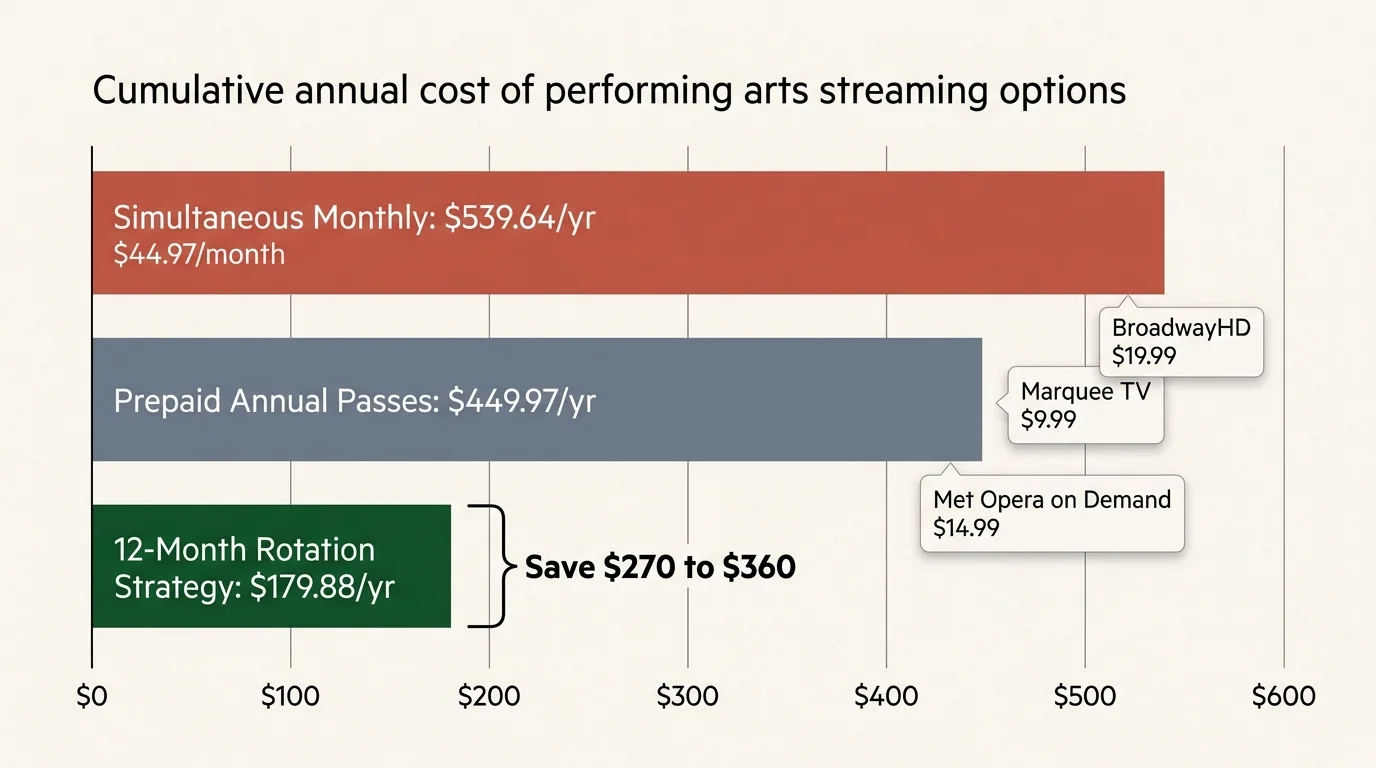
The BroadwayHD cost sits at $19.99 per month following its late 2023 price increase.
Marquee TV charges $9.99 per month, while Met Opera on Demand requires $14.99 per month.
Maintaining active subscriptions across all three services runs $44.97 every single month.
Over a full twelve-month billing cycle, continuous month-to-month billing totals $539.64.
Even if you prepay annual subscriptions upfront to secure discounted rates, you spend $449.97 per year.
That upfront figure combines BroadwayHD at $199.99, Marquee TV at $99.99, and Met Opera on Demand at $149.99.
Most subscribers do not watch all three platforms every week.
You pay a steep premium for digital shelf space while your attention stays anchored to one production at a time.
A structured rotation schedule eliminates that financial waste while keeping your watchlist fresh.
Catalog Overlap: Standalone Apps vs. Prime Video and Apple Channels
Subscribers frequently ask whether they should sign up through standalone apps or third-party channel hubs.
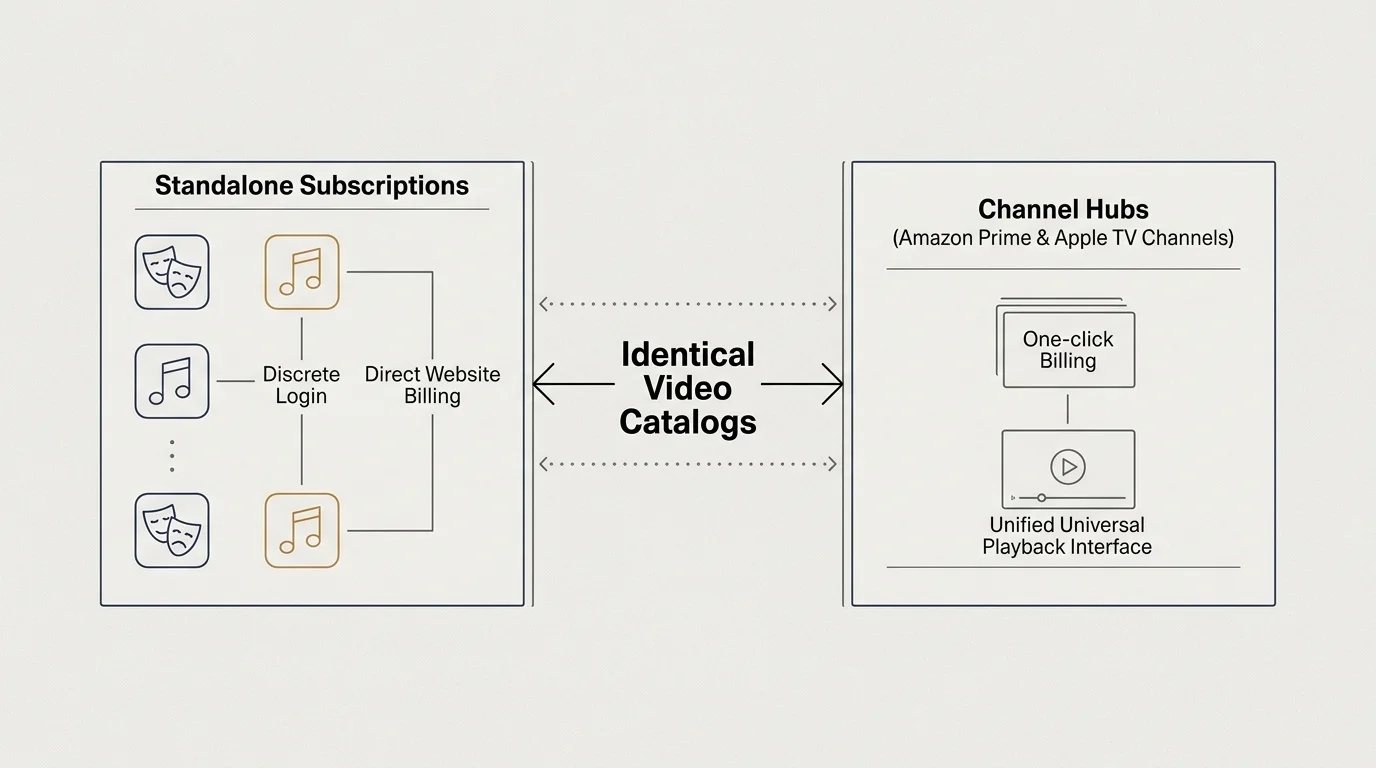
Both Amazon Prime Video Channels and Apple TV Channels offer BroadwayHD and Marquee TV as optional add-ons.
According to research from PCMag, channel hubs simplify billing by consolidating separate subscriptions into a single account.
The core video catalogs on Amazon and Apple mirror the standalone services almost completely.
You access the same Royal Shakespeare Company plays, Glyndebourne opera productions, and Lincoln Center performances.
However, minor differences exist that impact classical music streaming subscriptions and theater archives.
Standalone apps often host niche supplementary materials, digital programs, and artist interviews that channel aggregators omit.
Met Opera on Demand operates primarily through its standalone app and website, avoiding third-party channel storefronts entirely.
If you prefer one-click cancellations through an existing Amazon or Apple ID, third-party channels work well.
If you want complete archival program notes and curated playlist collections, standalone accounts offer a superior experience.
Crucially, neither route gives you a catalog discount over the other; both bill identical monthly rates.
Recognizing catalog overlap prevents you from accidentally paying for a standalone app while maintaining an active Amazon channel add-on.

Pricing and Feature Breakdown Across Performing Arts Services
Choosing where to allocate your subscription budget requires comparing costs, library depth, and viewing restrictions.
Unlike mainstream entertainment channels, fine arts platforms deliver ad-free streaming—meaning plans that cost more but show zero commercials.
They provide on-demand access, allowing you to watch whatever you want, whenever you want, without broadcast schedules.
The following table outlines the current pricing, trials, and technical limits for the leading stage and classical platforms.
| Streaming Service | Monthly Price | Annual Price | Free Trial | Simultaneous Streams | Library Size & Focus |
|---|---|---|---|---|---|
| BroadwayHD | $19.99 | $199.99 | 7 Days | 1-2 screens | 300+ Broadway, West End, and classic stage plays |
| Marquee TV | $9.99 | $99.99 | 7 Days | 2 screens | 600+ dance, contemporary ballet, and RSC theater works |
| Met Opera on Demand | $14.99 | $149.99 | 7 Days | 1 screen | 800+ Live in HD telecasts and historic radio archives |
| Medici.tv | N/A (Annual only) | $189.00 | None (Free tier exists) | 2 screens | 4,000+ orchestral concerts, ballets, and live webcasts |
| Berliner Philharmoniker | $14.90 | $149.00 | 7 Days | 1 screen | 700+ symphony concerts, 4K HDR live streams |
BroadwayHD carries the highest entry price among theater-focused apps at $19.99 each month.
That rate reflects the high licensing costs associated with commercial Broadway and West End musical rights.
Marquee TV delivers exceptional value at $9.99 per month for ballet, modern dance, and European theater enthusiasts.
Met Opera on Demand charges $14.99 per month, which matches the quality of its world-class Live in HD cinema captures.
“The most expensive streaming subscription is the one you leave running while your watchlist sits untouched.” — Cord-Cutting Strategist
Medici.tv relies on an annual billing model of $189.00, making it harder to rotate for single months.
However, Medici.tv maintains a limited ad-supported free catalog—a plan showing commercials—that you can watch year-round.
The Berliner Philharmoniker Digital Concert Hall offers 30-day standalone passes for $19.90 alongside its $14.90 recurring monthly option.
Understanding these price points makes building an efficient rotation calendar straightforward.
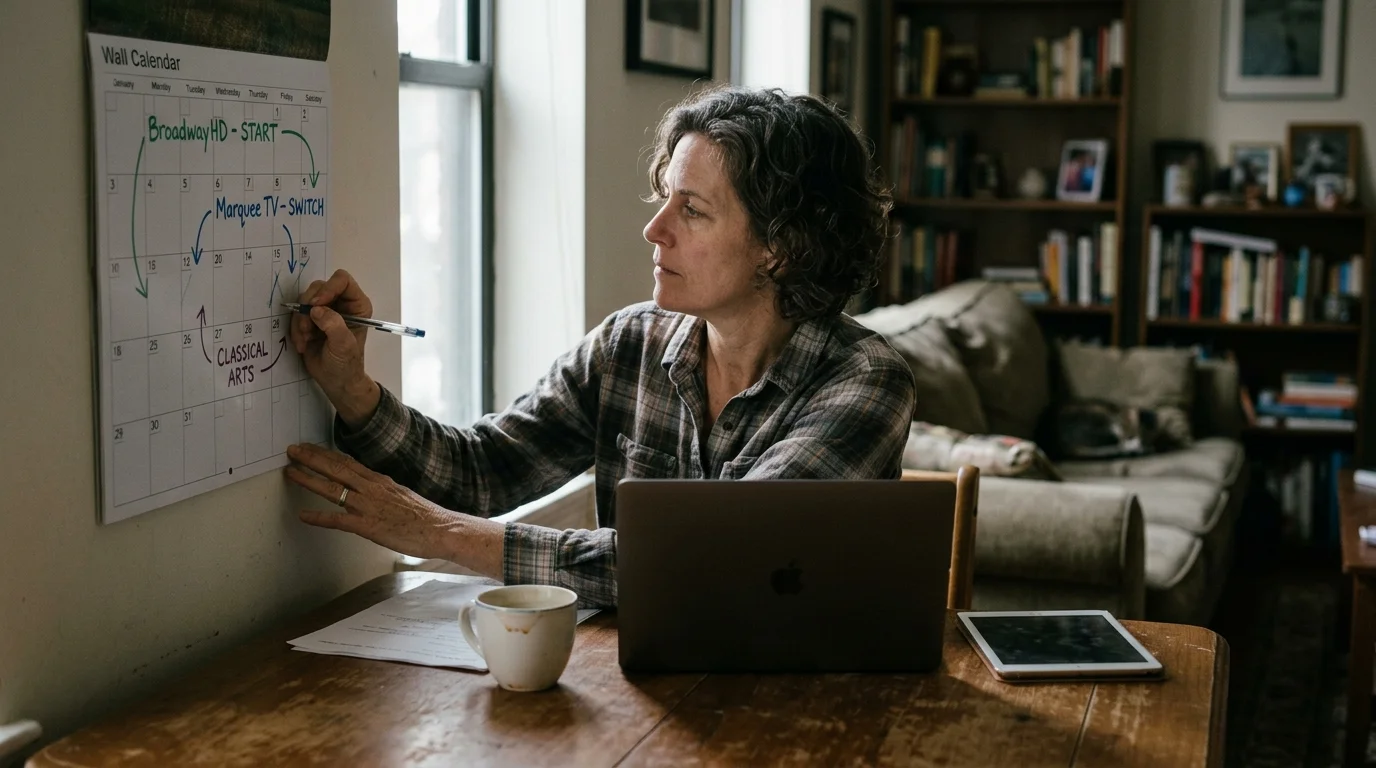
The 12-Month Rotation Schedule: Month-by-Month Blueprint
You do not need continuous annual passes to experience the best performing arts seasons.
Streaming performing arts works best on a four-month cycle where you activate only one platform at a time.
This worked rotation scenario shows exactly how to capture full seasons while keeping $270.09 in your pocket.
- Phase 1 (January through April): BroadwayHD
Subscribe to BroadwayHD on January 1. Pay $19.99 per month for four consecutive months.
Total Phase 1 expenditure: $79.96.
Spend winter evenings exploring major musical captures, Sondheim retrospectives, and West End comedies.
Cancel your renewal on April 15 so your access expires cleanly on April 30.
- Phase 2 (May through August): Marquee TV
Activate Marquee TV on May 1 at $9.99 per month for four months.
Total Phase 2 expenditure: $39.96.
Summer aligns with major dance festivals, contemporary choreography releases, and Royal Shakespeare Company plays.
Cancel your renewal on August 15 to conclude service on August 31.
- Phase 3 (September through December): Met Opera on Demand
Start Met Opera on Demand on September 1 at $14.99 per month for four months.
Total Phase 3 expenditure: $59.96.
Autumn brings the opening of the live performance calendar and holiday opera favorites like Hansel and Gretel.
Cancel your renewal on December 15 to end access on December 31.
Here is how the final numbers compare across a full calendar year.
Your total rotating outlay equals $79.96 plus $39.96 plus $59.96, totaling exactly $179.88.
Compared to paying month-to-month year-round ($539.64), you save $359.76.
Compared to buying all three annual discounted subscriptions upfront ($449.97), you save $270.09.
You never run out of curated stage material because each library refreshes while you explore another service.
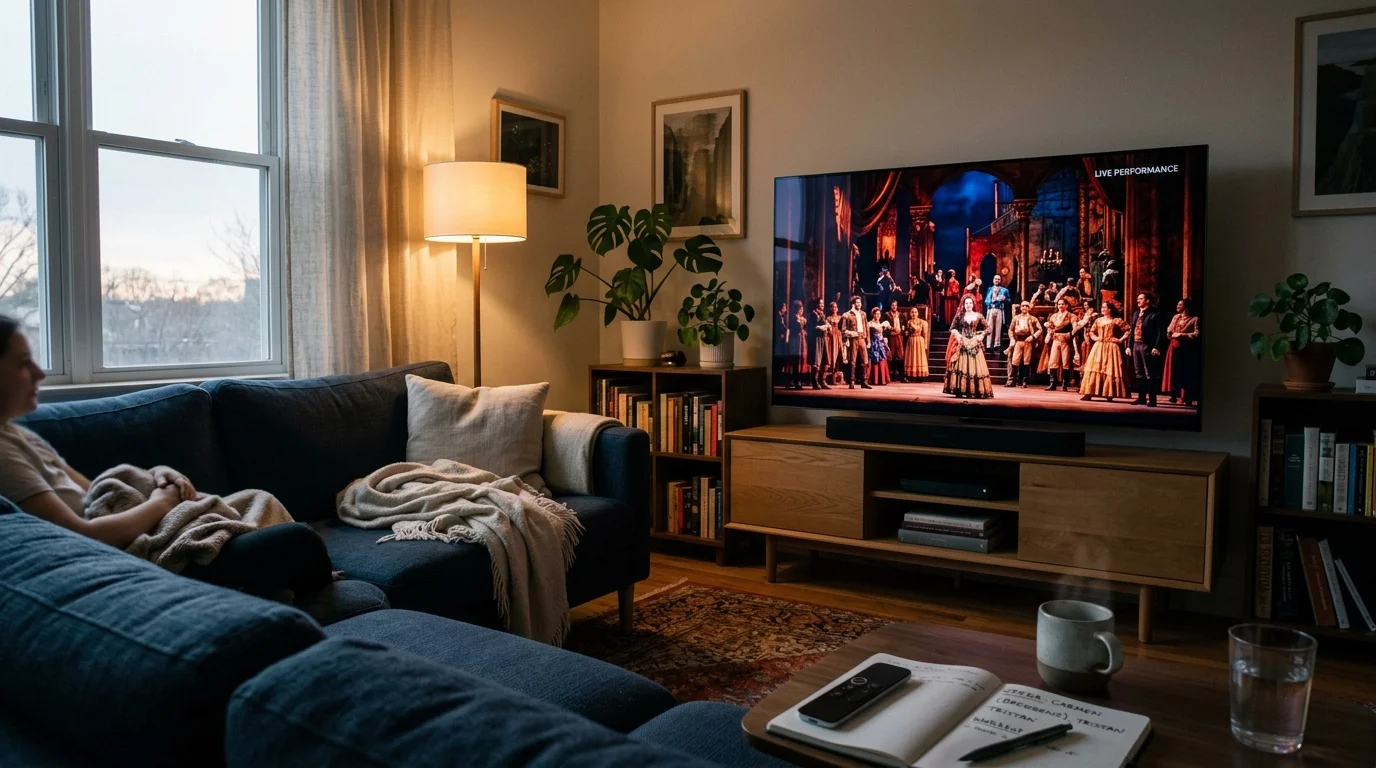
Optimizing Hardware, Simultaneous Streams, and Tech Setups
Watching orchestral performances and stage plays requires solid hardware and stable sound reproduction.
You can stream using a smart TV—a television with built-in internet connection and apps.
Alternatively, you can connect an external streaming device, which is a small box or stick that adds streaming to any TV.
A performance assessment from Consumer Reports emphasizes that dedicated streaming hardware provides faster navigation and longer software support than native TV interfaces.
Devices like the Apple TV 4K or Roku Streaming Stick 4K handle high-resolution classical audio streams reliably.
BroadwayHD and Marquee TV cap concurrent viewing at one or two simultaneous streams per household.
Met Opera on Demand limits accounts to a single active stream at any given time.
Because niche arts apps do not offer traditional DVR—a digital video recorder that lets you record and watch shows later—on-demand reliability matters.
Ensure your home internet delivers at least 25 Mbps download speeds for uninterrupted high-definition stage streaming.
Connect your streaming player directly to an external soundbar or stereo receiver using optical or HDMI eARC cables.
Stage vocal acoustics and orchestral dynamics require clean audio separation that built-in television speakers cannot deliver.

When Annual Passes Make Sense: Evaluating Met Opera and Medici.tv
While rotation saves money for casual and focused viewers, certain situations justify purchasing annual passes.
Active Metropolitan Opera Guild members receive a 33% discount on Met Opera on Demand, lowering the annual price to $99.99.
If you qualify for that discount and watch two complete operas every week, the annual plan costs just $8.33 per month.
Medici.tv presents another unique scenario because it specializes in classical music streaming subscriptions rather than theater plays.
Medici.tv does not offer a flexible monthly plan, charging a flat $189.00 upfront for full annual premium access.
However, Medici.tv routinely runs 50% discount sales during major holiday windows, cutting the annual fee to between $75.00 and $94.50.
If you secure Medici.tv at $75.00 annually, you can adjust your rotation schedule accordingly.
You could run BroadwayHD for three months ($59.97) and Marquee TV for three months ($29.97).
Pairing those rotating months with a discounted $75.00 Medici.tv pass yields a total yearly cost of $164.94.
That combined strategy saves $285.03 compared to maintaining standard annual passes across theater and classical hubs.
Review your historical viewing habits before committing to any upfront annual charge.
If you consistently watch one platform year-round, buy that specific annual pass and rotate the remaining two services around it.
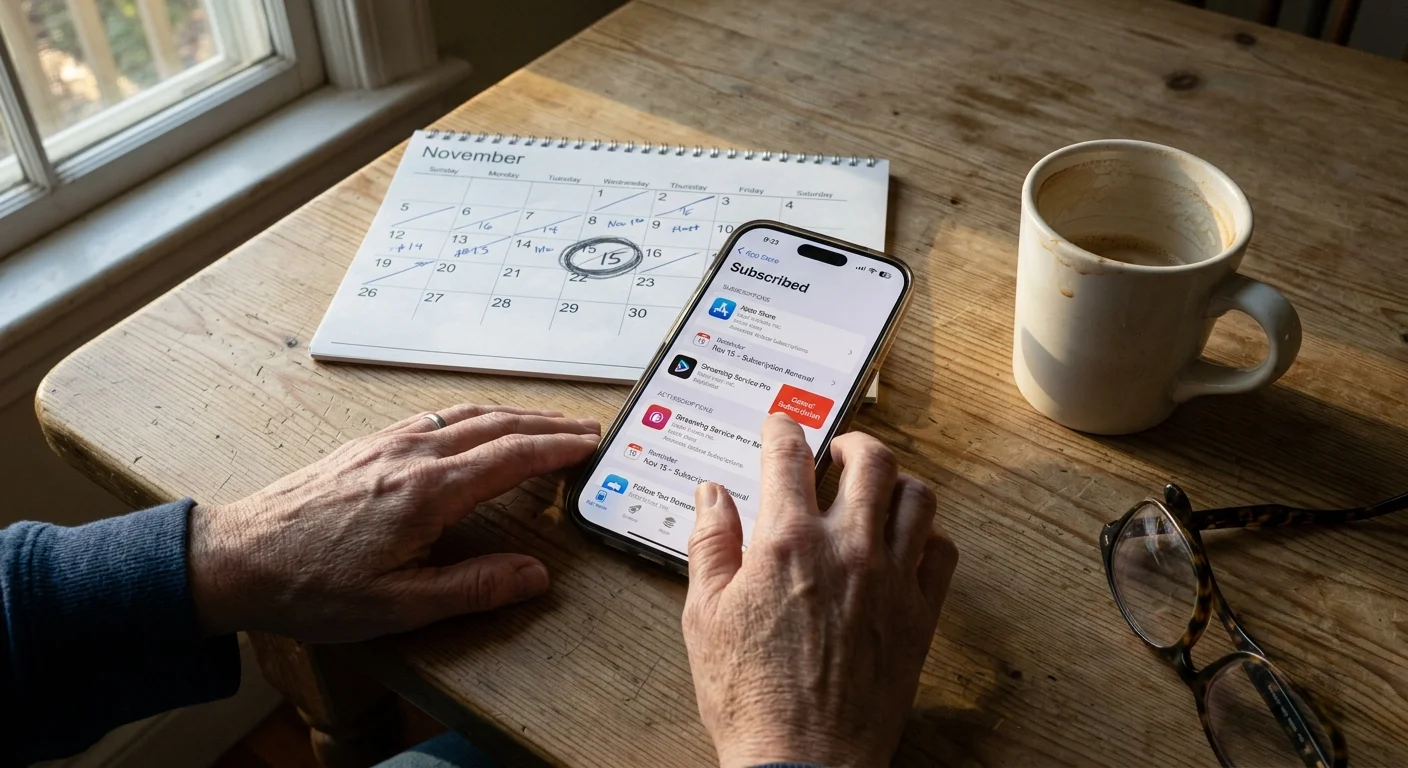
Managing Subscriptions and Avoiding Unintended Auto-Renewals
Subscription rotation requires basic calendar discipline to prevent forgotten auto-renewals from erasing your savings.
According to consumer streaming coverage from CNET, subscription fatigue often causes viewers to pay for unused platforms for months.
Every major arts service automatically renews your subscription at the end of your billing cycle unless you intervene.
Fortunately, canceling a subscription does not terminate your access immediately.
When you subscribe to a monthly pass on BroadwayHD or Marquee TV, cancel the renewal right after checkout.
Your credit card pays for the 30-day viewing period, and the platform keeps your access active until the cycle ends.
This preemptive cancellation prevents accidental renewals if you forget to check your account settings later.
If you subscribe through Apple Subscriptions or Google Play, manage your active passes directly in your device account settings.
Set a recurring calendar reminder on your phone five days before each planned four-month rotation phase begins.
Keep a simple digital watchlist on your phone to track performances you want to watch during your next active window.
This deliberate system keeps your entertainment intentional, affordable, and completely free of wasteful billing surprises.
Frequently Asked Questions
Will I lose my saved watchlist when I cancel and resubscribe?
No, your account profile, viewing history, and saved watchlist remain intact when you let a subscription lapse. Once you purchase another monthly pass later in the year, logging in restores your saved dashboard immediately.
Can I rotate BroadwayHD and Marquee TV as Amazon Prime Channels?
Yes, you can add and drop both services as Amazon Prime Video Channels on a month-to-month basis. Amazon bills them separately from your Prime membership, letting you cancel with a single click inside your Amazon account settings.
Which classical music streaming subscription offers the highest sound quality?
The Berliner Philharmoniker Digital Concert Hall leads the industry in audio fidelity, offering lossless High-Res Audio and immersive Dolby Atmos tracks. Met Opera on Demand and Medici.tv provide pristine stereo and 5.1 surround sound audio masters.
How often do BroadwayHD and Marquee TV add new stage productions?
Both platforms add curated batches of new productions monthly, typically adding between two and eight major stage recordings each month. Rotating every four months guarantees you return to a deep catalog of newly added performances.
Disclaimer: Streaming service prices, content libraries, and features change frequently. Prices shown were accurate at time of writing but may have changed. Always verify current pricing on the official service website before subscribing.