Choosing the best horror streaming service requires balancing digital video compression against niche curation. If you chase uncut cult cinema, standard platforms often hand you compressed, heavily banded files that ruin shadow detail.
Most guides treat these apps as interchangeable, but they serve entirely different horror subcultures. Arrow Player provides reference-grade boutique physical-media transfers, Shudder buys prestige festival acquisitions, and Screambox corners unrated independent splatter.
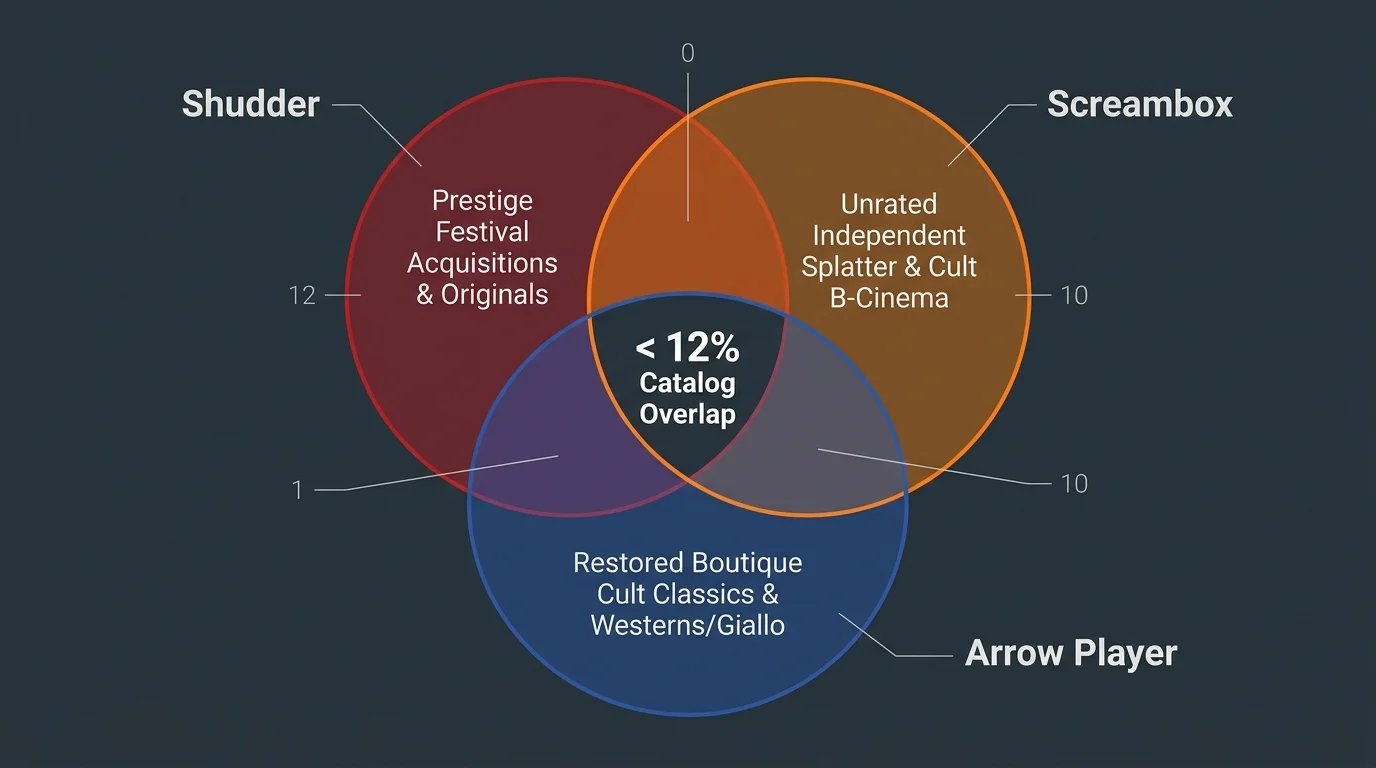
Catalog overlap between them sits below 12%, making your choice a question of master quality versus premiere velocity. We break down which subscription maximizes your monthly entertainment budget without sacrificing pristine transfers.
Pricing, Tiers, and Subscription Value
When evaluating subscriptions for cord-cutting—canceling traditional cable/satellite TV in favor of streaming services—base pricing determines your long-term value. Niche horror networks keep their prices lower than mainstream platforms.
If you want to supplement these paid libraries on a strict budget, exploring the best free streaming services you didn’t know existed can unlock dozens of vintage B-movies and grindhouse classics for zero dollars.
Viewers planning a seasonal binge can also implement an October horror streaming rotation across these apps to keep monthly costs minimal.
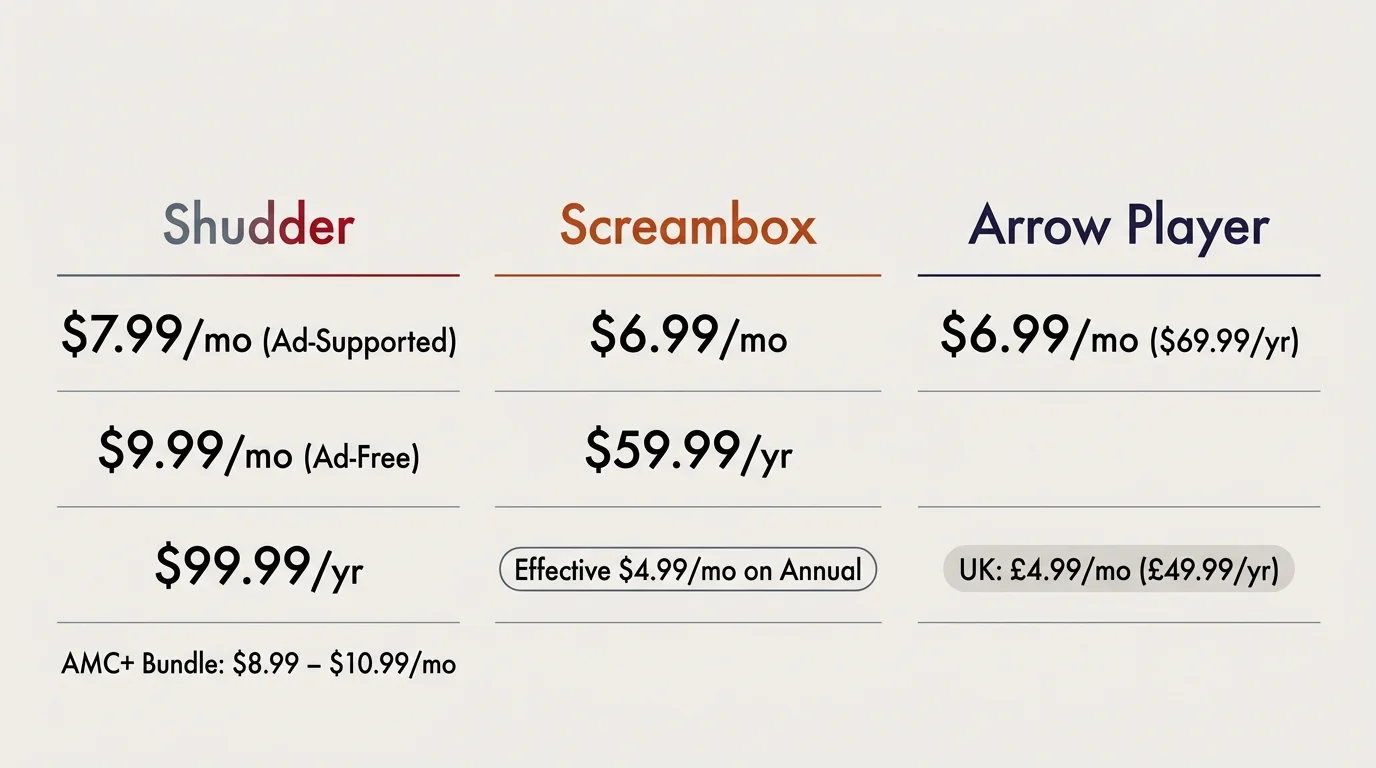
The world of streaming—watching video content over the internet instead of cable or satellite—contains varied pricing structures across horror channels. Shudder operates with two distinct payment tiers in the United States.
Shudder offers an ad-supported plan—free or cheaper plans that show commercials—for $7.99 per month. Its ad-free option—plans that cost more but don’t show commercials—runs $9.99 monthly or $99.99 annually.
AMC Networks also bundles Shudder inside AMC+. That multi-network package costs between $8.99 and $10.99 monthly, depending on promotional discounts and active commercial tiers.
Screambox keeps pricing straightforward under Cineverse ownership. You pay $6.99 per month or $59.99 per year, which reduces your effective monthly rate to $4.99.
Arrow Player matches that entry price point. It charges $6.99 monthly or $69.99 annually in the United States and Canada, while UK subscribers pay £4.99 monthly or £49.99 per year.
As detailed in PCMag’s guide to the best video streaming services, specialized platforms offer tighter catalogs at lower price points than broad entertainment apps. The table below compares these measurable service metrics directly.
| Streaming Platform | Monthly Price (Ad-Free) | Annual Cost | Native Video Resolution | Simultaneous Streams | Free Trial Window |
|---|---|---|---|---|---|
| Shudder | $9.99 ($7.99 with ads) | $99.99 | Up to 1080p (Many 720p) | 1 to 3 devices | 7 days |
| Screambox | $6.99 | $59.99 | 1080p Full HD | 3 devices | 7 days |
| Arrow Player | $6.99 | $69.99 | Up to 4K UHD & HDR | 2 to 3 devices | 30 days |
Arrow Player delivers the longest trial window at 30 days. Both Shudder and Screambox cap their trial periods at seven days.
If you want the lowest annual cost, Screambox wins on paper at $59.99. However, Arrow Player matches Screambox’s $6.99 monthly rate while providing significantly higher video quality.
Catalog Overlap and Curation Depth
Mainstream movie streamers share thousands of licensed studio films. Niche horror apps function differently because their licensing models target specific international distributors and boutique physical labels.
Because these specialized libraries rarely cross paths, learning how to find what to watch across all your streaming apps helps track obscure horror releases across services.
All three platforms offer on-demand viewing—watch whatever you want, whenever you want—yet their catalogs rarely duplicate titles. Direct catalog cross-referencing reveals that less than 12% of titles appear on more than one service.
Shudder designs its catalog around festival curation and prestige modern indies. You will find critically acclaimed titles like Late Night with the Devil, In a Violent Nature, and Phil Tippett’s stop-motion masterpiece Mad God.
Shudder also licenses rotating 1980s studio slashers and classic monster movies from major studios. These studio licenses rotate out quickly, forcing you to watch older catalog staples before monthly expirations.
Screambox ignores prestige arthouse titles to prioritize unrated independent splatter and underground exploitation. Cineverse partners with the genre website Bloody Disgusting to curate micro-budget gore and rare midnight movies.
You subscribe to Screambox for extreme titles that traditional services reject. It hosts extreme underground films alongside comprehensive retrospective horror documentaries like Pennywise: The Story of IT and RoboDoc: The Creation of RoboCop.
Arrow Player functions as the digital library of Arrow Video’s physical releases. Its curation emphasizes 1970s Italian giallo, Euro-horror, spaghetti westerns, restored Shaw Brothers martial arts, and Japanese extreme cinema.
If you want Lucio Fulci, Mario Bava, Dario Argento, or Takashi Miike, Arrow Player offers unmatched depth. It treats cult cinema as serious art rather than disposable late-night filler.
Bitrate Quality, Master Sourcing, and Uncut Presentations
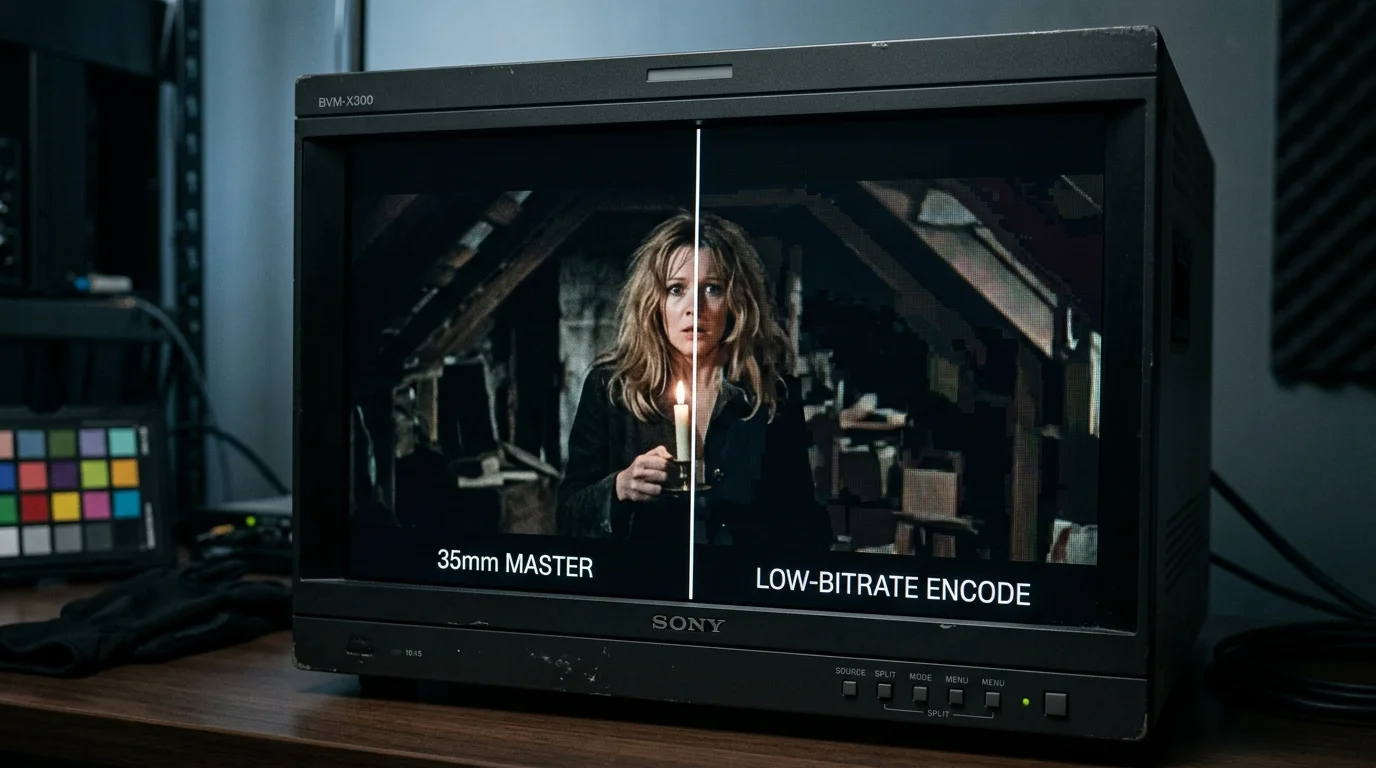
Dark film scenes expose the flaws of aggressive video compression. Low streaming bitrates cause color banding, blocking artifacts, and muddy shadow detail across horror movies.
Arrow Player sets the gold standard for transfer quality among independent streaming networks. It encodes video streams directly from Arrow Video’s physical-media digital restorations, which use 4K scans from original camera negatives.
Select titles on Arrow Player stream in 4K UHD with High Dynamic Range (HDR). Even its standard 1080p streams carry high average bitrates, preserving natural film grain during low-lit sequences.
“Compression artifacts ruin dark horror cinematography faster than any other genre, making master bitrate as critical as the movie selection itself.”
Shudder delivers mixed results with its video masters. While high-profile Shudder Originals stream in crisp 1080p, older licensed titles frequently stream in 720p with heavy compression artifacts.
Shudder also relies on standard two-channel stereo audio for most of its native app catalog. Audiophiles with surround-sound home setups will notice the lack of uncompressed multi-channel audio tracks.
Screambox streams cleanly at 1080p, but its source masters vary widely in quality. Because it licenses micro-budget, shot-on-video, and underground indies, original capture limitations often restrict the visual presentation.
However, Screambox never censors its master files. You receive the unrated, director-intended splatter cuts without the trims commercial ad-supported services often enforce.
Arrow Player also guarantees complete uncut European and international versions. It frequently lets you select between theatrical cuts, extended festival cuts, and uncensored export prints on the same title page.
Exclusive Premieres and Release Velocity
Monthly retention depends on how frequently a service adds high-profile exclusive content. Each platform approaches premiere velocity from a distinct angle.
Standalone genre apps offer the same flexibility as learning how to keep premium channels like HBO and Showtime without cable, letting you add and drop subscriptions based on current premiere schedules.
Shudder commands the largest acquisition budget. It buys prominent titles straight out of Sundance, Fantastic Fest, and the Sitges Film Festival to maintain a weekly release cadence.
Shudder also produces original episodic television, including the Creepshow anthology series and The Boulet Brothers’ Dragula. Its signature appointment-viewing show, The Last Drive-In with Joe Bob Briggs, generates massive social engagement during live broadcasts.
According to CNET’s streaming service breakdown, niche services keep subscriber churn low by securing high-profile genre exclusives rather than maintaining bloated catalogs. Screambox adopted this strategy directly by acquiring the Terrifier franchise.
Screambox served as the exclusive SVOD premiere home for both Terrifier 2 and Terrifier 3. Those box-office hits drove massive subscriber spikes that outpaced its regular indie release slate.
Arrow Player avoids modern theatrical bidding wars entirely. Instead, its exclusive release velocity comes from newly restored catalog restorations arriving every month.
Arrow brings forgotten international titles to digital streaming months before physical disc releases hit store shelves. You gain access to obscure Asian cinema and rare European gothic horror that exists nowhere else online.
Bonus Features, Commentaries, and Physical-Media Preservation
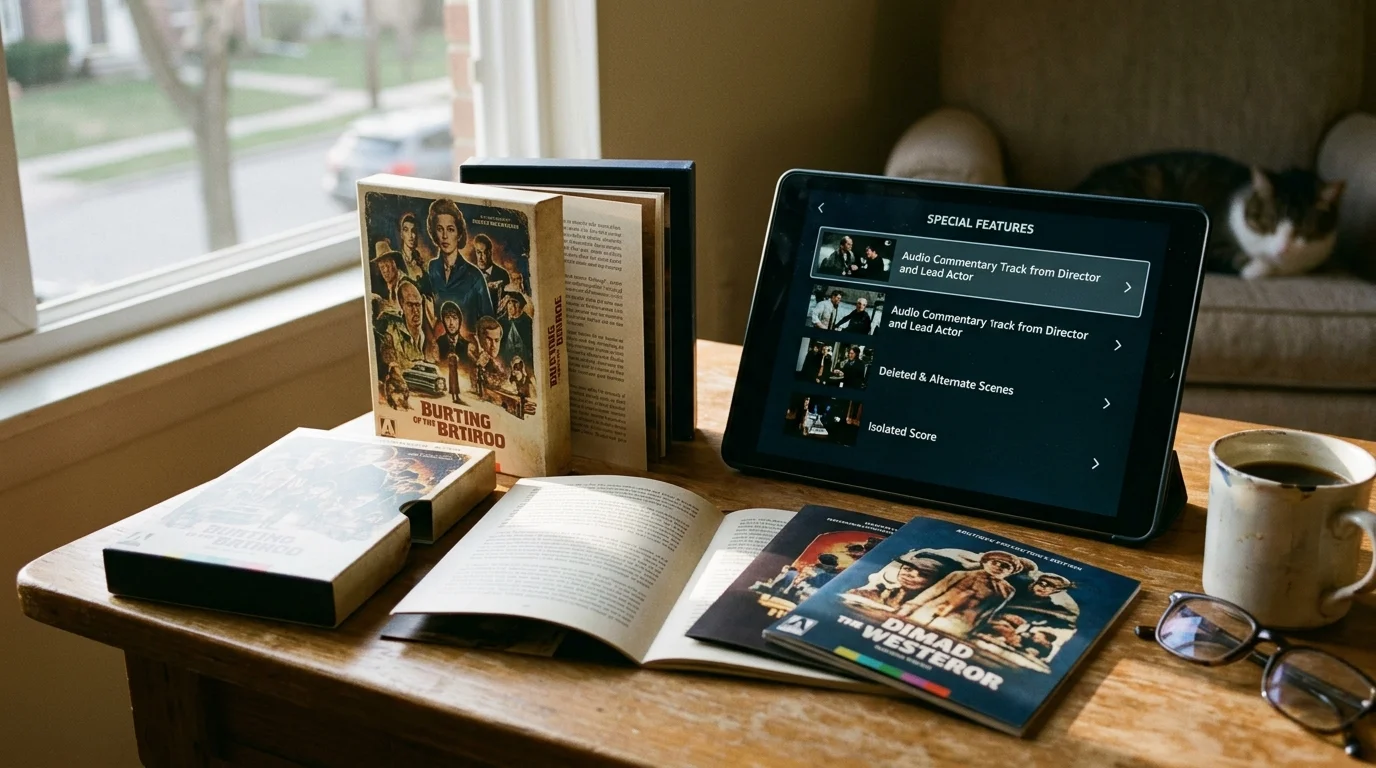
Physical media collectors treasure audio commentaries, deleted scenes, and retrospective documentaries. Mainstream streaming platforms almost always strip these supplemental materials from digital uploads.
Arrow Player breaks this industry pattern completely. It is the only horror streaming service that packages comprehensive physical-media extras directly into the digital interface.
An arrow video player subscription review reveals full director audio tracks, visual essays from film historians, and making-of documentaries attached to its films. You receive the educational value of a $40 boutique Blu-ray disc for a fraction of the cost.
Arrow also organizes its catalog into curated video collections. Curators group titles by specific subgenres, directors, cinematographers, and historical cult film movements.
Shudder provides limited supplemental features outside of its Joe Bob Briggs broadcasts. Joe Bob’s hosting segments provide historical context and trivia, but standard Shudder movies lack dedicated commentary audio tracks.
Screambox builds supplemental content directly into standalone releases. Its feature-length retrospective documentaries deliver hours of interviews and behind-the-scenes footage, but individual horror movies rarely feature secondary audio tracks.
If you value film preservation and archival extras, Arrow Player operates in a league of its own. It serves as both a streaming channel and an interactive film school.
Device Compatibility, Simultaneous Streams, and App Usability
A deep catalog means nothing if the underlying application crashes or stutters during playback. Each platform features distinct technical operating parameters across connected devices.
You can access these services across any modern smart TV—a television with built-in internet connection and apps. Dedicated horror viewers often encounter different user interfaces depending on their screen operating system.
Alternatively, attach a streaming device—a small box or stick (like Roku or Fire TV) that adds streaming to any TV. Testing from Wirecutter’s streaming reviews highlights that app stability and responsive search indexing matter just as much as stream limits.
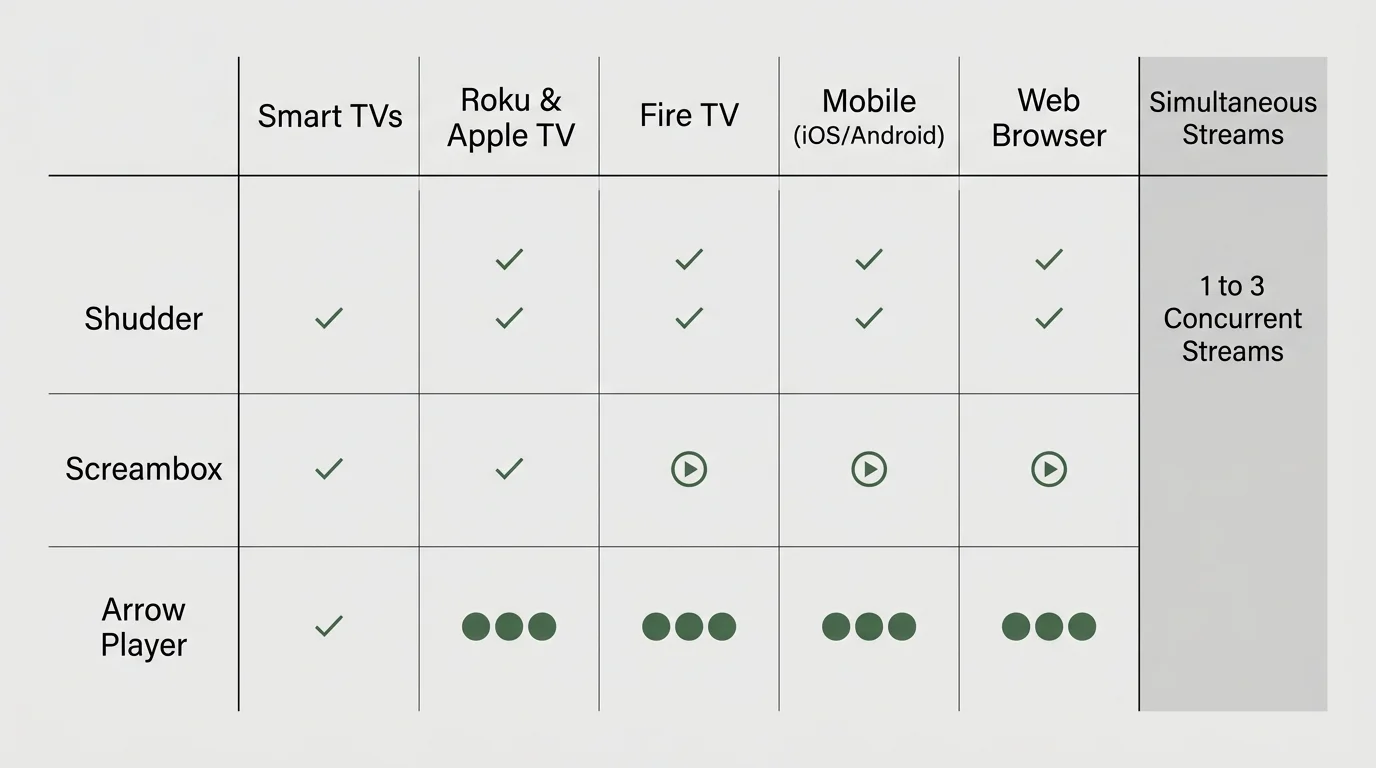
Unlike live television with a DVR—digital video recorder, lets you record and watch shows later—these apps archive films indefinitely or until licensing windows expire. Screambox permits up to three simultaneous streams per account.
Screambox also includes mobile offline downloads within its iOS and Android apps. This feature lets you store unrated indie horror movies on your phone before traveling.
Shudder limits direct standalone subscribers to one stream at a time on select hardware, though some setups permit three. If you access Shudder via the AMC+ add-on channel on Prime Video or Apple TV, you gain more reliable video throughput.
Arrow Player supports two to three concurrent streams and runs on Vimeo’s enterprise streaming infrastructure. The backend provides swift load times, zero buffering, and reliable cross-device bookmarking.
Arrow’s search engine also lets you filter titles by director, cast, year, and even bonus-feature availability. Screambox’s search functions adequately, while Shudder’s native search occasionally struggles with exact-title matching on older streaming sticks.

The Cult Fan Budget: Worked Rotational Spending Scenario
Horror enthusiasts often assume they must subscribe to every platform simultaneously. Maintaining year-round subscriptions to all three services inflates your annual entertainment spending rapidly.
Let us look at a concrete spending scenario featuring Marcus, a cult horror fan tracking his entertainment budget for 2026. Marcus wants access to festival premieres, unrated splatter, and restored physical-media masters.
If Marcus subscribes to all three services at monthly standalone rates for twelve consecutive months, his costs add up quickly:
- Shudder (Ad-Free): $9.99 per month × 12 months = $119.88
- Screambox: $6.99 per month × 12 months = $83.88
- Arrow Player: $6.99 per month × 12 months = $83.88
- Total Year-Round Standalone Cost: $287.64 per year
Marcus can optimize this expense by building a rotational cord-cutting strategy based on catalog turnover and release calendars. Arrow Player offers an annual tier that cuts costs while providing high-replay cult classics.
Marcus purchases an Arrow Player annual pass for $69.99, which gives him continuous access to its massive 4K restoration catalog at roughly $5.83 per month. Because Arrow updates classics continuously and includes commentary tracks, it warrants year-round retention.
Next, Marcus subscribes to Shudder for only four months—from September 1 through December 31. This window captures the Halloween release rush, new festival additions, and weekly autumn Joe Bob Briggs specials.
Marcus pays $9.99 × 4 months = $39.96 for his seasonal Shudder run. He then cancels before January to avoid paying during slower winter licensing rotations.
Finally, Marcus activates Screambox for two specific months: October for Halloween horror marathons, and March when new unrated indie releases drop. That adds $6.99 × 2 months = $13.98.
Here is the financial breakdown of Marcus’s optimized rotational spending model:
- Arrow Player Annual Subscription: $69.99
- Shudder Ad-Free (4-Month Fall Window): $39.96
- Screambox Standalone (2 Targeted Months): $13.98
- Total Optimized Spending: $123.93 per year
By shifting to this rotational model, Marcus saves $163.71 annually compared to standard month-to-month renewals across all three apps. That represents a 56.9% reduction in cost while preserving access to every priority title.
Final Verdict: Which Horror Service Fits Your Screen?
The shudder vs screambox debate comes down to modern indie festival cinema versus raw, unrated exploitation. Neither service replaces Arrow Player’s high-bitrate archival focus.
Subscribe to Shudder if you want modern indie hits, festival winners, and appointment viewing. It remains the essential platform for contemporary releases like Late Night with the Devil and weekly live genre events.
Choose Screambox if you love unrated splatter, micro-budget b-movies, and deep retrospective documentaries. It is the mandatory home for Terrifier franchise completists and fans of unfiltered, raw gore.
Pick Arrow Player if you demand reference-grade transfers, uncompressed audio, and European cult cinema. Its inclusion of 4K masters and disc-level audio commentaries delivers the highest technical quality in horror streaming.
For the best overall value, combine an annual Arrow Player subscription with seasonal Shudder and Screambox activations. You protect your streaming budget while enjoying the best master files available.
Frequently Asked Questions
Which horror streaming service offers the highest video picture quality?
Arrow Player offers the highest video quality by far. It streams select titles in native 4K UHD with HDR, sourced directly from original camera negative digital restorations with higher bitrates than its competitors.
Is Shudder included with a Screambox or Arrow Player subscription?
No, all three platforms are entirely independent entities. Shudder is owned by AMC Networks, Screambox is operated by Cineverse, and Arrow Player is owned by Arrow Films.
Can I download movies to watch offline on these horror services?
Screambox provides direct offline mobile downloads inside its official iOS and Android applications. Shudder and Arrow Player have limited mobile download support, making Screambox the strongest option for offline traveling.
Are movies on Screambox and Arrow Player censored?
No, both services specialize in uncut presentations. Screambox streams unrated gore that mainstream streamers reject, while Arrow Player provides uncut international and European prints with scenes restored.
Disclaimer: Streaming service prices, content libraries, and features change frequently. Prices shown were accurate at time of writing but may have changed. Always verify current pricing on the official service website before subscribing.